Last Updated on October 5, 2026 by Aaron Chen
Shanghai has six main mosques that travelers realistically use, and for most visitors four of them matter: Xiaotaoyuan Mosque and Fuyou Road Mosque in the old city near Yu Garden, Pudong Mosque on the east side of the river, and Huxi Mosque in Putuo District. A fifth, Songjiang Mosque, is the oldest in the city — built in the Yuan dynasty — and worth a trip in its own right rather than a quick prayer stop.
Names and construction dates only get you so far. The questions that decide a real trip: which mosque sits near the places you will already be, when Jumu’ah starts, where women pray, and what happens on the days your route keeps you far from all of them. Our team plans Shanghai itineraries for Muslim travelers, and mosque locations are one of the inputs we design around — the details below are the ones we actually use.
How Many Mosques Are in Shanghai?
Six mosques hold regular prayers in Shanghai: Xiaotaoyuan, Fuyou Road, Huxi, Pudong, Songjiang, and Jiangwan (a smaller mosque in Yangpu District that few travelers visit). Counts in other sources run to seven or eight — a separate women’s mosque stands next to Xiaotaoyuan, and a couple of older prayer sites get counted inconsistently. For planning purposes, the six above are the ones that matter. For how prayer fits into a full Shanghai trip — hotels, food and day plans — see is Shanghai Muslim-friendly.
For a city of over 24 million, that is not many — Shanghai is not Xi’an or Lanzhou, where Muslim life shapes whole districts. But the mosques it has are active, well kept, and spread usefully across the city:
| Mosque | District | Nearest metro | Best for |
|---|---|---|---|
| Xiaotaoyuan 小桃园清真寺 | Huangpu (old city) | Laoximen, Line 8/10 | Largest mosque; Yu Garden / Bund days; women’s mosque adjacent |
| Fuyou Road 福佑路清真寺 | Huangpu (old city) | Yuyuan Garden, Line 10/14 | Closest to Yu Garden; historic 1870 mosque |
| Huxi 沪西清真寺 | Putuo | Changshou Road, Line 7/13 | West Shanghai; Friday street market |
| Pudong 浦东清真寺 | Pudong | Yuanshen Sports Center, Line 6 | East of the river; women’s prayer room |
| Songjiang 松江清真寺 | Songjiang | Zuibaichi Park, Line 9 | Oldest mosque (Yuan dynasty); half-day heritage trip |
Which Mosque Fits Your Day?
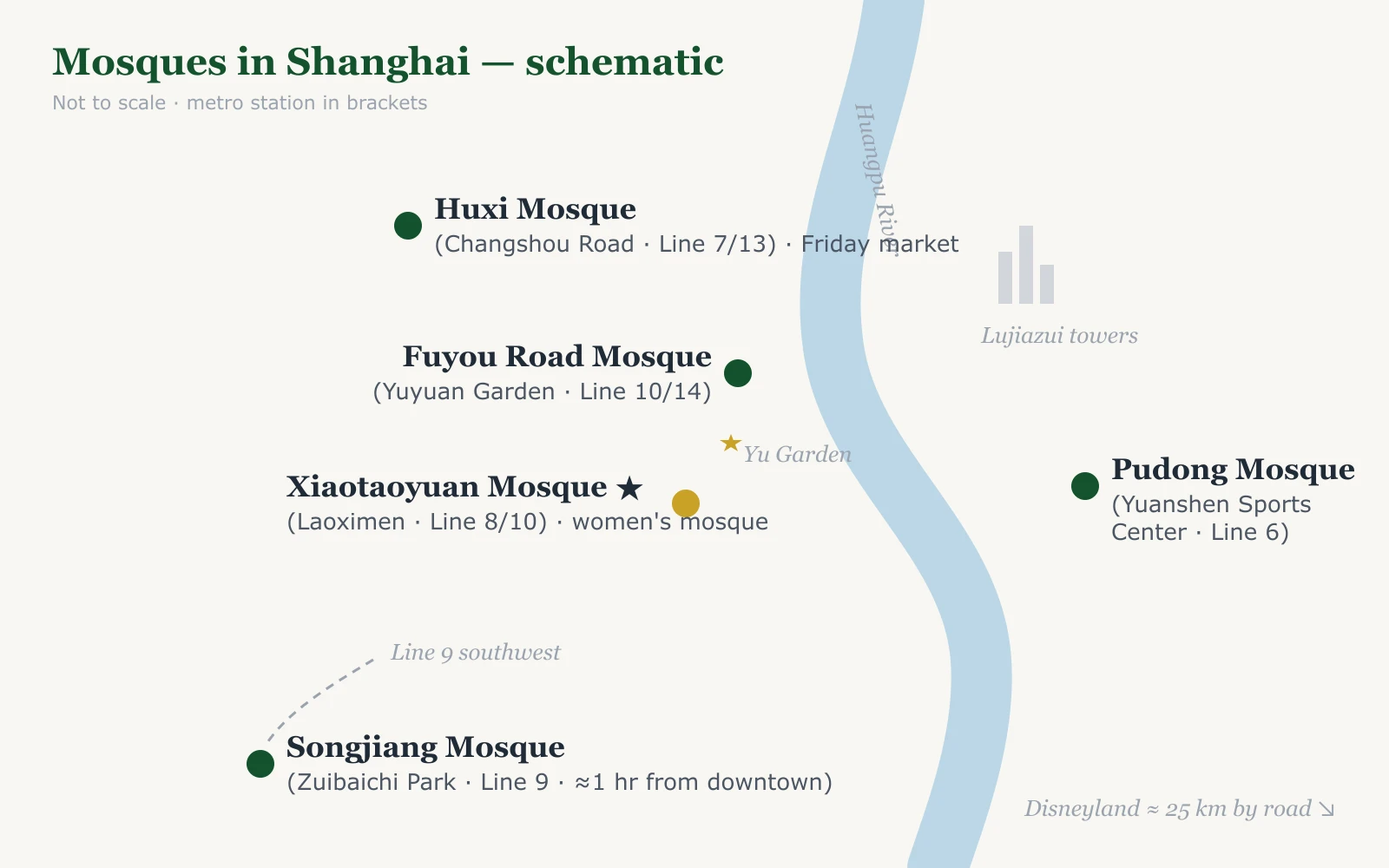
Pick the mosque by your itinerary, not the other way around. Shanghai is too big to cross town for Dhuhr and still keep a day plan intact — the metro is fast, but a mosque on the wrong side of the river can cost you 45 minutes each way.
- Yu Garden, the Bund, Nanjing Road: Fuyou Road Mosque is a short walk from Yu Garden itself, and Xiaotaoyuan is about ten minutes further into the old city. This is the easiest prayer logistics in Shanghai — you can pray Dhuhr mid-sightseeing without changing your route.
- Lujiazui and Pudong (towers, Disneyland direction): Pudong Mosque on Yuanshen Road, near Line 6. Note that it is near the towers, not near Disneyland — the resort is roughly 25 km further southeast by road, with no mosque nearby.
- West Shanghai, or any Friday: Huxi Mosque in Putuo, two metro stops’ worth of interest on its own thanks to the Friday market (more below).
- A free half-day and an interest in history: Songjiang Mosque, out on Line 9. Treat it as a destination, not a prayer stop — it is roughly an hour from downtown.
This mapping is exactly how we build Shanghai days for our clients: the day’s sightseeing sets the route, and the route decides which mosque (or which hotel prayer window) covers each prayer time. When a client tells us in advance that they want to pray Dhuhr in a mosque on specific days, we sequence that day’s attractions around it rather than bolting it on.
Xiaotaoyuan Mosque — Shanghai’s Largest, With a Women’s Mosque Next Door
Address: 52 Xiaotaoyuan Street, Huangpu District · Metro: Laoximen (Line 8/10), then a short walk into the old city.
Xiaotaoyuan is Shanghai’s main mosque and the seat of the Shanghai Islamic Association. First built in 1917 and rebuilt in 1925, it mixes Chinese and West Asian architecture and opens from early morning through evening. There is a small shop selling prayer books and religious items.
Two things matter for travelers here. First, it is within walking distance of Yu Garden, so it slots into the single most common Shanghai sightseeing day without any detour. Second — and this is the detail almost no guide mentions — a separate women’s mosque stands a few doors away at 24 Xiaotaoyuan Street, a building dating to 1920. If you are traveling as a family or a group of sisters and want to confirm access and prayer times for the women’s building, ask at the main mosque office when you arrive, or have your tour operator confirm ahead — this is the kind of detail we check by phone before a group lands, because signage in English is minimal.
Fuyou Road Mosque — The Yu Garden Mosque
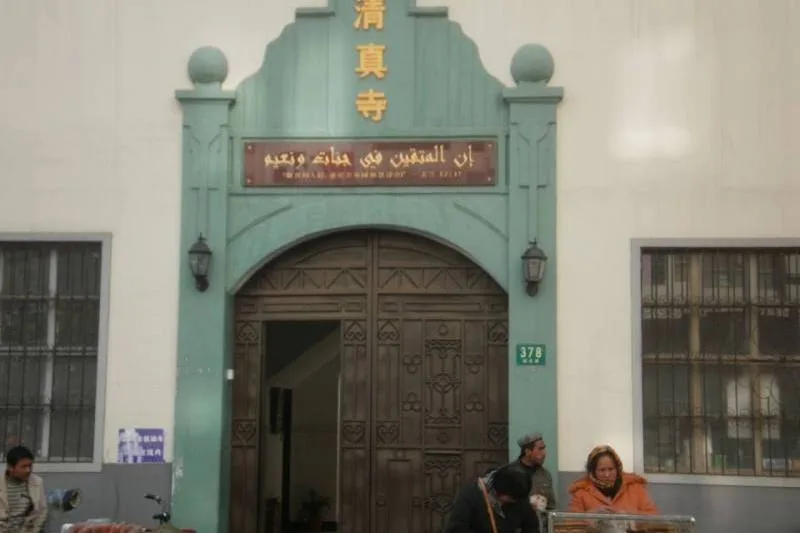
Address: 378 Fuyou Road, Huangpu District · Metro: Yuyuan Garden (Line 10/14).
Founded in 1870, Fuyou Road Mosque is the historic heart of Muslim Shanghai and the most convenient mosque in the city for tourists: it sits on the edge of the Yu Garden bazaar area. If your Shanghai plan includes Yu Garden — and almost every first-timer’s does — this is where you will likely pray.
It is a working neighborhood mosque, not a monument: recent visitors describe it as tidy, unhurried, and welcoming. Friday prayer draws a full house; recent visitors report Jumu’ah starting around 1:30 pm, though the exact time shifts with the season, so confirm on arrival or the day before.
Huxi Mosque — West Shanghai and the Friday Market
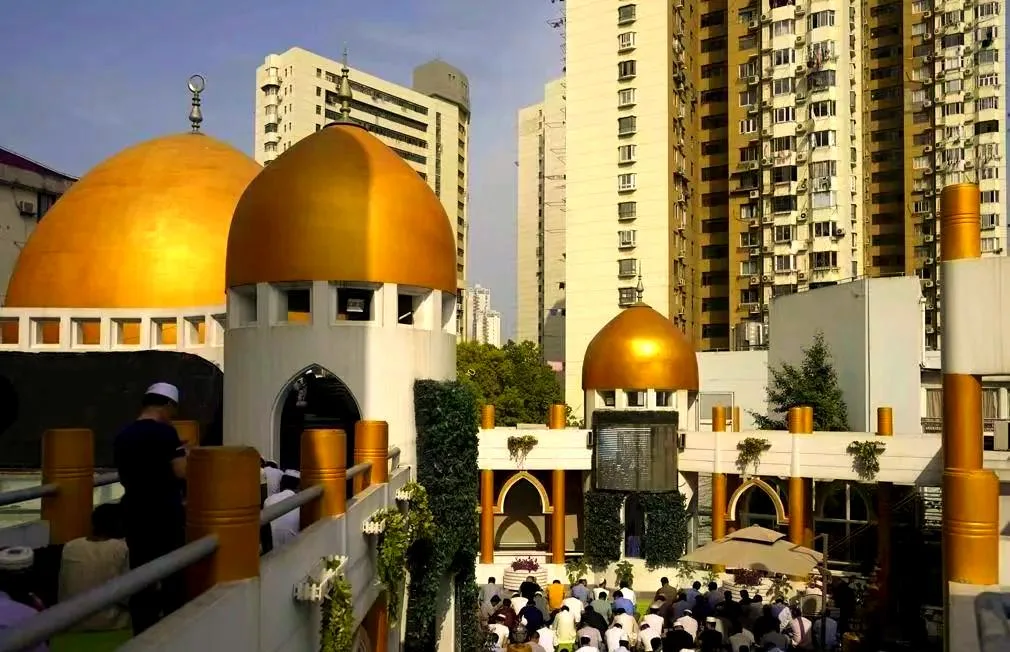
Address: Lane 1328, Changde Road, Putuo District · Metro: Changshou Road (Line 7/13), a few minutes on foot.
Huxi Mosque serves the west side of the city — golden domes, a 25-meter minaret, and full wudu facilities. Rebuilt at this site in 1994, it is the natural choice if your hotel or day plan sits in Putuo, Jing’an west, or along Line 7 or 13.
The reason travelers cross town for it is Friday: after Jumu’ah, a halal street market forms on the lane behind the mosque, with stalls — many run by Xinjiang vendors — selling grilled lamb skewers, naan, polo rice, and sweets, roughly from late morning to mid-afternoon. The market has paused and restarted over the years, so treat it as a bonus on a Friday you are already nearby rather than the anchor of your week. Bring cash: stall vendors may not be able to take foreign cards or your version of the payment apps.
Pudong Mosque — East of the River
Address: 375 Yuanshen Road, Pudong New Area · Metro: Yuanshen Sports Center (Line 6).
Rebuilt in 1995 with a 40-meter minaret, Pudong Mosque is the only major mosque east of the Huangpu River. The main hall holds around 500 worshippers, a second hall opens for Friday prayer, and — useful for families — there is a dedicated women’s prayer room holding around 50.
Be realistic about distances on the Pudong side: the mosque is near the Yuanshen Road area, a metro ride from the Lujiazui towers and nowhere near Disneyland. If your Pudong day is all towers and riverside, Dhuhr here is feasible; if it is a Disneyland day, plan to pray at your hotel before and after instead — the park has no dedicated prayer room (Guest Services has been known to offer a quiet room on request, but we tell clients not to plan around it).
Songjiang Mosque — The Oldest Mosque in Shanghai
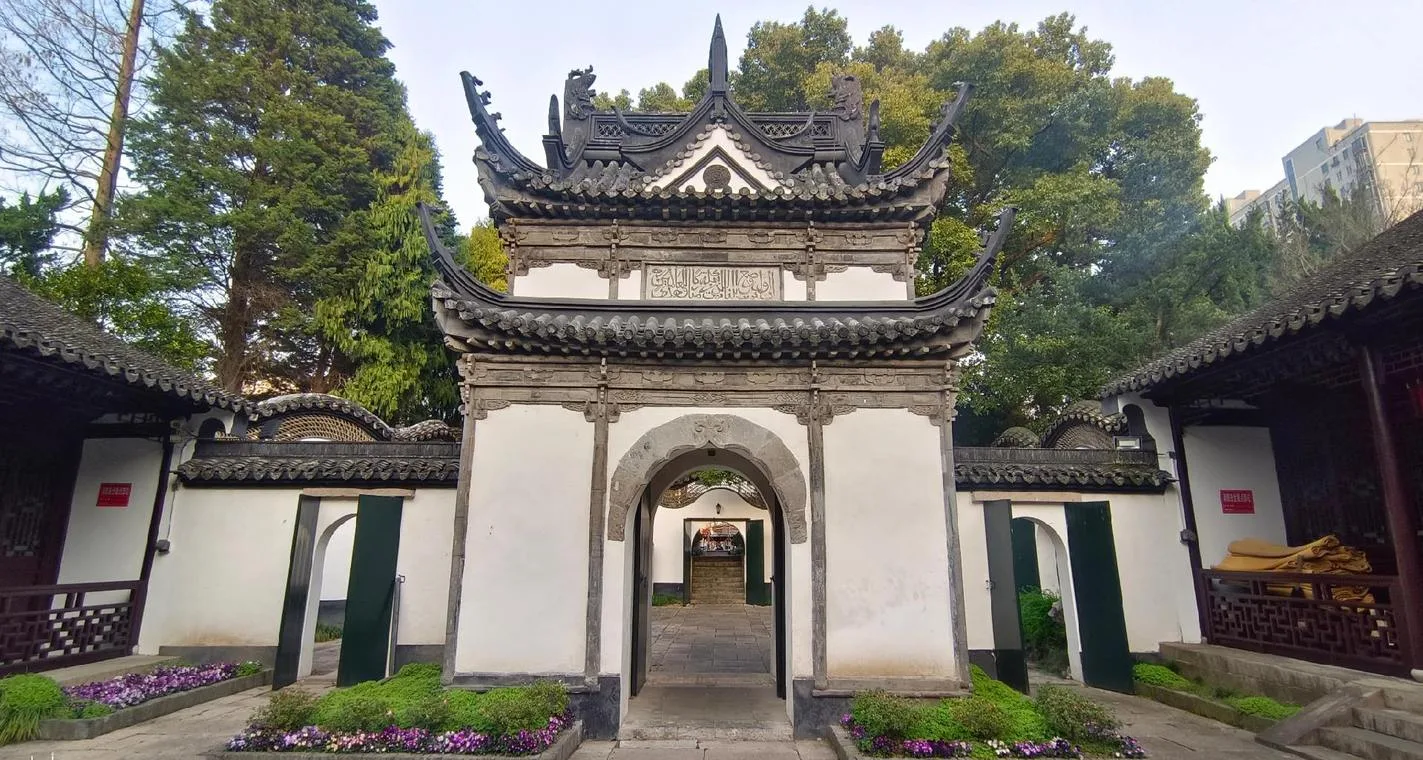
Address: Gangbeng Alley, near Zhongshan Central Road, Songjiang District · Metro: Zuibaichi Park (Line 9).
Built between 1364 and 1367 under the Yuan dynasty, Songjiang Mosque is the oldest in Shanghai and one of the older Islamic sites in eastern China — a courtyard complex in classical Chinese palace style that has been renovated across the Ming and Qing dynasties. It has been open to visitors since 1989, with posted visiting hours of roughly 9:00 am to 4:00 pm and a small entrance fee of a few yuan.
It is also an hour from downtown. Go because you want to see it — a 650-year-old mosque built like a Chinese garden is genuinely worth the trip — not because you need a place for Asr. Pair it with Songjiang’s old town or Zuibaichi garden to make the half-day worthwhile.
What About Jumu’ah (Friday Prayer)?
All the main Shanghai mosques hold Friday prayer, and Fridays are when they feel most alive — Fuyou Road and Xiaotaoyuan fill up well before the khutbah, with recent visitors reporting the hall crowded by around 12:30.
Two planning rules we apply to every client itinerary that includes a Shanghai Friday:
- Do not book fixed-time tickets across Friday midday. Timed-entry attractions, acrobatics matinees, or a Zhujiajiao day trip that departs at noon will collide with Jumu’ah. Keep roughly 11:30 am–2:30 pm flexible: metro time, prayer, and — if you are at Huxi — lunch from the market afterwards.
- Arrive early, not on time. Space is finite and regulars arrive well ahead. Reaching the mosque 30–45 minutes before the reported start also gives you margin for the one thing Shanghai always adds: transit time.
If a Friday simply cannot bend — a flight, a fixed event — Dhuhr prayed at the hotel is the fallback, and it is better to decide that in advance than to spend the morning anxious about logistics.
Not Near a Mosque? How Prayer Actually Works on a Shanghai Trip
Here is the honest picture. On a typical Shanghai itinerary, most of the five daily prayers do not happen in a mosque. Fajr and Isha happen at your hotel. Dhuhr and Asr happen wherever the day puts you — and Shanghai’s attractions, malls, and airports do not reliably provide prayer rooms. We have seen claims of a prayer room at Pudong Airport, but we could not confirm one through any official source, so do not build your plan around it; a quiet gate area and a travel prayer mat are the realistic option on a flight day.
None of that makes prayer difficult — it makes it a planning input. What we do for our clients, and what you can replicate yourself:
- Choose the hotel with prayer in mind: your room, not a lobby, is your main prayer space — so pick a hotel central to your route rather than one next to a mosque.
- Put prayer windows into the day plan, not around it. We slot each day’s attractions between prayer times and tell the driver and guide in advance where the pauses fall. Your guide will not automatically know your requirements — the difference between an awkward day and a smooth one is usually that someone told the team beforehand.
- Use the mosque days deliberately. One or two days of your Shanghai stay will naturally pass through Yu Garden or Pudong; those are your mosque prayers. The rest are hotel and en-route prayers, and that is a perfectly normal rhythm for Muslim travel in eastern China.
If you want a Shanghai plan where this is already thought through — mosque stops matched to your route, Jumu’ah kept clear, halal meals booked nearby — tell us your dates and we will sketch the prayer-and-sightseeing rhythm for you.
FAQ
Can non-Muslims visit Shanghai’s mosques?
Songjiang Mosque is a heritage site with posted visiting hours (about 9:00 am–4:00 pm) and is the most visit-friendly. The city mosques are working prayer spaces; visitors are generally received courteously, but come modestly dressed (arms and legs covered), remove shoes before prayer halls, and avoid the five prayer times and Friday midday if you are sightseeing rather than praying.
Which is the biggest mosque in Shanghai? The oldest?
Xiaotaoyuan is the largest and serves as the city’s main mosque. Songjiang, built 1364–1367 in the Yuan dynasty, is the oldest.
Is there a mosque near Shanghai Disneyland?
No — Pudong Mosque is the closest of the five, but it sits roughly 25 km from the resort, and the park has no dedicated prayer room; asking at Guest Services for a quiet room sometimes works, but treat that as a bonus. Pray at your hotel before and after the park day. For food inside the park, our Shanghai Disneyland halal food guide lists what is actually available.
Do Shanghai airports have prayer rooms?
We could not verify a dedicated prayer room at either Pudong (PVG) or Hongqiao (SHA) through official sources, and traveler reports conflict — a few directories list a room in PVG Terminal 1, so it is worth asking staff, but do not count on it. The safe plan: pray at your hotel before heading out, or use a quiet gate area with a travel mat.
Where do women pray?
Xiaotaoyuan has a separate women’s mosque next door at 24 Xiaotaoyuan Street, and Pudong Mosque has a dedicated women’s prayer room. For the other mosques, ask on arrival — arrangements exist but are not documented in English anywhere we could verify, which is why we confirm by phone for our own groups.
Where This Fits in Your Shanghai Plan
Prayer logistics are one layer of a Shanghai trip, and honestly the easier one — the harder daily question is food, which we cover in our halal food guide for Shanghai. For how the mosques, meals, and sights combine into actual days, start from our Shanghai Muslim itinerary or the Shanghai destination overview. And if you are still at the “is China workable for us at all” stage, our halal travel in China page answers that first.