Last Updated on October 23, 2026 by Aaron Chen
On a China trip, the qibla is west, tilted slightly north — about 7 to 15 degrees north of due west from Beijing, Shanghai, Xi’an and Chengdu, not southeast or southwest, which is a question we genuinely get asked. The harder part is the clock. All of China runs on Beijing time, so as you travel west your prayer times move later on your watch, by an hour or more, and most of your prayers will happen in a hotel room or at a quiet stop beside the car rather than in a mosque. We plan routes around that, and it works as long as prayer goes into the plan before the day starts, not after.
If you are looking for which mosques to visit, that is our guide to mosques in China. This article is about everything in between: direction, timing, wudu, and the train, park and airport days where no mosque is anywhere near.
Which Way Is the Qibla in China?
West, tilted slightly north, from every city on a typical first trip. The tilt shrinks as you go inland, and only in China’s far west — Xinjiang, for example — does the qibla swing south of west.
| City | Qibla (degrees from true north) | In plain words |
|---|---|---|
| Shanghai | 285° | About 15° north of due west |
| Guangzhou | 285° | About 15° north of due west |
| Zhangjiajie | 281° | About 11° north of due west |
| Beijing | 279° | About 9° north of due west |
| Chongqing | 279° | About 9° north of due west |
| Xi’an | 277° | About 7° north of due west |
| Chengdu | 277° | About 7° north of due west |
| Urumqi | 256° | About 14° south of due west |
| Kashgar | 250° | About 20° south of due west |
These are great-circle bearings from each city center toward the Kaaba, rounded to the nearest degree; moving across town changes them by a fraction of a degree. If you have been told “northwest”, that is too far north: true northwest is 315°, more than 30° away from the qibla in Beijing.
Getting the direction right on your phone
Two practical notes. First, install a prayer app with its own compass before you fly, and calibrate the compass before you use it. Second, web tools that run on Google, such as Google’s own Qibla Finder, generally will not load on hotel Wi-Fi or a Chinese SIM, because Google services are blocked on mainland networks. On many international roaming plans, and on eSIMs that route traffic outside mainland China, they often work — check with your provider before you fly. Our guide to WhatsApp in China covers the same connection question for messaging.
Why Your Prayer Times Move as You Cross China
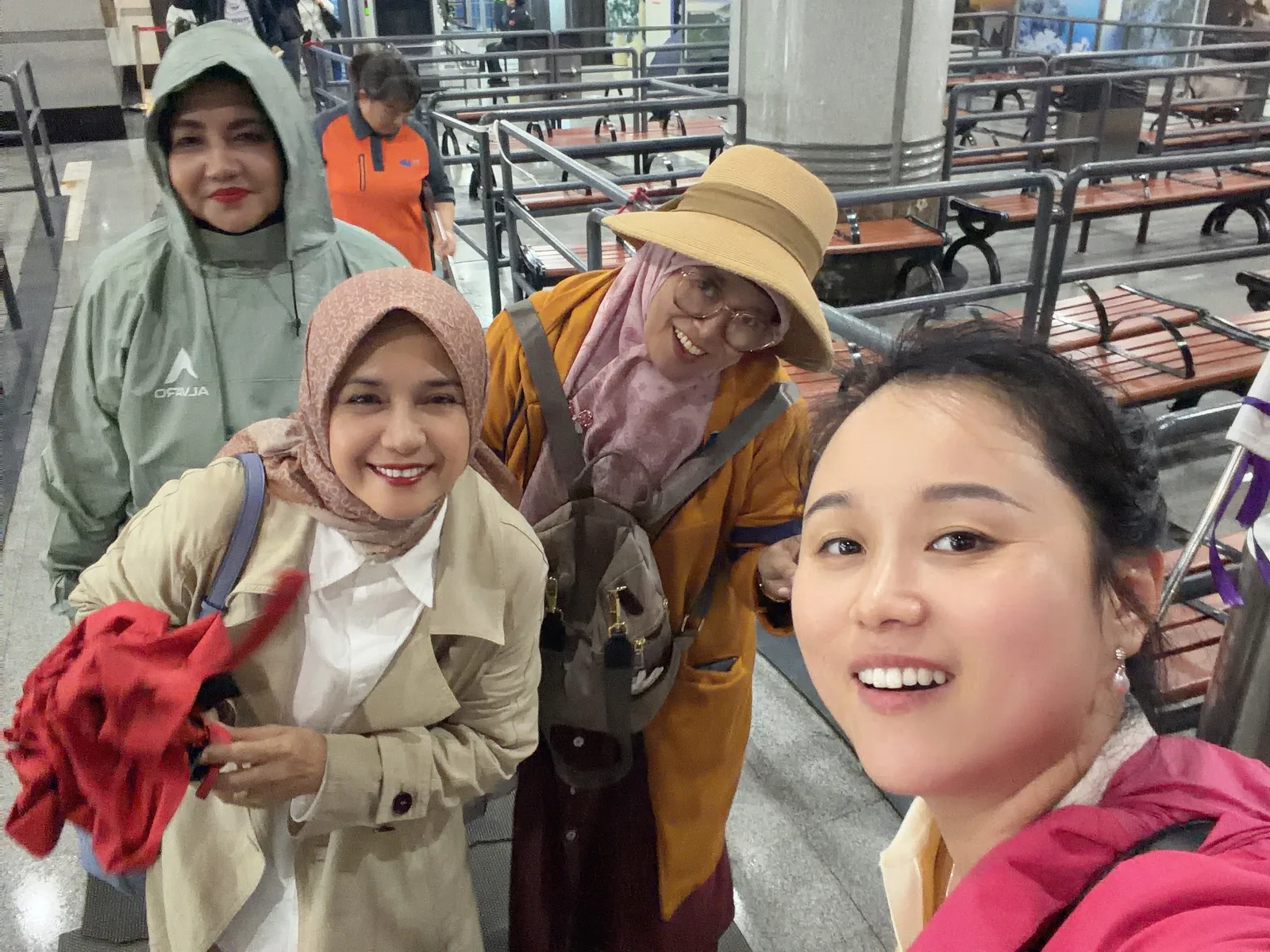
In late September we hosted an Indonesian group in Zhangjiajie. At lunch in a halal restaurant, a little after 11 am, they asked whether they could pray there. The owner, a local Hui Muslim, was happy for them to pray in the restaurant, but told them to wait: the time for Dhuhr had not started yet, because the sun had not yet passed its highest point. He was right. That day, Dhuhr began at about 11:44 local time in Jakarta, but in Zhangjiajie, on Beijing time, it began at 12:29.
The reason is the clock. China uses a single official time zone, Beijing time (UTC+8), for the whole country, and has not used daylight saving time since 1991. The sun does not follow the clock: solar noon arrives about four minutes later for every degree of longitude you travel west. On one clock, that means Dhuhr in Xi’an begins roughly 50 minutes after Dhuhr in Shanghai, and in Chengdu roughly 70 minutes after.
Here is when Dhuhr and Maghrib begin on two sample dates, calculated with the Muslim World League method in Beijing time:
| City | Dhuhr, 21 June 2026 | Maghrib, 21 June 2026 | Dhuhr, 21 Dec 2026 | Maghrib, 21 Dec 2026 |
|---|---|---|---|---|
| Shanghai | 11:56 | 19:01 | 11:52 | 16:56 |
| Beijing | 12:16 | 19:46 | 12:12 | 16:52 |
| Zhangjiajie | 12:40 | 19:40 | 12:36 | 17:45 |
| Xi’an | 12:46 | 20:00 | 12:42 | 17:38 |
| Chongqing | 12:56 | 19:57 | 12:52 | 17:59 |
| Chengdu | 13:05 | 20:09 | 13:02 | 18:07 |
Times on other dates are different, so check your own travel dates in your app. Calculation methods can also give slightly different times, especially for Fajr and Isha; use the setting you follow at home.
Expect one more set of numbers: the mosque’s own board. In September 2026, the board at Xiaotaoyuan Mosque in Shanghai showed Dhuhr at 12:56 and Asr at 16:26. Calculated for that week, the time for Dhuhr began at about 11:47, the earlier Asr at about 15:15 and Hanafi Asr at about 16:10. An app, like the table above, tells you when each prayer’s time begins; a mosque’s board shows that mosque’s own prayer times. If you are going to pray with a congregation, go by the board.
Three consequences we plan around:
- Flying west moves the whole day. Fly from Shanghai to Chengdu and Dhuhr moves from just before noon to just after one. A 12:00 lunch booking that came just after Dhuhr in Shanghai now lands an hour before it. When we build a day, we read the prayer times for the city you will be in that day, not the one you started from — and we keep the prayer windows free of anything with a fixed start time.
- Northern summers stretch the day at both ends. In Beijing in late June, Fajr begins at about 2:45 am and Isha at about 9:40 pm by the Muslim World League method, which makes for a short night before an early Great Wall start.
- Xinjiang runs much later on the same clock. In Urumqi in June, Maghrib begins close to 10 pm Beijing time, and some people there keep a local time two hours behind — so when a time is quoted to you in Xinjiang, ask which clock it is on.
Shafi’i travelers: the mosque’s Asr may be later than yours
Most Hui Muslims follow the Hanafi school, so a mosque in eastern or central China may set its Asr by the Hanafi time, which begins later than the Asr of the Shafi’i, Maliki and Hanbali schools. Many travelers from Malaysia, Indonesia and Singapore follow the Shafi’i school. Many prayer apps let you choose between the earlier Asr and Hanafi Asr, so check which one yours is set to. In Shanghai on 21 December 2026, the earlier Asr begins at 14:37 and Hanafi Asr at 15:18 — a 41-minute gap.
How you pray on your own stays between you and your school. The gap matters if you plan to join a mosque’s congregation for Asr: arrive by the mosque’s own time, not your app’s, or you may be 40 minutes or more early.
Where You Will Actually Pray on a Travel Day
One traveler asked us whether the tour could stop at a mosque every day. The honest answer depends on the city. In Xi’an, Beijing, Shanghai, Guangzhou, Chengdu and Chongqing, a mosque is reachable on most city days. In Zhangjiajie — our home base — and across the wider Xiangxi region including Fenghuang, there is no mosque open to visitors. So on any multi-city trip, most of your prayers happen somewhere else. This is how it works day by day.
City days
One prayer goes into the route at a mosque, often Dhuhr, placed where the day already passes it. The other prayers happen at the hotel.
Mountain and park days
Inside Zhangjiajie National Forest Park you get around on the park’s own shuttle buses and on foot, so Dhuhr, and Asr if you are still in the park, are prayed at a quiet spot on the plateau; the guide times each break so it falls inside that prayer’s time. Fajr is prayed at the hotel before entry, and Maghrib and Isha after you return; our Zhangjiajie park itinerary shows where each prayer falls on a real park-day timetable. On road days such as the Great Wall, the stop is a quiet spot at a rest area or beside the vehicle, chosen in advance with the driver. For women who prefer privacy when they pray, a private vehicle makes a roadside stop easier: it gives some cover to pray beside, which is one reason we run these days with a private vehicle rather than public transport.
Train days
We plan the prayer around the train, not on it. Before we book high-speed rail tickets, we choose trains around your itinerary and prayer times and send you the train numbers and departure times to confirm. If you see a clash with a prayer, tell us and we change the train. We choose trains so that each prayer’s time can be met at the hotel before you leave or after you arrive, rather than on board.
Airport days
Do not build the day around an airport prayer room. We could not confirm a prayer room at either Shanghai airport, and reports of prayer rooms at other Chinese airports may be out of date. Pray at the hotel before the transfer, and plan as if there will be nothing airside.
The hotel room
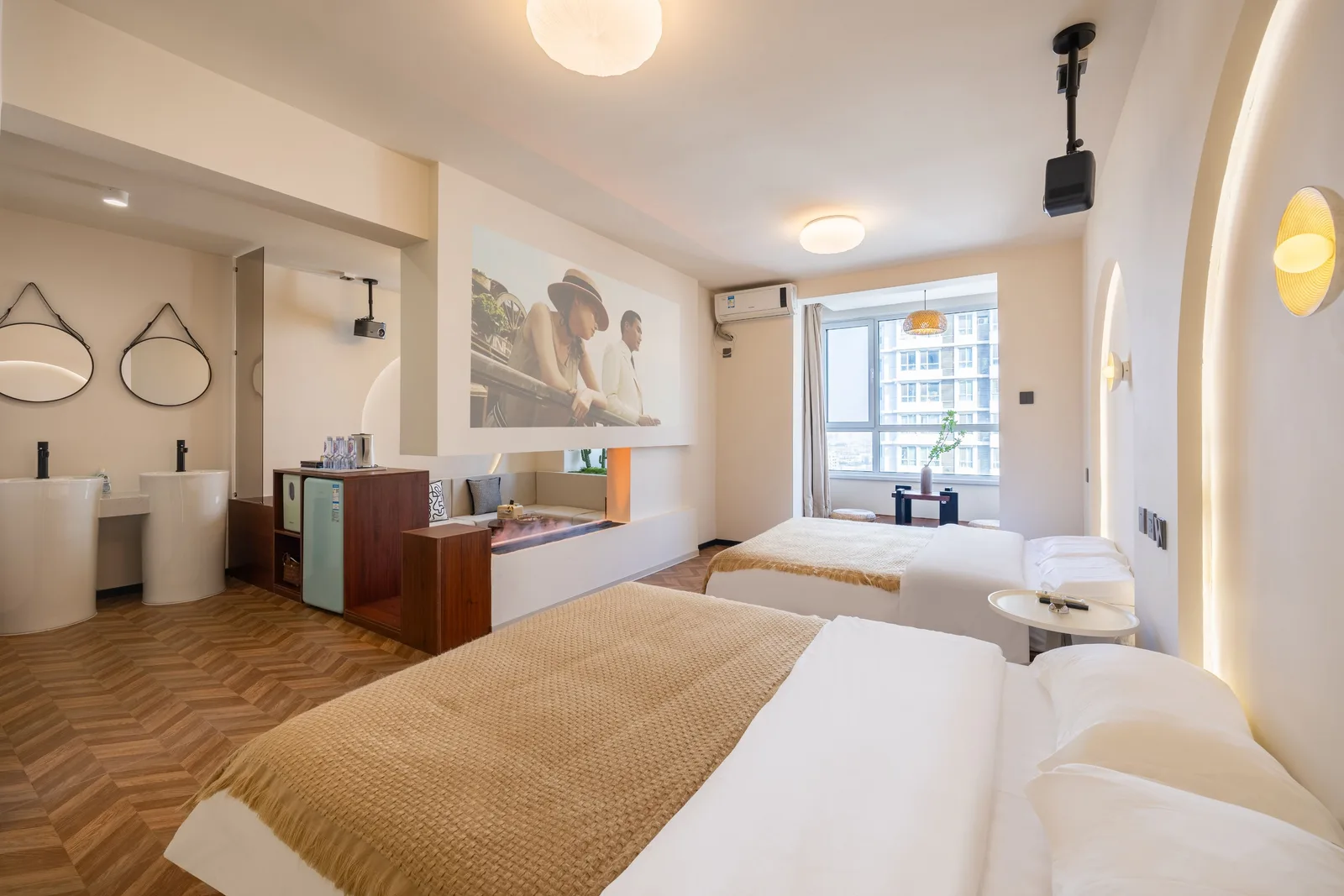
The hotel room carries most of the trip: Fajr and Isha almost every day, and Dhuhr or Asr whenever the day passes back through. This is why we choose hotels for their position on your route rather than for proximity to a mosque. If a room smells of cigarette smoke, tell us and we will help you change rooms.
Wudu When There Is No Mosque Nearby
The easiest wudu of the day is the one at the hotel before you head out, so make it there before a long park or train day. For the rest of the day, plan for three realities:
- Highway service areas are your best roadside option. On road days, our drivers stop at service areas, which have public washrooms, and the stop doubles as the prayer break.
- Scenic-area and station restrooms are basic. Many are squat toilets, and toilet paper is not always provided. Carry tissues and a small refillable water bottle; if you prefer to use water for istinja, a portable travel bidet helps, as covered in our guide to Chinese hotel rooms for Muslim families.
- Hotels and malls usually have the more comfortable washrooms. If a long sightseeing day passes a mall or a large hotel near prayer time, that is often the better place for wudu than the restroom at the attraction gate.
Can You Pray in Public in China?
Quietly, and in a discreet spot, yes: that is how our own clients pray on mountain and Great Wall days — beside the vehicle at a rest stop, at the quiet edge of a park, or in the hotel room.
The limits are practical. Temple grounds, ticket queues, narrow trail sections and station concourses are poor choices, because crowds have to move around you and you will not get the calm you want for prayer. A large group praying together is a different situation. Chinese regulations expect organized group religious activities to take place at registered religious venues, so for groups we route congregational prayer to a mosque; on days without one, travelers pray in their rooms or at the vehicle stop, individually or as a family, rather than as a large group in a public place.
What we do about it is unglamorous: the prayer stop is chosen with the driver before the day begins, so nobody is searching for a spot when the prayer time begins. If a planned spot does not work on the day, you message us on WhatsApp and we sort it out with the driver in Chinese, rather than you negotiating at the roadside. For the related question about dress, see whether you can wear a hijab in China.
What to Tell Us Before the Trip
We plan around five daily prayers on every day of a trip. Your driver and guide may not be Muslim and may not know the prayer times, so the plan has to travel down the chain — from you to us to them — before the day starts. These are the three things that change how we plan, in the order they affect the itinerary:
- How your group handles prayer on travel days. Whether you combine or shorten prayers while traveling is between you and your own school or scholar; we do not advise on it. But a mountain day is planned differently depending on the answer, so tell us which way your group prays.
- Whether you want to pray in congregation. If yes, we place mosque visits for Dhuhr or Asr on city days and, on a Friday, keep the midday free for Jumu’ah. If a Friday would land in Zhangjiajie, where there is no mosque open to visitors, we reorder the route where we can so that Friday falls in a mosque city instead; our mosques guide covers how we time Friday prayer.
- Privacy needs for the women in your group. This decides where roadside stops happen and, where you request one, whether we book a female guide — which we confirm city by city and date by date.
FAQ
Which direction is Mecca from Beijing?
About 279° from true north — about 9° north of due west. From Shanghai and Guangzhou it is about 285°.
Will my prayer app work in China?
Set it up and download it before you fly. Features that rely on Google maps or web tools generally will not load on local Wi-Fi or a Chinese SIM; on many roaming plans, and on eSIMs that route traffic outside mainland China, they often work, so check with your provider.
Why does the mosque’s timetable differ from my app?
Your app shows when each prayer’s time begins. A mosque’s board shows that mosque’s own prayer times, and for Dhuhr the difference can be more than an hour: at Xiaotaoyuan Mosque in Shanghai in September 2026, the board showed Dhuhr at 12:56, while the time for Dhuhr began at about 11:47. If you are joining a congregation, go by the board.
Are there prayer rooms at Chinese airports?
Do not count on one. We could not confirm a prayer room at either Shanghai airport, and reports for other airports may be out of date. Pray at the hotel before your transfer.
Can I pray on a high-speed train?
Plan not to need to. How you pray if a prayer time falls during a journey is a question for your own school or scholar. Our part is the timing: before we book, we send you the train times to check against your prayer times, and we change any train that clashes.
Should I bring my own prayer mat?
It helps. A compact travel mat covers hotel rooms, roadside stops and park days.
Prayer on a China Trip Is Scheduled Before You Land
The pattern behind all of this is simple: for most travelers in China, finding a place to pray is not the hard part. Time is. One clock across the whole country, prayer times that move as you travel, and days built around trains, cable cars and fixed entry times will push prayer aside unless it is written into the plan first.
If you would like to see how your own route handles it, send us your cities and dates on WhatsApp — we will show you where each day’s prayers fit into the plan, before you commit to anything.