Last Updated on October 23, 2026 by Aaron Chen
China’s last official count recorded over 39,000 mosques — and on a typical two-week trip, you might step inside two of them. Both numbers are true, and the gap between them is what this guide is about. Every major tourist city in China has at least one active mosque that receives visiting Muslims, so praying in congregation is possible in Beijing, Shanghai, Xi’an, Chengdu, Chongqing, and Guangzhou. But most of your five daily prayers will happen in your hotel room or beside the car — which is why, when our team builds an itinerary, mosque locations are a design input for one or two specific days, not a checklist to tick. Below: the mosques actually worth planning a day around, city by city, and how prayer works everywhere else.
How Many Mosques Are in China — and Where Are They?
The last official nationwide count, from 2014, put the number at 39,135. The great majority are in the northwest — Xinjiang, Gansu, Ningxia, Qinghai — where Muslim communities have lived for over a thousand years. Kashgar, in the far west, is a destination in its own right for travelers drawn to that heritage; our Kashgar destination page covers it separately.
For trip planning, the more useful fact is smaller: the eastern cities on a standard China itinerary each have a handful of active mosques, run by local Hui Muslim communities, and they are used to receiving travelers. You will not find a mosque on every corner the way you might in Kuala Lumpur or Istanbul — but you will find one where it counts, if you know which one to aim for.
Can Tourists Actually Pray in Chinese Mosques?
Yes. Muslim visitors are admitted to pray, free of charge, at the active mosques in every city covered below. At the Great Mosque of Xi’an — which charges sightseeing admission to non-Muslim visitors — the practice is simply to tell the gate staff you have come for prayer. If English fails, the phrase to say or show is 我来礼拜 (wǒ lái lǐbài) — “I have come to pray.”
Three things to know before you go, in the order they will matter:
- English signage is minimal. Prayer times are posted in Chinese and Arabic, and office staff rarely speak English. This is manageable — prayer apps give you the times, and they work normally on roaming or eSIM data, the same setup covered in our WhatsApp in China guide — but confirm anything that matters (Jumu’ah start time, women’s access) before the day, not at the door. We do this by phone before our groups arrive: when one client asked us whether a venue on their route offered a prayer room, we called the venue, confirmed the building and floor, and sent that. A quick call in Chinese settles what an hour at the gate cannot.
- These are working neighborhood mosques, not monuments. You will be praying with the local Hui community. Dress modestly, remove shoes before the hall, and expect the atmosphere of a community masjid rather than a tourist site.
- Women’s facilities vary by mosque, not by city. Shanghai is the best-documented case — a separate women’s mosque beside Xiaotaoyuan and a women’s prayer room at Pudong Mosque. Elsewhere, provision ranges from a dedicated hall to none, and it has to be confirmed mosque by mosque; that call is a standard item on our pre-trip checklist for family groups traveling with mothers and daughters.
The Mosques Worth Planning a Day Around
The table is the short version; the notes after it are the judgment calls.
| City | Mosque to aim for | Why this one |
|---|---|---|
| Xi’an | Great Mosque of Xi’an (Muslim Quarter) | The one mosque in China that is itself a destination |
| Beijing | Dongsi Mosque | Central, active, receives foreign Muslims; Niujie is closed for renovation |
| Shanghai | Fuyou Road / Xiaotaoyuan | Both sit in the old city, minutes from Yu Garden |
| Guangzhou | Huaisheng Mosque | Traditionally China’s oldest; five daily prayers and Jumu’ah |
| Chengdu | Huangcheng Mosque | Sichuan’s largest, ten minutes’ walk from Tianfu Square |
| Chongqing | Several city mosques | Pick by the day’s route — we choose when we build the day |
Xi’an
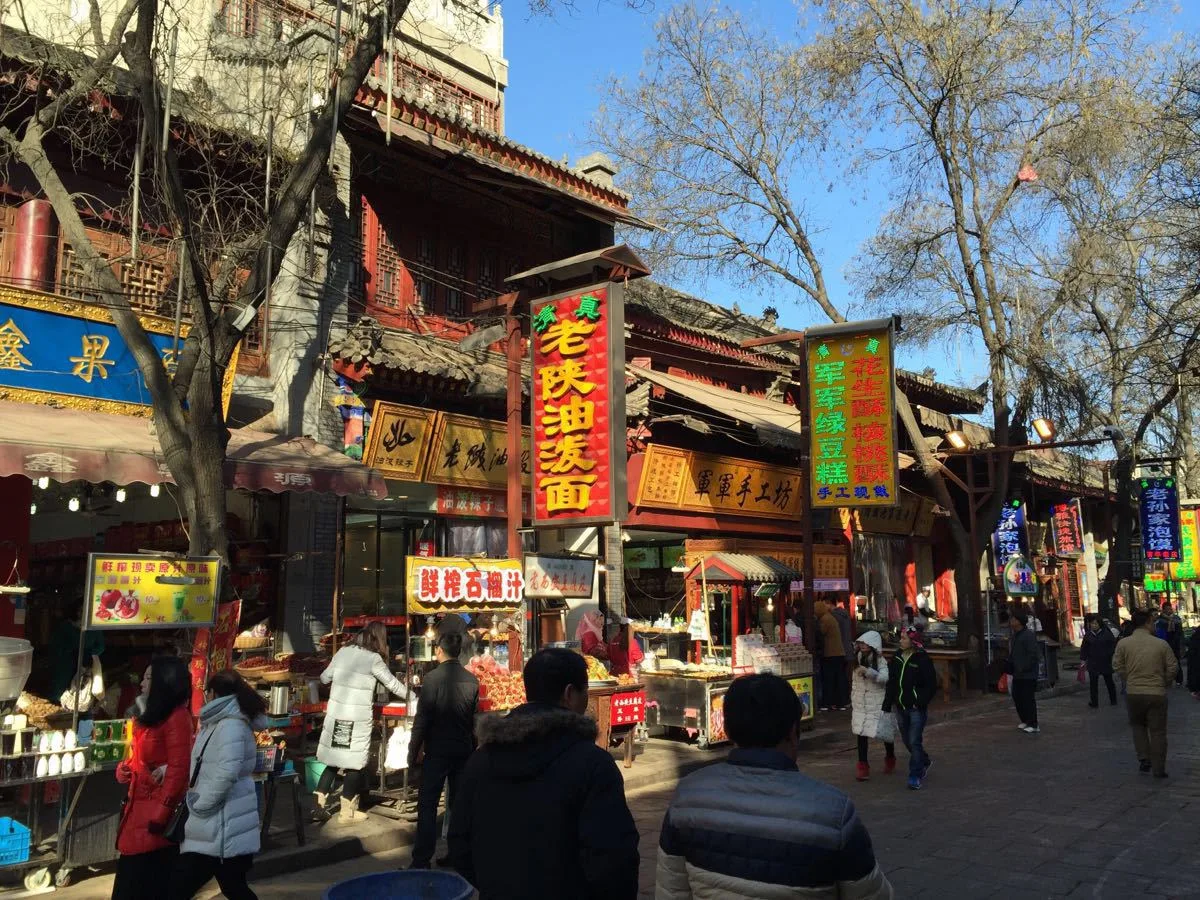
Xi’an is the exception to everything else on this page: here the mosque genuinely shapes the trip. The Great Mosque, traditionally dated to 742 AD and among the largest premodern mosques still standing in China, is built entirely in Chinese courtyard style — pavilions and gardens, no domes — and sits inside a living Hui neighborhood where halal food is the street culture, not a special request. It holds all five daily prayers. Praying Maghrib here and then eating your way down Beiyuanmen is the standard end to a Terracotta Army day; our Muslim Quarter guide covers the details.
Beijing
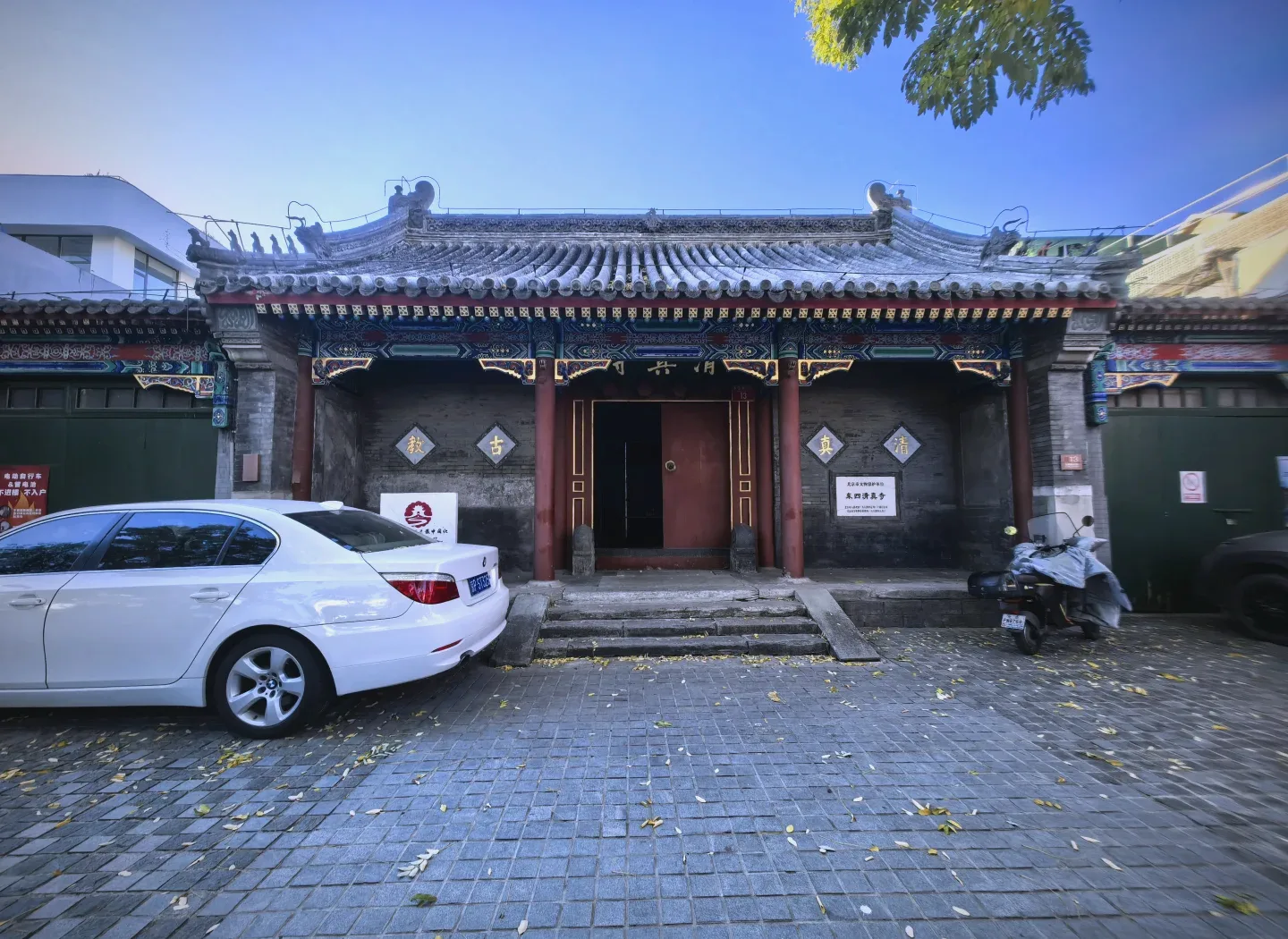
Beijing needs one honest correction to what most directories still say: Niujie Mosque, the city’s most famous, has been closed for heritage renovation since 2024 and is expected to stay closed until around 2027 — do not plan around it, though the halal restaurants on Niujie street are open as usual (current status here). The working answer is Dongsi Mosque in the city center, which receives foreign Muslims for daily and Friday prayers and sits a short drive from the Forbidden City. How this fits a full Beijing plan — Great Wall days included — is in our Beijing guide for Muslim travelers.
Shanghai
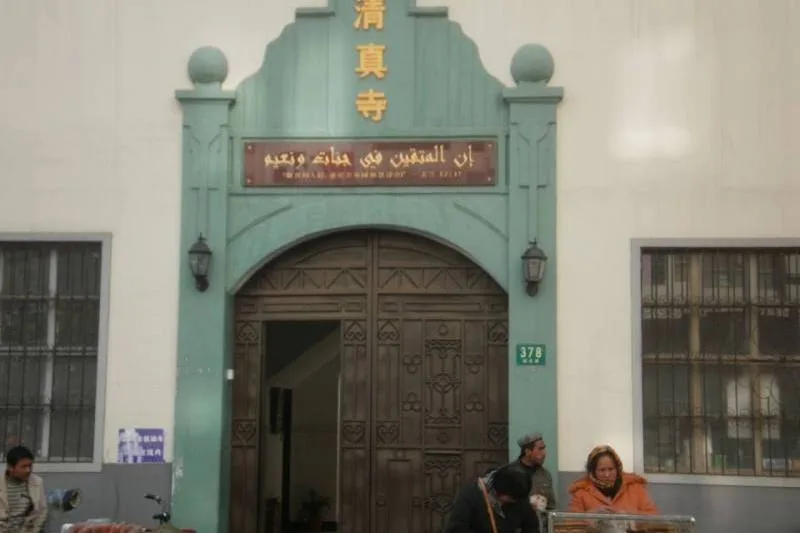
Shanghai has six active mosques, and the two in the old city — Fuyou Road and Xiaotaoyuan — cover the Yu Garden–Bund sightseeing core so well that you can pray Dhuhr mid-route without changing your day. Xiaotaoyuan also has that separate women’s mosque a few doors away. The full picture, including the Friday street market at Huxi Mosque, is in our Shanghai mosque guide.
Guangzhou
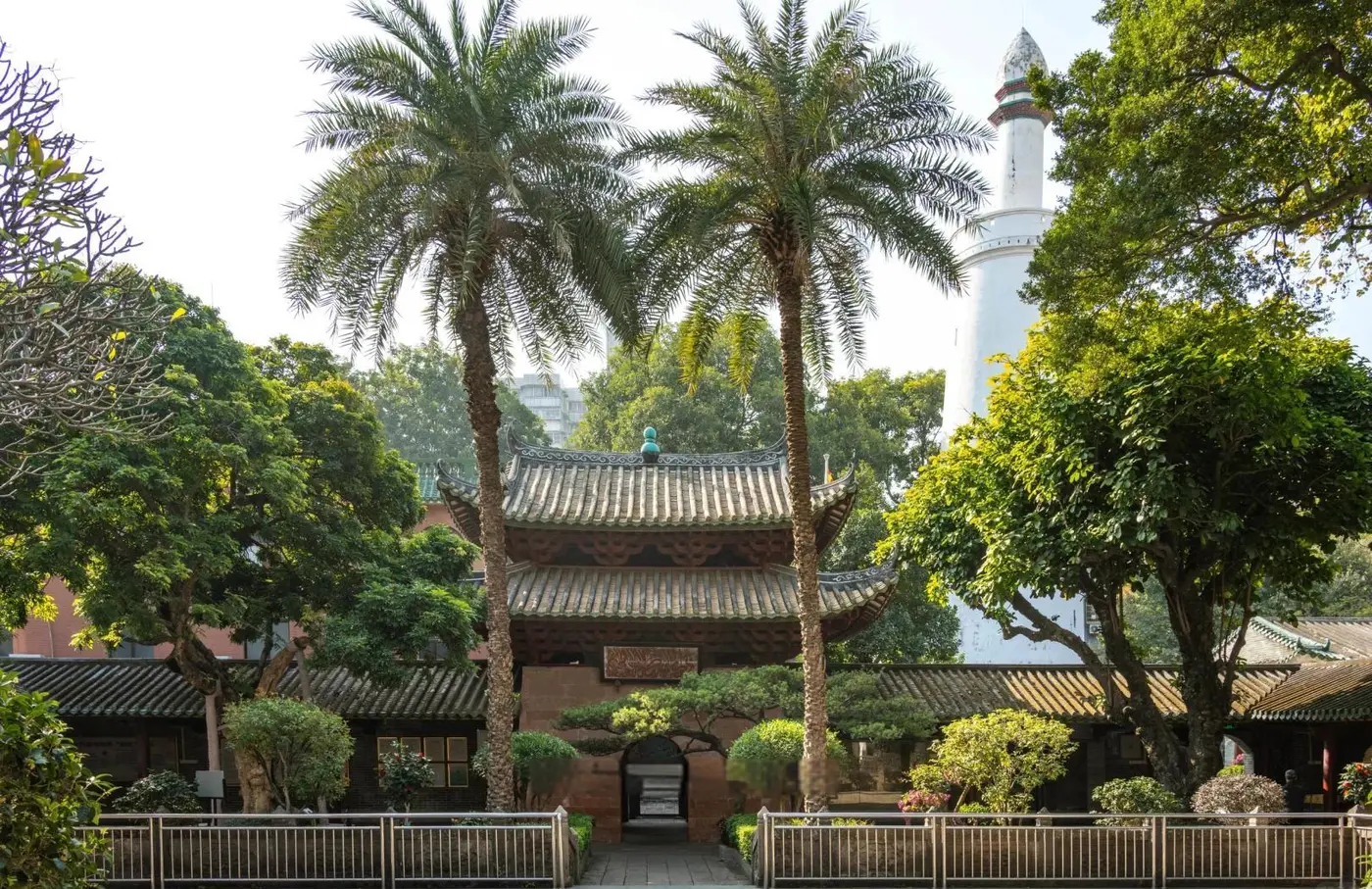
Guangzhou holds the mosque every “oldest in China” list points to: Huaisheng, on Guangta Road, traditionally dated to 627 AD (historians debate the exact founding, which is why we say “traditionally”). It is open for the five daily prayers and Friday congregation, and since Guangzhou is the arrival gateway for many travelers from Southeast Asia and the Gulf, it is often the first mosque of the trip — usually paired with dim sum, as our Guangzhou halal food guide lays out.
Chengdu
Chengdu’s Huangcheng Mosque is the largest in Sichuan and sits about ten minutes’ walk from Tianfu Square, with the city’s halal restaurants clustered around it — mosque, lunch, and central sightseeing resolve into a single stop, which is exactly how the city days in our Chengdu guide are built.
Chongqing
Chongqing has several mosques open to visiting Muslims, and it is the one city where we deliberately do not name a single “mosque to aim for”: the city’s geography — rivers, ridgelines, long transfers — means the right mosque is the one nearest that day’s route, and we choose it when we build the day. How a Chongqing trip handles prayer and halal food day by day is in our Chongqing guide.
What If Your Destination Has No Mosque?
Some of China’s best destinations have none. Zhangjiajie — the Avatar mountains, and our home base — has no public mosque for visitors, and neither does the wider Xiangxi region including Fenghuang. We would rather tell you that here than have you search for one on arrival.
A trip through mosque-free territory is still a trip where every prayer gets prayed. In practice, prayer on a China itinerary works at three levels, and a good plan uses all of them:
- Mosque prayers, written into the route. One or two days of a typical trip naturally pass a mosque from the table above. Those are your congregation prayers — planned, not improvised.
- Hotel-room prayers. Fajr and Isha, and on most days Dhuhr or Asr too. This is the workhorse of the trip, which is why we weight hotel choice toward location on your route rather than proximity to a mosque.
- En-route prayers. On a national park day or a Great Wall day, the realistic option is a clean, private spot beside the vehicle, with wudu at a highway service area. For the women in a group, the parked vehicle itself is usually the workable private space — one reason we run these days with a private vehicle rather than public transport. A driver who knows the requirement in advance builds the stop into the schedule; if anything is missed mid-trip, the fix is a WhatsApp message to us, not a roadside negotiation in Chinese.
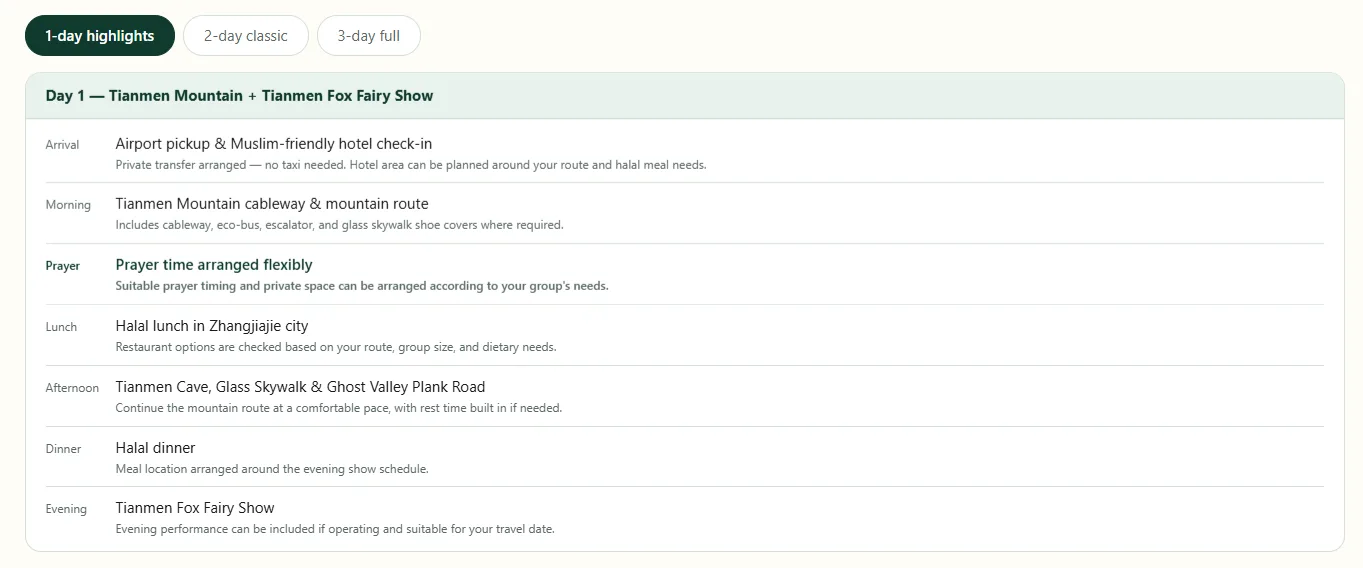
The third level is where trips actually differ. The mosques exist whether or not anyone plans for them; the roadside prayer stop only happens if someone told the driver beforehand. We are direct with clients about this: we understand the requirement, but not every driver and guide in China will — so the requirement has to travel down the chain from you to us to them, before the day starts. That handoff, more than any mosque list, is what decides whether prayer on the road feels routine or fraught. Our Zhangjiajie Muslim travel guide shows what this looks like across a full itinerary in a region with no mosque at all. For the practical side of praying away from a mosque — which way the qibla is, how prayer times shift on Beijing time, wudu, and train, park and airport days — see our guide to how to pray while traveling in China.
Jumu’ah and Your Itinerary
Friday prayer is where mosque access and trip planning genuinely collide, because Jumu’ah is fixed and midday tickets are not movable either. Two rules we apply to every itinerary that includes a Friday in a mosque city:
- Keep roughly 11:30 am–2:30 pm free of fixed-time commitments — timed-entry attractions, matinee shows, day trips departing at noon. The window absorbs transit, the khutbah, and prayer without racing.
- Arrive 30–45 minutes early — and with an elderly parent in the group, earlier still, so the walk to the hall is unhurried and there is time to sit. City mosques fill with regulars well before the start, and reported start times shift with the season — recent visitors at Shanghai’s Fuyou Road, for example, report Jumu’ah around 1:30 pm, but the only reliable time is the one confirmed that week.
If a Friday cannot bend — a flight, a fixed event — decide in advance that Dhuhr will be prayed at the hotel. Made early, that decision costs nothing; made at 11 a.m. on the day, it costs the whole morning’s peace of mind.
Oldest, Biggest, Most Famous — the Quick Answers
- Oldest: Huaisheng Mosque in Guangzhou, traditionally dated to 627 AD — by that account among the oldest mosques anywhere in the world.
- Most famous: the Great Mosque of Xi’an (traditionally 742 AD), both an active mosque and the architectural icon of Chinese Islam — a mosque built like a classical Chinese garden.
- Biggest: depends entirely on how you measure, and the honest answer is that no single claim holds up well. The Great Mosque of Xi’an is among the largest surviving premodern mosques in China; several modern mosques in the northwest are larger by capacity.
FAQ
Can non-Muslims visit mosques in China?
Generally yes, outside prayer times and dressed modestly — the Great Mosque of Xi’an operates as a historic site with paid admission for non-Muslim visitors. Working city mosques receive non-Muslim visitors courteously but are prayer spaces first; avoid Friday midday.
Is there a mosque in Zhangjiajie?
No. Zhangjiajie and the wider Xiangxi region, including Fenghuang, have no public mosque for visitors. Prayer there happens at your hotel and en route — see the three-level approach above.
Do Chinese mosques have women’s prayer areas?
It varies by mosque. Shanghai has a separate women’s mosque beside Xiaotaoyuan and a women’s prayer room at Pudong Mosque; elsewhere, provision ranges from a dedicated hall to none. Confirm before the day — this is one of the standard items we check by phone for family groups.
Are mosques open during Ramadan?
Yes — city mosques hold taraweeh and communities break fast together. Restaurant timing and day plans need real adjustment during the month, so tell whoever plans your trip that you will be fasting.
Is it okay to wear hijab while visiting China?
Yes, everywhere tourists go — our hijab in China guide answers this in full. For the broader picture of traveling China as a Muslim, start with Is China Muslim-friendly?
Praying Well in China Is a Planning Question
China will not hand you a mosque at every turn, but it will give you one where it matters — if the days are built with prayer in mind from the start. That is the difference between a trip where prayer is a daily scramble and one where it is simply part of the rhythm. If you want to see how your route maps against the mosques above — which days can hold a congregation prayer, which need a hotel or roadside plan — send us your cities and dates and we will map the prayer logistics for you — asking costs nothing.