Last Updated on October 13, 2026 by Aaron Chen
Start by separating the three common ways people visit China: independent travel, a private tour, and a join-in group tour. Private tours and group tours normally come with a guide; independent travel means doing everything yourself. And China does not require foreign tourists to hire a guide — you can land (visa-free, if your passport qualifies), ride the metro, and see almost the whole country on your own. So the honest question isn’t whether you’re allowed to go guideless. It’s whether a guide is worth paying for, and for which days. Every week our team builds private Muslim-friendly itineraries for our travelers, and books and briefs the guides who run them — and the questions that actually decide this are never the ones in travel forums. They’re “will the guide be with us the whole trip or change in every city?”, “can the driver just walk us through instead?”, and “can you make sure it’s someone who understands halal?” Let us answer those properly.
Is a tour guide required in China?
No. There’s no rule that says a foreign tourist must join a tour or be accompanied. Independent travel is normal and legal, and plenty of our own customers only book a guide for two or three days out of a ten-day trip — the rest they do alone. If your worry is more basic than logistics (“can I even manage China as a Muslim traveler?”), that’s a different question, and we’ve answered it separately in our guide to whether China is Muslim-friendly.
How tour guides in China actually work
This is the part nobody explains, and it changes how you should think about the whole question.
A traveler planning a multi-city trip once asked us: “I don’t know how it works — is the guide going to stay with me through the whole trip and move along to different cities?” Fair assumption, because that’s how escorted tours work in many countries. In China it usually works differently. In the most common setup, guides are local — one city, one guide. The person who walks you through the Forbidden City lives in Beijing; the one who routes you around Avatar Mountain lives in Zhangjiajie. When your trip moves, your guide changes. Operators don’t normally fly a guide across the country with you, for two reasons. First, China is huge, the cities are far apart and each one is dense with attractions — a guide is genuinely expert on their own city’s sights and much weaker everywhere else, so assigning a local guide in each city is how an operator protects the quality of the explanation you’re paying for. Second, cost: an escorting guide’s hotel, meals and transport ride on top of the day rate, and you’re the one paying for all of it.
That’s the norm, not an absolute. Full-trip escorting does happen — just less often. One of our travelers toured Beijing, Shanghai and Zhangjiajie with the same guide throughout; in the two cities outside the guide’s home base the sight-by-sight commentary was a notch less specialist, but the guide’s own service skill and the rapport built over the days more than made up for it, and the traveler came home very satisfied. And there’s one setup where the same guide staying with you is simply the natural arrangement: road-trip routes covered by one car, like Changsha → Zhangjiajie → Fenghuang. The cities sit along one driving line, so the same guide rides the whole journey. That’s geography, not a higher service tier.
Three more mechanics worth knowing before you compare any quotes:
- Guides are priced per day, per group — not per person. Two travelers or eight, the day rate is one number and your group splits it.
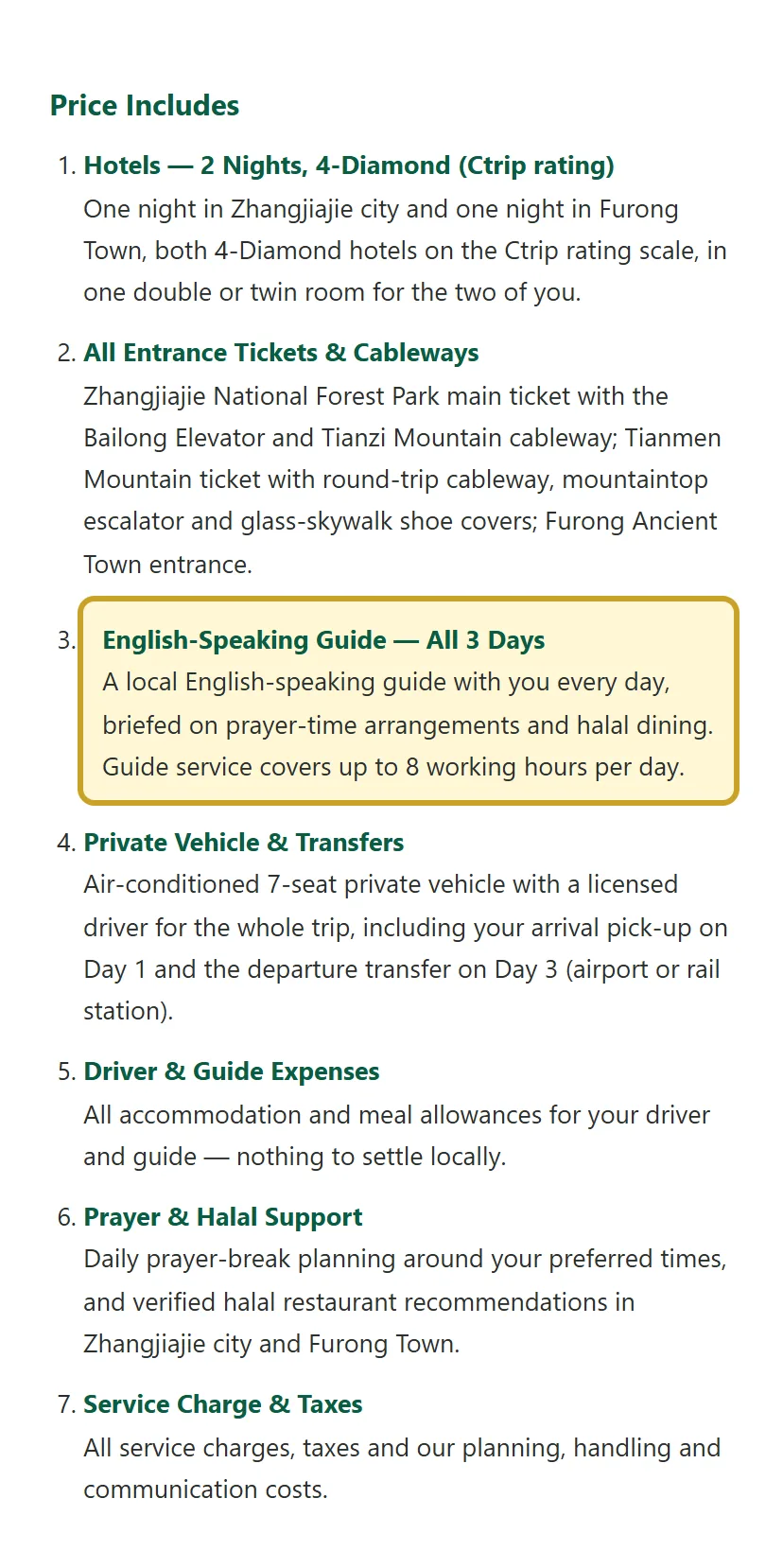
- A guide day is a working day, usually 8 hours, counted from hotel pickup or the agreed meeting point. Our quotes state it, and overtime runs ¥100–200 per hour depending on the city. If you’re picturing someone on call from breakfast to midnight, that’s not what the day rate buys — and an operator who doesn’t mention working hours at all is leaving you to find out mid-trip.
- A guide doesn’t need to come with a car. If you’re keeping costs down, the guide can meet you at the scenic area entrance and accompany you only for the sightseeing hours. We’ve booked exactly that for travelers who handled their own transport — including single-day, guide-only bookings with a small deposit, refundable up to 15 days out.
What does a guide cost per day?
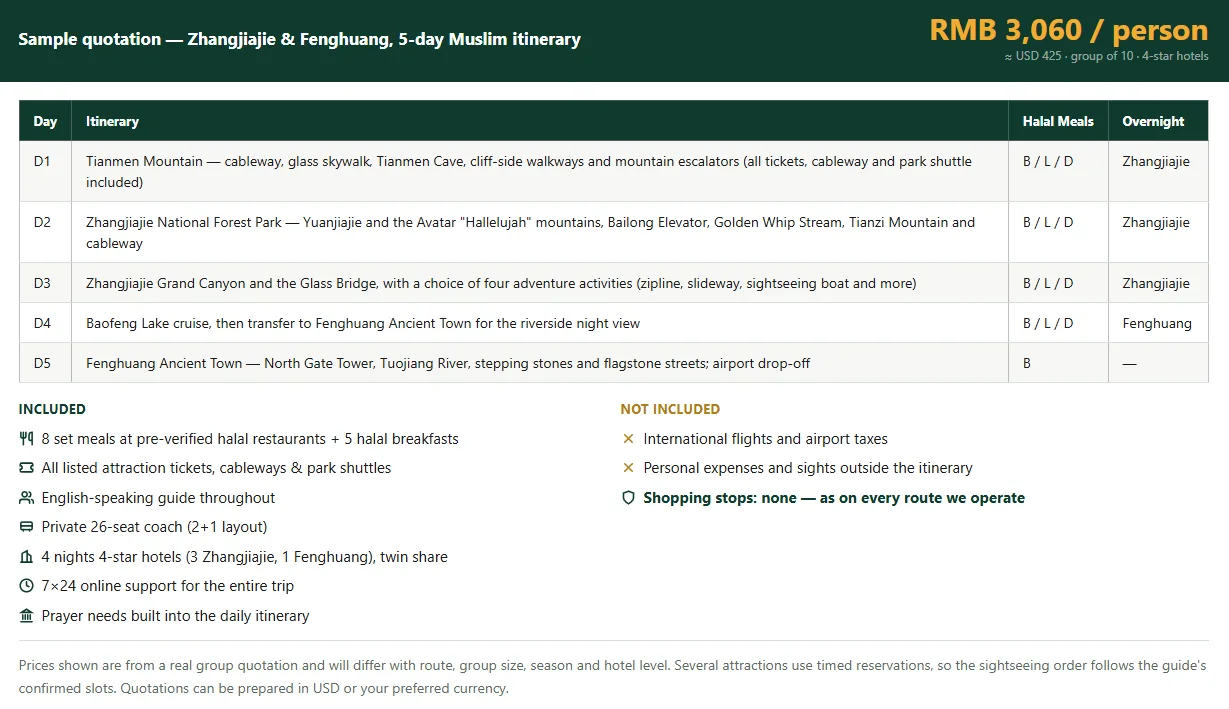
From our own 2026 quotes: around ¥600–800 per day in cities like Zhangjiajie, Chongqing and Chengdu, and around ¥800–1,000 per day in Beijing, Shanghai and Guangzhou — per group, 8-hour day, overtime extra. Split between six travelers, that’s roughly ¥100–170 a head per day; for a couple, three times that. The arithmetic of who pays what, and what else sits in a private tour quote, is a topic of its own — we’ve broken down a real quote line by line here, so we won’t repeat the full table.
The number worth remembering isn’t ¥600, though. It’s the per-day framing itself: because guides are hired by the day, you don’t have to decide “guide or no guide” for the trip — you decide it day by day. That’s where the real savings are, and it’s the subject of the next two sections.
What a guide actually does for a Muslim traveler
A common picture of a tour guide is someone reciting dynasty dates in front of a temple. If that were the whole job, we’d tell most travelers to skip it and read Wikipedia on the bus. Here’s what our guides actually spend their days on:
Keeping the halal plan real on the ground. An itinerary that looks fine on paper — park in the morning, old town in the afternoon — works for Muslim travelers only if lunch lands at a restaurant that’s genuinely halal and actually on the route, not 40 minutes off it. The guide is the person who holds that line during the day: times the walking loop so you reach the restaurant before the kitchen break, orders in Chinese and confirms with the kitchen what’s in the broth, and when a planned restaurant turns out closed, finds the verified backup — on one of our tours the team re-anchored lunch within about fifteen minutes. The verification itself happens before your trip (how we check certification and re-confirm is in our halal food planning guide); the guide is how it survives contact with a real day.
Making prayer fit the day instead of fighting it. A guide who knows your requirements plans the quiet gap — which stretch of the route has a clean, private spot, whether the afternoon cable car queue leaves room before Maghrib — rather than you negotiating it sight by sight. One honest note from the operator’s side: guides in China are not all Muslim, so this doesn’t happen by instinct. It happens because you tell us your requirements once, and we brief the guide and driver before day one.
On “can we have a Muslim guide?” — travelers ask us this straight, so here’s the straight answer. What we can guarantee is an English-speaking guide experienced with Muslim travelers. Where a Muslim guide is available for your city and dates, we’ll assign one. And before you confirm, we send you the actual guide’s profile — experience, languages — so you’re approving a person, not a promise. We’d rather confirm than over-promise.
Female guides are a real option, not a slogan: for women traveling alone, sisters’ groups and mother-daughter trips, we book female English-speaking guides, and we’ve delivered that multiple times this year. We’ll also tell you the limit honestly, because we hit it once: mid-trip, a family asked to switch to a guide who was both female and Muslim, and on short notice in that city we couldn’t source one. We talked it through, they kept the original female guide, and the trip went fine — but “any combination, any city, any date” is not a promise we’ll make. Ask early and we’ll confirm what’s actually available for your dates.
When you don’t need a guide — and when a driver is enough
Now the other direction. If we quoted you a guide for every day of your trip, we’d be padding the bill, so here’s the honest cut list we apply to our own quotes:
- Free city days in metro cities. Shanghai, Guangzhou, Chengdu — good metro, taxi apps work, major sights are self-explanatory. A wander-and-shop day needs no guide.
- Theme park days. Disneyland doesn’t get better with a guide standing behind you in the queue. Cut it.
- Repeat-visit cities. If you’ve done Beijing before and just want the Wall again, a car arrangement beats a full guide day.
Can the driver just guide you? Travelers ask us this a lot — usually as “can the driver walk me through, the way another company offered?” The honest answer: a driver-only day is a legitimate budget option and we quote it, but know what you’re buying. Most drivers don’t speak English. They’ll be on time, handle luggage, get you gate to gate — and that’s the product. A driver can’t phone a restaurant to confirm the broth is halal, can’t explain what you’re looking at, and can’t renegotiate the afternoon when a cable car closes. One more thing worth knowing: in China’s tourism industry, a driver who also guides is a defined professional role — a licensed driver-guide (司兼导, si jian dao) — and it requires its own qualification. So this is never just a question of whether a driver happens to speak English; it’s also about keeping the service legal and compliant, which is a line we hold. If a company tells you their driver “also guides,” ask two questions: in what language, and with what license.
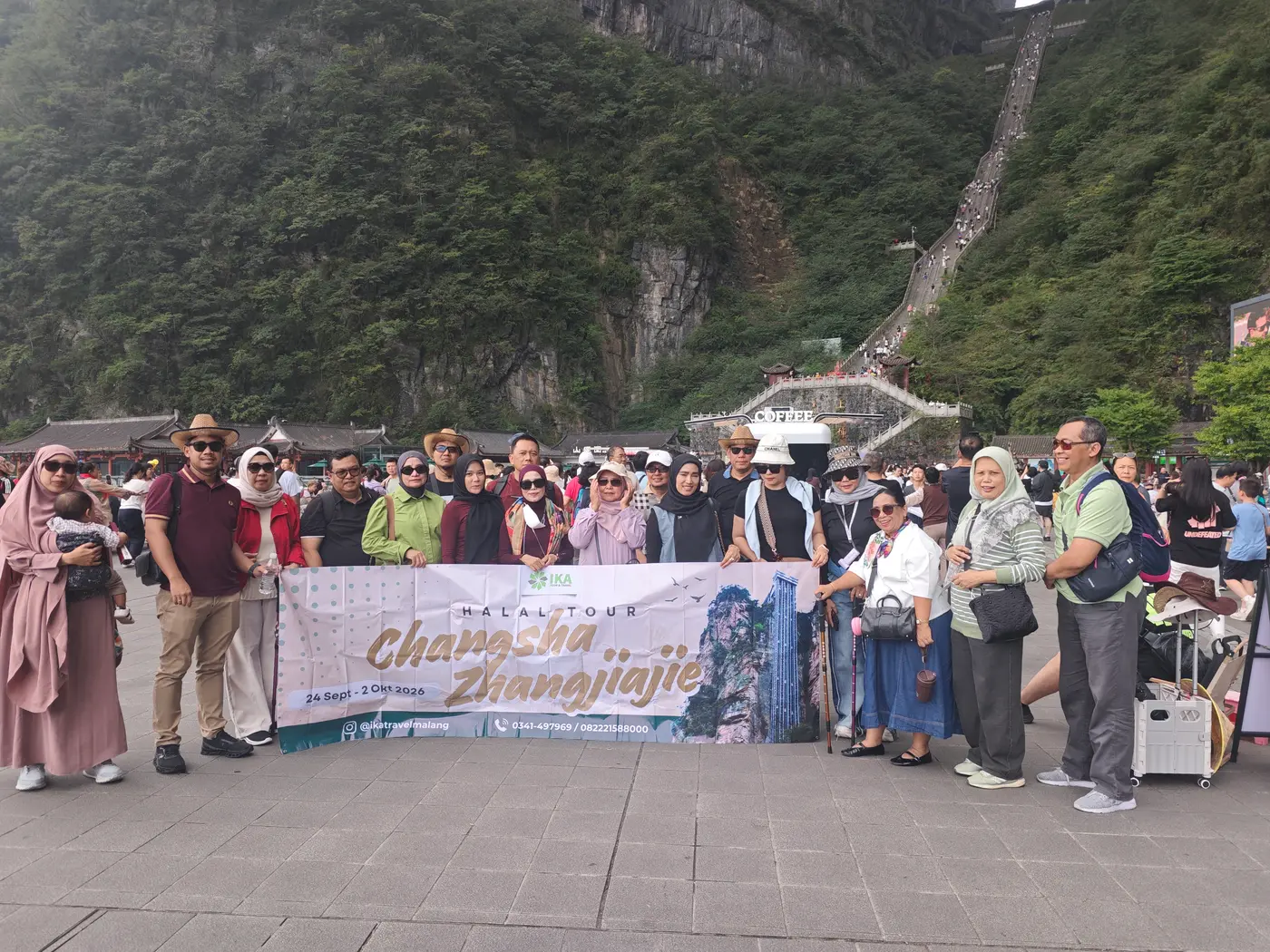
And the day we’ll defend keeping a guide: big-park days, Zhangjiajie being the clearest case. Inside the national forest park, the routing between Yuanjiajie, Tianzi Mountain and the cable cars decides whether you spend your day at viewpoints or in the wrong queues. And there is no halal food inside the park at all — the checked restaurants sit in Wulingyuan town and Zhangjiajie city — so the whole day has to be timed around eating before you enter, carrying a packed halal meal, or exiting at the right gate at the right hour. That timing puzzle is exactly what the guide is for, and it’s a day where the fee buys back more than it costs. If you’re weighing that trip, our Zhangjiajie DIY versus private tour comparison runs the full decision, and the current park ticket rules show why first-timers find the ticketing alone worth outsourcing.
What this looks like on a real trip. Take the route we’re asked about most — Shanghai plus Zhangjiajie, 8 days, a family with grandparents along. The way we’d mark it: arrival day, no guide (airport pickup only). Shanghai city day, no guide — metro and DiDi, with a halal restaurant list in hand. Disneyland day, no guide. Then Zhangjiajie: two park days with a guide and car (the routing, the meal timing, and a pace the grandparents can keep — shuttle instead of stairs, cable car instead of the long trail). Transfer-and-old-town day, guide rides along because it’s one driving line. Departure day, driver only. That’s three guide days out of eight — roughly ¥1,800–2,400 of guide fees at Zhangjiajie rates, instead of ¥6,000 or more for guiding every day of the trip at each city’s rate — and nothing about the halal plan is left to luck.
Tipping, languages, and the small print
Tipping. China has no tipping culture — restaurants, taxis and hotels don’t expect it. There’s a wrinkle, though: Chinese people who work with foreign visitors know that tipping cultures exist abroad, so guides and drivers hosting international guests often quietly hope for one. They won’t ask — soliciting tips is against the rules for licensed guides in China, and if anyone ever demands a tip from you, refuse. Tour operators sit under the same rule — forcing a tip into the bill isn’t allowed — yet in practice many quietly build an assumed tip, commonly $3–5 per person per day, into their price, and it has become something close to an industry default. We’re not part of that “many”: every charge in our service is a visible line, and our quotes carry no tip line, assumed or otherwise. Our rule on tipping is simple — no one on our team will stand at the van door expecting an envelope. If the guide and driver made your trip worth it and you want to tip, do; if you don’t, nothing is owed.
Who pays the guide’s costs? Group organizers ask us this. Within one city, the day rate is the cost — the guide’s lunch and transport aren’t your problem. On multi-day road routes where the guide travels with you, their room and meals are built into our quote as a stated line, not discovered later.
Languages. English-speaking guides we can provide in every city we operate — that’s a guarantee. Indonesian-speaking guides exist on our roster but are limited in number and need to be reserved well in advance, so ask early so we can confirm availability for your dates. A stable supply of Arabic-speaking guides we don’t have, and we won’t pretend otherwise — for Gulf travelers we run trips in English, and it has worked well.
Frequently asked questions
How much does it cost to hire a tour guide in China?
From our 2026 quotes: about ¥600–800 per group per day in cities like Zhangjiajie, Chongqing or Chengdu, and about ¥800–1,000 in Beijing, Shanghai or Guangzhou, on an 8-hour working day with overtime at ¥100–200/hour. The group splits it — it’s not per person.
Will the same guide travel with us between cities?
Normally no — guides are local, so each city has its own. The exception is one-car road routes like Changsha–Zhangjiajie–Fenghuang, where the same guide rides the whole line with you.
Can I hire a guide for just one day?
Yes. Single-day, guide-only bookings are normal — the guide can meet you at the site entrance, and you handle your own transport. We confirm these with a small deposit, refundable up to 15 days before the date.
Can I request a female guide?
Yes — for solo women, sisters’ trips and family groups we book female English-speaking guides and have delivered this repeatedly. Specific combinations (female and Muslim, in a smaller city, on short notice) depend on the city and date, so raise it when you first message us, not the week before.
Do we need to tip tour guides in China?
No. Tipping isn’t customary in China, soliciting tips isn’t allowed, and our quotes include no tip line — stated or hidden. If you choose to tip a guide who did well, it’s welcome — but it’s never expected or owed.
If you’re deciding which days of your route deserve a guide and which don’t, that’s literally a ten-minute job for us — send us your cities and dates on WhatsApp and we’ll mark the days where a guide earns the fee, the days a driver is enough, and the days you need neither. If the answer is “mostly neither,” we’ll tell you that too.