Last Updated on October 18, 2026 by Aaron Chen
“Could you arrange 3 family rooms for us? Three children will be sharing with adults — please confirm if extra beds can be provided.” I get a message like this almost every week. And before I build any Muslim-friendly itinerary, I ask my own hotel questions first: 4-diamond or 5-diamond on Trip.com? How do you want the rooms split? I ask early for two reasons. First, most Chinese hotels are laid out around the two-person room — in a 300-room hotel, family rooms might be less than a tenth of the inventory, often far less, and some hotels have none at all (the same goes for triple rooms). Second, we run private, custom trips for Muslim travelers, and no two groups have the same hotel needs — so when it matters, we ask rather than assume. What it all comes down to is bed math: matching room types to your group’s size and your family’s own rules, so that everyone sleeps in the right bed, with the right person. For a Muslim family, “the right person” is exactly where generic booking advice falls short — who shares with whom matters as much as how many beds there are. I build these room plans for a living; here is how I’d build yours.
The bed math: how we split a Muslim family across rooms
Start with the room types you’ll actually meet in Chinese hotels:
- Twin room: two separate single beds (usually 1.2–1.5 m wide) — narrower than the double beds Malaysian and Gulf travelers are used to at home, fine for one adult or an adult with a small child, tight for two adults. Designed for 2 guests, with breakfast for 2 included.
- King room: one large bed (usually 1.8–2 m wide) that genuinely sleeps two adults, or two adults and a baby. Designed for 2 guests, breakfast for 2.
- Family room: one 1.8 m bed plus one child-sized bed (1.2–1.5 m). Made for a family of three, breakfast for 3.
- Triple room: three separate single beds (1.2–1.5 m each) — a genuinely uncommon room type. Designed for 3 guests, breakfast for 3.
- There are others — presidential suites, themed rooms — but they’re outside today’s topic.
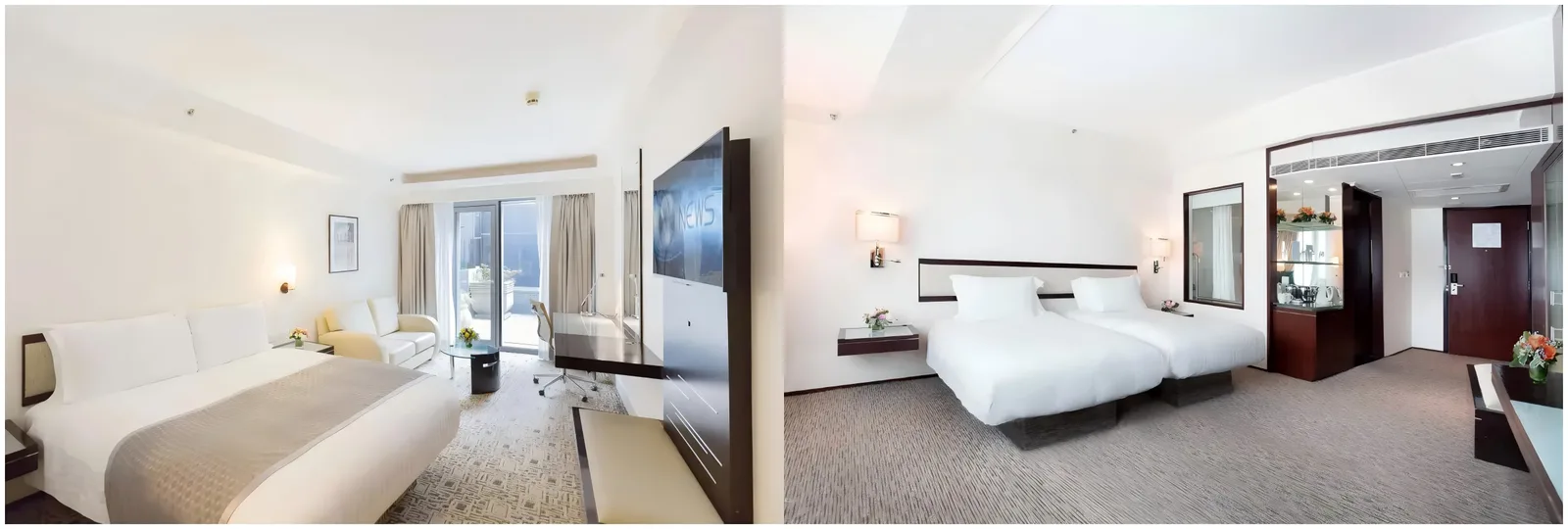
A question I keep seeing — “what is a twin bed in China?” — exists because booking sites translate 标间 (the standard twin) inconsistently. When in doubt, ask for a photo of the actual room type before paying.
Once you know the room types, decide the room mix and who sleeps with whom. This is the step OTA guides skip, and it’s where Muslim families have their own rules. The patterns we use most, worked out over many real bookings:
- Parents + a small child → one king room; a child sharing the parents’ existing bed adds no hotel charge. Hotels set their own age cut-offs for bed-sharing (some chains allow it up to 12), so confirm the line for your specific hotel when you book.
- A son past childhood → his own bed, and not in his mother’s or sisters’ room. Note that hotels won’t register an unaccompanied minor in a room of his own, so a teenage son pairs with dad, or two teen brothers share a twin room next to the parents.
- Grandmother traveling along → she usually wants quiet and her own space more than company. A twin room shared with an older granddaughter works well; ask for a lower floor near the lift, but not next to it.
- Sisters’ groups and women traveling together → twin rooms throughout, two per room, and we tell the hotel in advance it’s a female group so housekeeping and any room visits are handled accordingly.
An example: a six-person family — two parents, a 14-year-old son, daughters of 11 and 8, one grandmother. The sensible plan starts with one check: do the hotels in your destination city actually have family or triple rooms? If yes, take the family room first. If not, it’s three standard rooms: dad + son in a twin, mum + younger daughter in a king, grandmother + elder daughter in a twin. Everyone sleeps where they should.
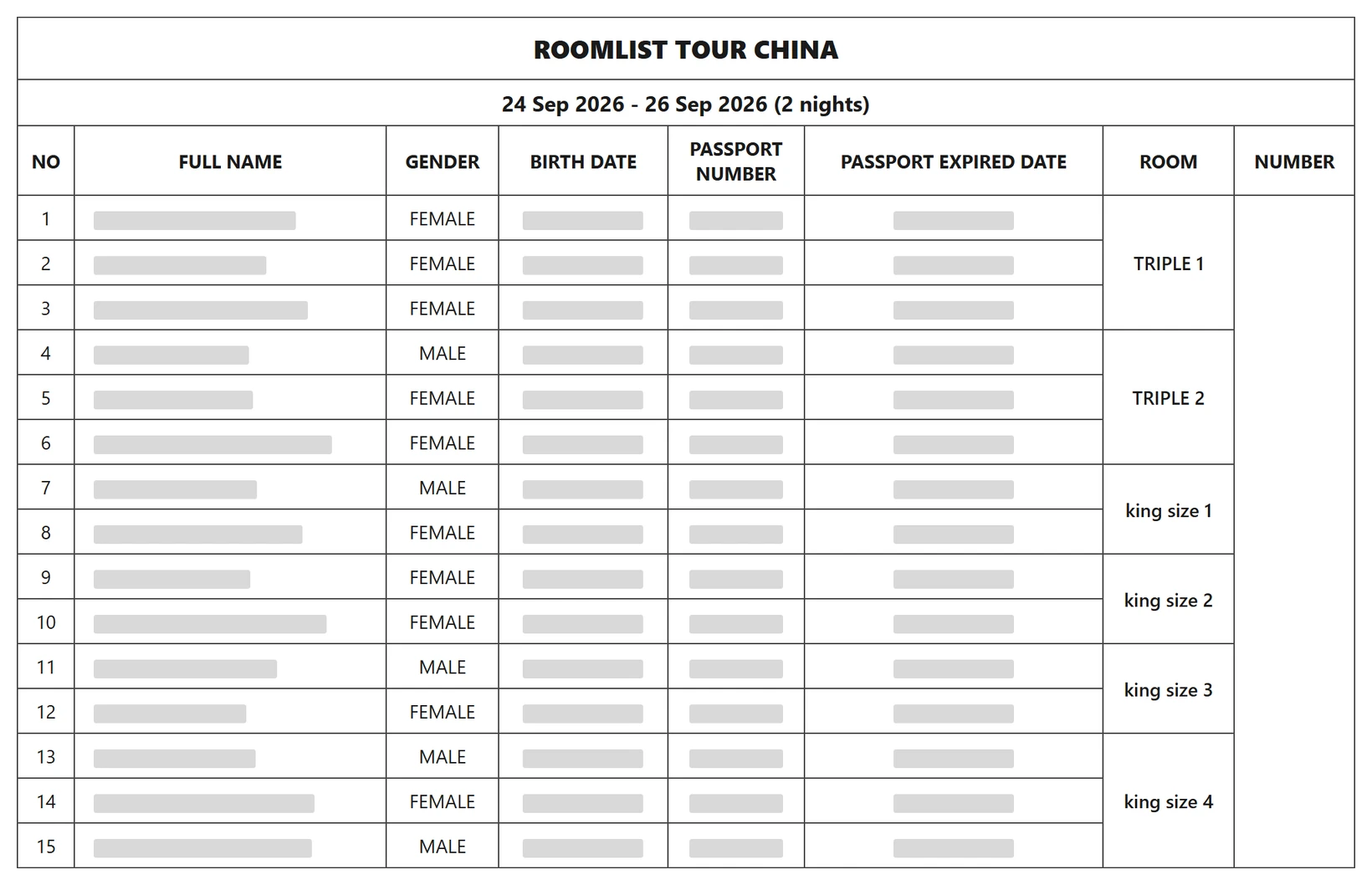
One rule to keep in mind: in China, every guest — children included — is registered by passport at the front desk. A declared child sharing your bed is completely normal; anyone who wasn’t registered will need to be added at the desk. So when you check in, bring the whole family’s passports with you.
One of our families reshuffled their room plan five times between first enquiry and final booking — every reshuffle changed the quote, because rooms, not people, are what hotels charge for. That booking taught us to put a who-sleeps-where table into the quote itself before any money moves. If you take nothing else from this article: write your own version of that table, then get three things confirmed by the hotel in writing — the exact bed configuration of each room, whether an extra bed is possible in that specific room type (many rooms physically can’t fit one), and what each child will be charged. “Extra beds available” on a listing page is a category-level statement, not a promise about your room.
What children actually pay
Hotel charges and attraction tickets follow different rules, and mixing them up is the single most common pricing confusion we untangle on WhatsApp.
At the hotel, the question is does the child occupy a bed? In our quotes the rule is: an infant under one travels free; a child who shares an existing bed with parents adds no hotel cost; a child who takes their own bed is priced as an adult. Put plainly: a child who doesn’t occupy a bed pays no hotel charge with us, and there is no such thing as a “child supplement.” Whenever a group includes children, we ask the extra hotel questions up front — experience usually tells us the answer already, but the point is that every line goes into the quote in writing, so you can see it and challenge it before any money moves. That line-by-line visibility is what to demand from whoever you book with — it’s the same transparency we argue for in our breakdown of what a private China tour actually costs.
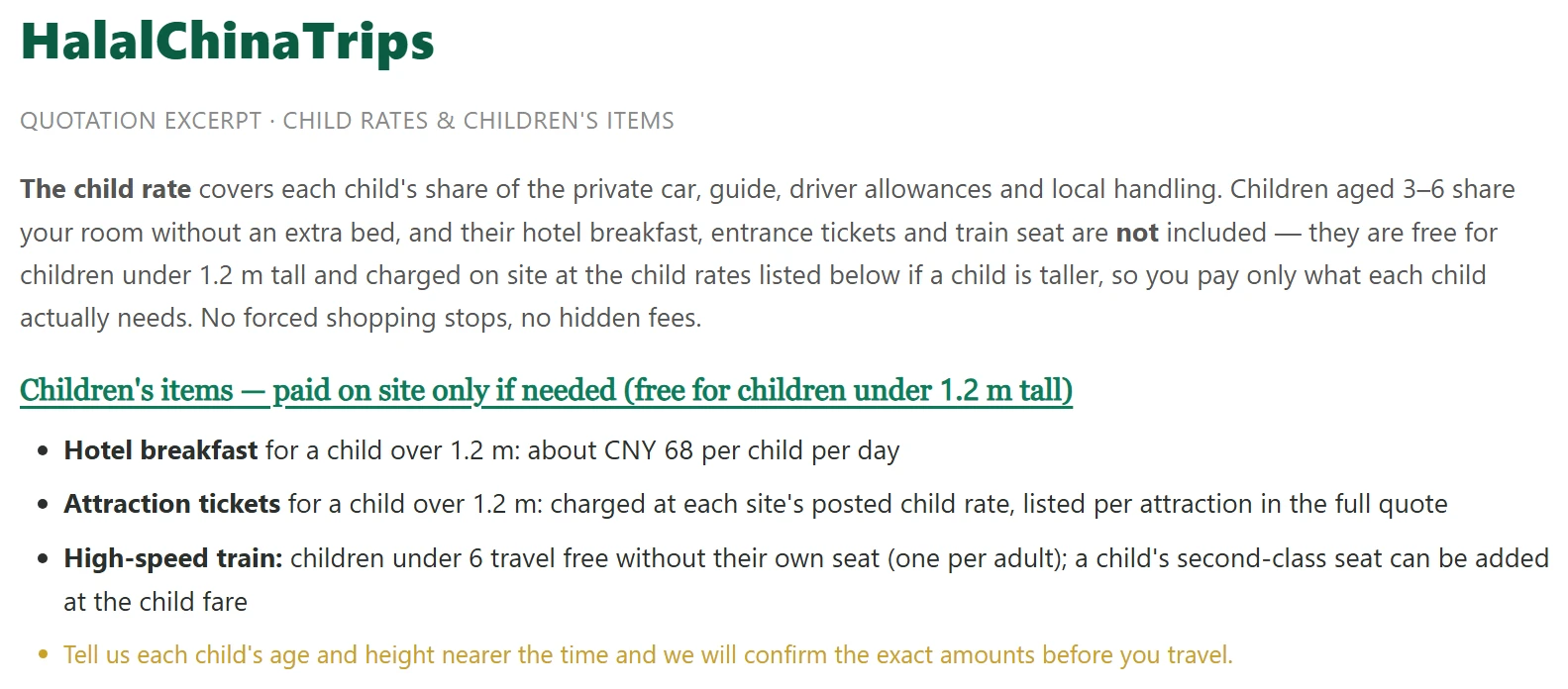
Breakfast is allocated by room type, not by headcount: king and twin rooms come with breakfast for 2, family and triple rooms with breakfast for 3. Extra breakfasts are usually charged separately — though a child who doesn’t occupy a bed and is under the hotel’s height line typically eats free. Small line, but multiplied across rooms and days it adds up; ask when you confirm the beds.
At attractions, bed math is irrelevant — Chinese scenic spots price children by height or age, with free and half-price bands that vary site by site. Many gates still measure height on the spot, but a growing number also accept age by passport — so a tall ten-year-old is worth arguing for, politely, with the passport in hand. Budget for child tickets rather than around them.
Understanding China’s hotel star (and diamond) ratings
Wherever you travel, hotels come with a star rating — China too. The difference is that China’s booking market runs through several big OTA platforms (Trip.com, Meituan and others), so there isn’t one rating system; there are several, side by side. For convenience, most Chinese tour operators — ours included — quote hotel levels in Trip.com diamonds. Which explains something you may have noticed: an operator calls a hotel “Trip.com 4-diamond,” you look it up on a foreign OTA, and it shows as 3-star. Different systems, different answers.
And an honest caveat: Trip.com is a commercial platform rating the hotels listed on it, so the grades carry some distortion. One of the criteria for 4-diamond status, for example, is having a gym — and a few hotels meet it by buying a handful of exercise machines and calling it done.
So diamonds alone won’t let you choose a hotel with full confidence. We’ve paid our own tuition on this: in our early days we picked a wrong hotel and the guests had a poor night. Our response was to move them to another hotel immediately at no charge, refund that night’s room cost, and blacklist the property. Choosing hotels well takes experience — it’s one of the quieter things you’re actually paying an operator for.
“Muslim hotels,” halal breakfast, microwaves, and washing machines: the honest answers
Start with the “Muslim hotel” question, because many travelers search for one: today’s China has no true Muslim hotels, only a small number of Muslim-friendly ones. That doesn’t mean other hotels won’t host Muslim guests — every hotel will.
Halal breakfast next, because it decides more than people expect. The straight answer: hotels with a genuinely halal kitchen are rare in China outside the northwest, and a hotel buffet that contains some safe items is not the same as a halal breakfast. At a typical buffet you can usually manage eggs, bread, fruit, and plain congee — but the hot dishes share the kitchen, so families who are strict simply skip it. Our way of handling this is upstream, when we choose the hotel: we treat walking distance to verified halal restaurants (certificate checked, then called, then re-checked before your trip) as a hard input, not a bonus, so breakfast can be a five-minute walk instead of a buffet gamble — it’s the same logic we applied street by street in our Guangzhou hotel-location guide, and our halal food in China overview explains how we verify the restaurants themselves. For the rest of the day’s meals — set meals, meal standards, and the days with no halal restaurant at all — see our guide to how halal meals work on a China tour.
Travelers from Malaysia often tell me they’re bringing ready-to-eat meals and ask if the room has a microwave. Standard Chinese hotel rooms have a kettle, not a microwave; the front desk can sometimes heat food, but don’t build your meal plan on it.
As for laundry: most hotels have a shared laundry room, and a few even put a washing machine in the room. Hotels also replace or sanitize everything after each checkout — the washing machines included — so this is not something to worry about.
Are there other types of accommodation?
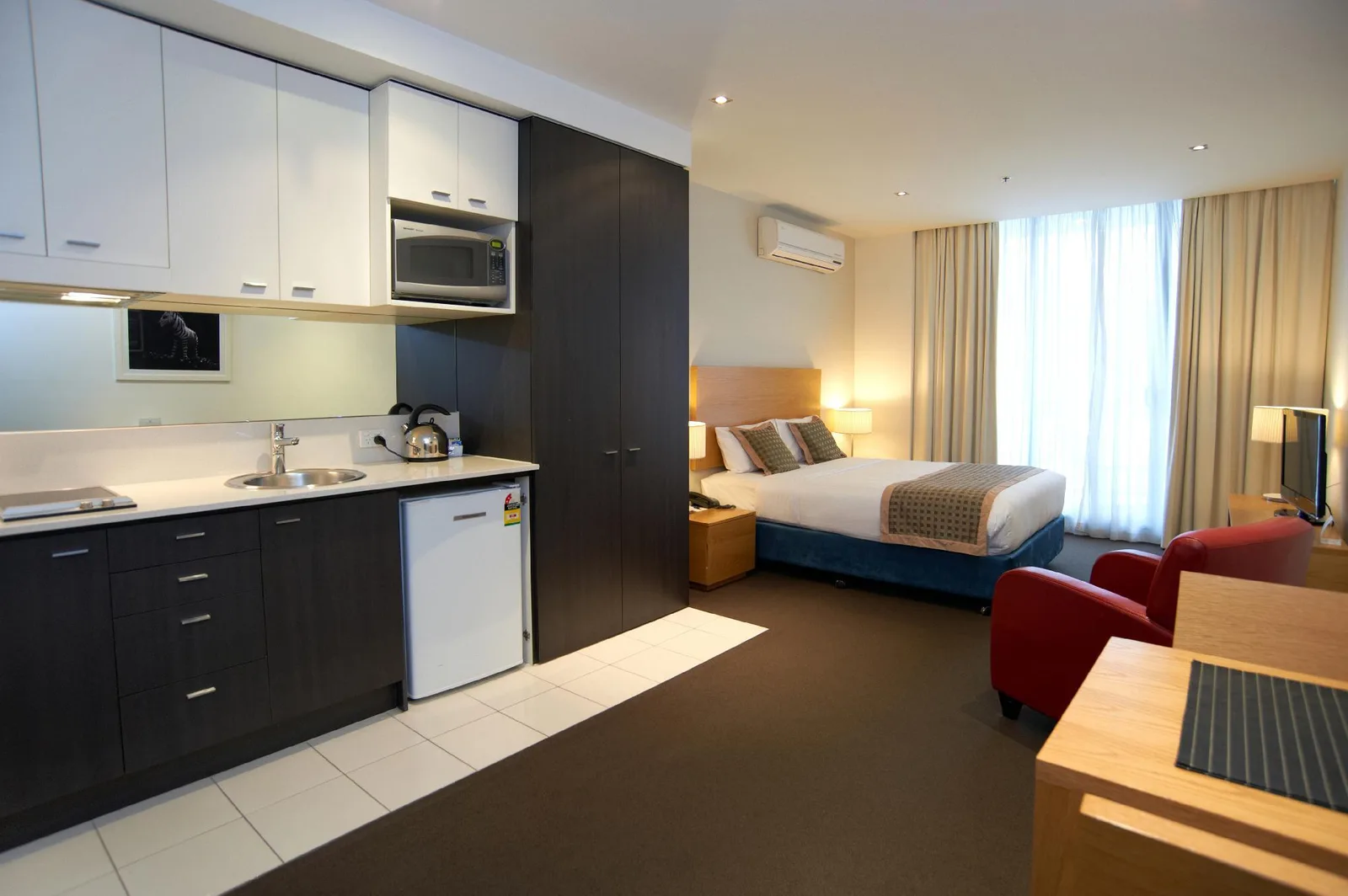
Yes — the serviced apartment (公寓式酒店): a kitchen, a washing machine, and enough bedrooms for six to eight people. You can cook your own meals and live much as you would at home. The trade-off is that these properties usually sit away from the city center — honestly, for a short trip they’re more hassle than help. But for a long stay with a slow, flexible rhythm, they’re a great fit. On my own travels in Yunnan, I once rented a whole courtyard house for exactly that kind of trip.
Quick answers (FAQ)
Is an infant free of charge?
In our quotes, yes — under one year old, no hotel bed, no seat, no charge. Confirm the same rule with whoever you book with.
Is 3 the maximum occupancy for all hotels in China?
No single national cap — each hotel sets a maximum per room type, and that number is enforced through the check-in registration, so it only works if everyone staying is declared. If you need a room for three, filter for it explicitly rather than assuming a third person can be added later.
I’m traveling alone. Can I share a room to halve the cost?
In a group departure, same-gender twin-share can sometimes be arranged, honestly subject to who else is on the trip. In a fully private booking there’s no stranger to pair you with — a single room is the realistic plan.
Do Chinese hotel bathrooms have bidets?
Often no, though newer high-end hotels increasingly fit smart toilet seats with a wash function. What you can count on everywhere is a handheld shower. Travelers who need washing facilities for istinja usually manage with the shower head or a portable travel bidet; if a bidet seat is non-negotiable, say so before the hotel is chosen, because it narrows the list sharply.
What time is check-out?
Noon check-out is the norm. If the day’s plan needs it, we apply for late check-out on your behalf and the hotel confirms on the day — an extension to 2 pm is the usual outcome.
The short version
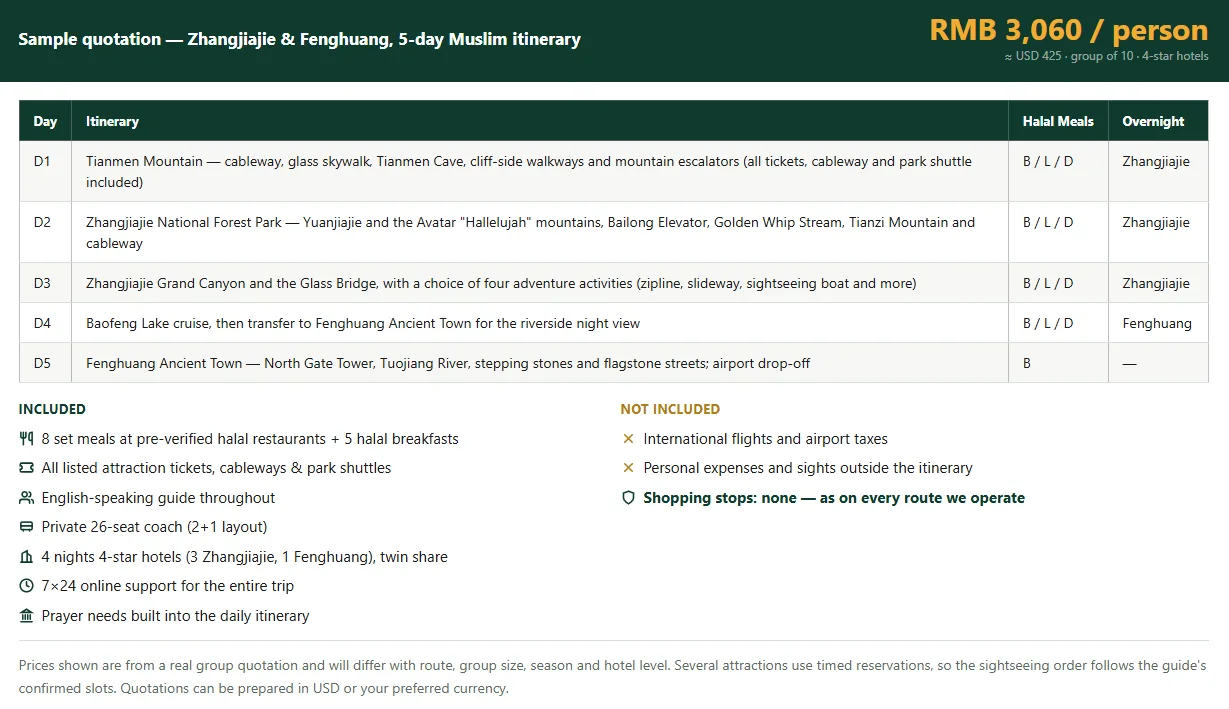
Learn the room types first, then do the bed math: check whether your destination’s hotels have family or triple rooms, take them if they exist, and split into standard rooms if they don’t — so everyone sleeps where they should. Before you pay anything, get three things confirmed in writing: bed configuration, extra-bed feasibility, and child charges. Diamond ratings are a reference, not a guarantee — choosing hotels well takes experience. If the hotels are part of a package — as they are in trips like our 5-day Zhangjiajie and Fenghuang itinerary — the room plan and the hotel vetting are the operator’s job, and they’re the first things worth testing an operator on: send us your family list and a good operator should come back with a who-sleeps-where table, not just a price.