Last Updated on November 19, 2026 by Aaron Chen
Scrolling through Facebook and TikTok, I noticed something interesting. When someone posts in a China travel group that they are planning a trip, comments and private messages start arriving straight away, and some of them come from people who say they are a Chinese travel agency or a guide. So how do you tell whether the one you are dealing with is a legitimate Chinese travel agency? A legitimate agency holds two documents you can check, a business licence and a travel agency licence, in the name of one registered company. It puts the price, payment schedule and cancellation terms in writing before you pay, and it takes your money only into an account in that same company’s name. Guests often ask us “who am I dealing with?” before sending a deposit, and it is the right question.
Below: three rules that stop most deposit scams, how to check an agency’s licences without reading Chinese, and how to pay once you are satisfied.
Three Rules That Stop Most Deposit Scams
- Ask for the documents before you pay. If anything feels unclear, ask the agency to send its business licence, its travel agency licence and a proforma invoice (PI). The PI should show the details of your trip and the payment details.
- Pay only the licensed company you are booking with. The bank account, or the payee on a payment QR code, should carry the same company name as the agency’s licences and your invoice.
- Trust bank details only from the agency’s official channels. If payment details arrive from a new number or email, or someone tells you the account “has changed”, stop and check with the agency on the channel you already know.
At HalalChinaTrips, payment details only come from our official WhatsApp (+86-19118612939), email from info@halalchinatrips.com, or the group chat we set up with you. The money goes to a company account, and so do the Alipay and WeChat Pay QR codes we send.
Part 1: How to Check a China Travel Agency
Ask for two documents
- Business licence (营业执照). It shows the company is registered, and it carries an 18-character company code (the Unified Social Credit Code).
- Travel agency licence (旅行社业务经营许可证). Chinese law requires a travel agency to hold one before it can operate. It is issued by the provincial culture and tourism department, or a city bureau acting on its behalf, and the number starts with “L-” followed by a province code. For a trip inside China, the business it covers should include inbound tourism (入境旅游).
Ask any agency for both, including us. A real agency sends them without fuss.
Check them, even if you don’t read Chinese
- The company: search the company name or its 18-character code on the National Enterprise Credit Information Publicity System (gsxt.gov.cn). It is free and official, but only in Chinese, with a captcha. The registration status should read 存续, not 注销 (cancelled) or 吊销 (revoked).
- The travel licence: China’s tourism ministry advises travelers to check an agency’s name and licence on its 全国旅游监管服务 platform, which has a WeChat mini program with an agency search (旅行社查询). It is also in Chinese.
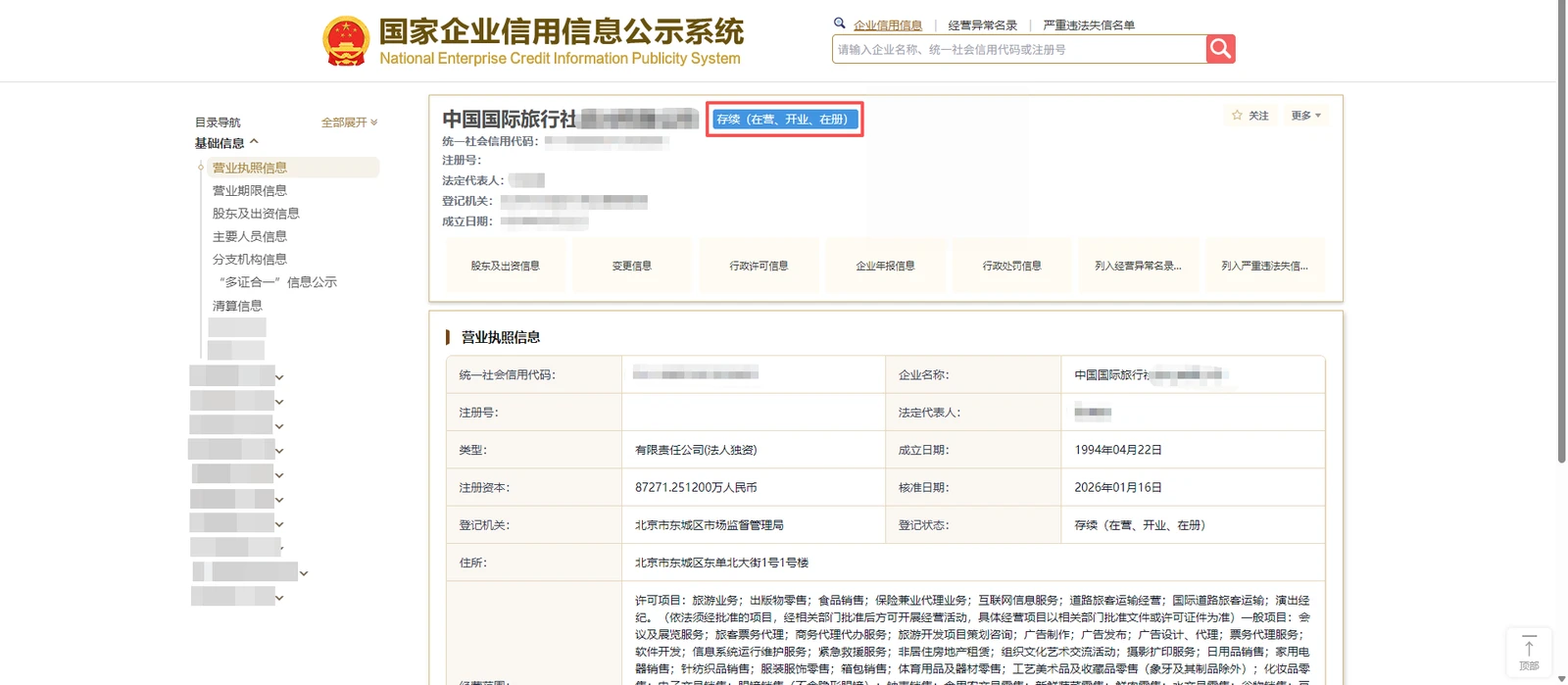
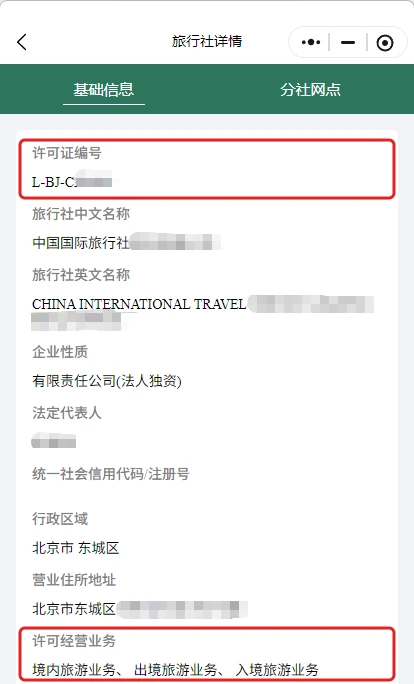
To get the Chinese name into a search box, use your phone’s text recognition on the licence photo (Live Text on an iPhone, Google Lens on Android) and copy it. If you have a friend or colleague who reads Chinese, ask them to confirm three things:
- The company on the licences shows up on gsxt.gov.cn under the same name, with status 存续.
- The travel agency licence shows up in the ministry’s agency search under the same name.
- The company on your invoice and bank details is that same company.
One company name on everything
Many agencies sell under a brand or website name, and that is normal. What has to match is the registered company: the licences, your contract, your invoice and the bank account you pay should all show the same company. If the account is in a different company’s name, or a person’s name, ask why before you pay.
What the licence does for you
A licensed agency must keep a quality-guarantee deposit, held in a designated bank account or as a bank guarantee, that can be used to compensate tourists if the authorities find the agency broke its contract, or if it closes and prepaid fees are lost. It is a safety net, not a quick refund: claims go through the Chinese authorities. An unlicensed operator has nothing like it behind it. It is one of the ways China protects travelers’ rights.
What we do when guests ask
Guests ask us “May I know whom I’m chatting with?”, or ask for our business registration and travel agency licence before they pay, and we send them. When a guest asked us whether a cheaper agency they had found was legitimate, we suggested asking that agency for the same two licences.
Checking the company is half the job. Whether its trips are really Muslim-friendly (halal meals, prayer time, no shopping stops) is a separate check: take our five questions to ask any tour operator before you pay.
Part 2: How to Pay Safely
What you get before and after the deposit
At HalalChinaTrips, the full process is:
- A written itinerary and quote. Before any deposit, we write an itinerary and quote around what you need, change it as you give feedback, and add our own advice where it helps. We only move to the next step when both sides are happy with it. Planning and quoting are free.
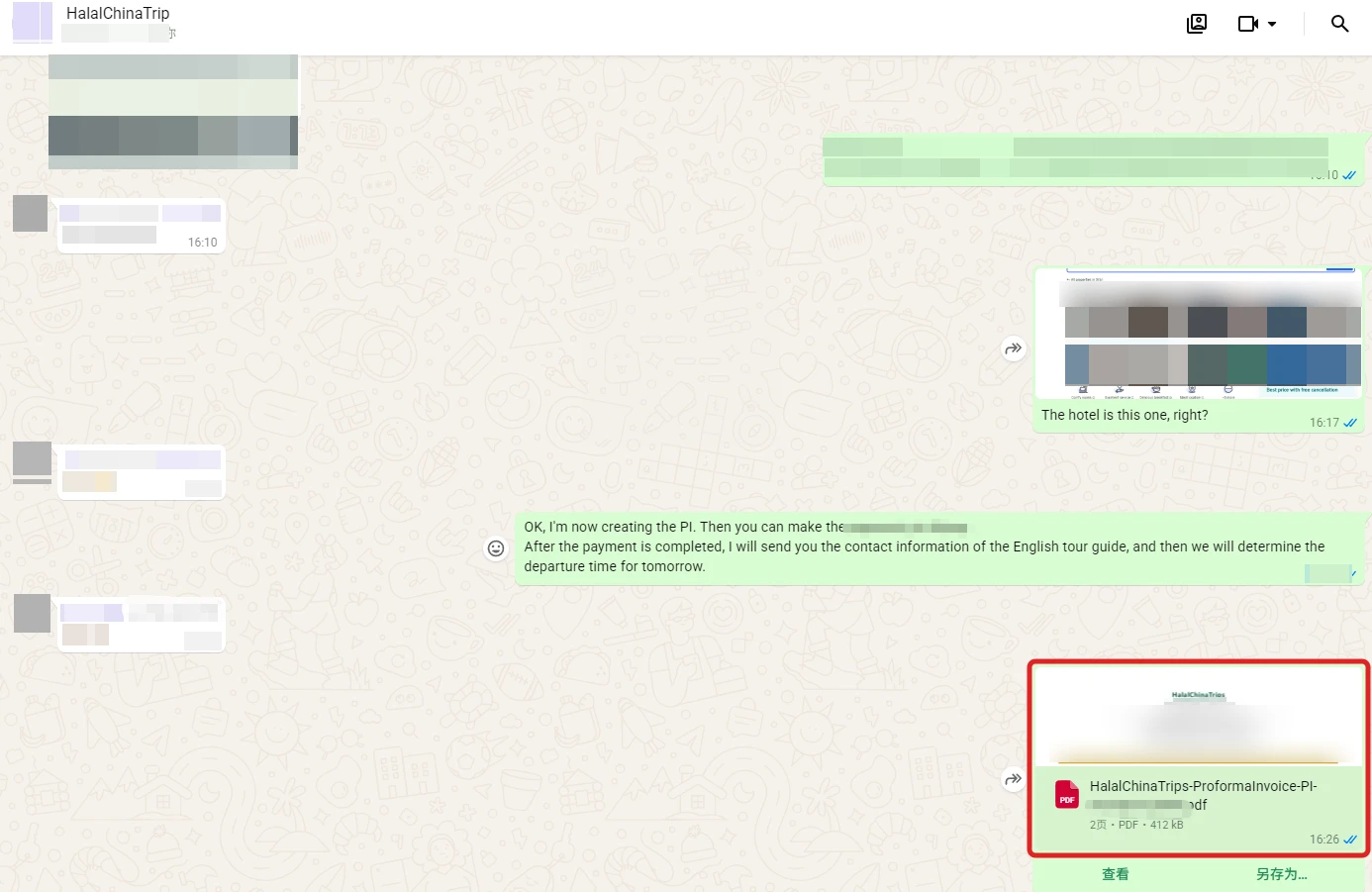
- A proforma invoice (PI) with the details of your trip, our bank details, the payment schedule and the cancellation terms. It sets out the terms of the booking itself: what you pay, when, and what happens if you cancel. You have it before paying anything.
- Your deposit confirms the trip.
- We ask for traveler details. Once the trip is confirmed and the deposit is paid, we ask for each traveler’s full name, passport number, gender, date of birth and passport expiry date, and you can send a photo of each passport’s information page instead. We use these details only for your bookings, such as hotels, train and attraction tickets, and insurance. We take your privacy seriously.
- You sign the travel contract. It is the standard travel contract issued jointly by China’s Ministry of Culture and Tourism and its market regulator for use nationwide, and it sets out everything about your trip. It covers the trip itself, and we attach an English translation so you can follow every clause. Its payment and cancellation terms are the same as your invoice.
- The balance is paid before you travel, by the date on your invoice.
- A receipt for every payment. To be honest, I have occasionally forgotten to send one, and that was my own mistake. If a receipt hasn’t reached you, remind me.
The full booking steps are on our Plan My Trip page.
Bank transfer in five steps
With your banking app open:
- Add us as a company or business recipient, not as a person.
- Copy the recipient name, account number and SWIFT code exactly as they appear on your invoice.
- Send the currency and amount shown on the invoice.
- In the reference box, write “Tour deposit” and your name.
- Send us a screenshot of the confirmation on WhatsApp.
When the bank form doesn’t cooperate
- It asks for a Chinese ID number. You are in a form for paying a person. Choose a business or company recipient, or your bank’s standard international transfer (often called a SWIFT or telegraphic transfer).
- The recipient name doesn’t fit. Don’t shorten it yourself, because a name that doesn’t match can hold up the transfer. Message us first. One guest whose app stopped at 35 characters paid from a bank branch instead; another sent US dollars through Wise. Both payments arrived.
- The app shows a different city. If the SWIFT code on your invoice ends in XXX, it is the bank’s head-office code, so your app may show the head office’s city. The head office routes the payment to the branch that holds our account. Keep the code exactly as written.
- It arrives a little short. With SHA or BEN, banks along the way can take their fees out of the payment, and even with OUR a small fee is occasionally taken. Don’t send a second transfer for the difference: we usually cover the shortfall or the fee ourselves, so there is nothing to chase.
- There’s a limit or a wait. Raising a transfer limit or adding a new recipient can take time; two of our guests’ banks each made them wait 12 hours. Check a few days before the deposit is due. Even so, in our view payment is the simplest step of the whole process, and we will sort it out with you whenever it suits you.
Alipay or WeChat Pay
We can send you a payment QR code. Link your card to the app first. Foreign cards are usually charged 3% on any payment above ¥200, so check the fee the app shows before you confirm. Foreign cards also have a per-payment cap, so a large group deposit may need a bank transfer instead.
The same payment apps are how you will pay for most things during the trip; how to pay in China as a tourist walks through setting them up.
Frequently Asked Questions
What if we have to cancel because of illness or a visa refusal?
The cancellation terms on your proforma invoice decide it, and you have them before you pay. If something is a real risk for your group, such as an elderly parent’s health or a visa that might be refused, raise it when you get the quote and get the answer for your dates in writing. Travel insurance bought at home that covers trip cancellation is worth considering too, especially with an older parent travelling.
What currency will I pay in, and can the amount change?
Our prices are set in Chinese yuan. Your invoice shows the deposit in the currency to send. If you pay in another currency, the amount in that currency follows the exchange rate on the day you pay, which is why we confirm the exact balance amount before it is due. If you would rather send ringgit, Singapore dollars or yuan, ask us first, because the account on your invoice may not accept another currency.
Who can I complain to if something goes wrong?
Start with the agency. If that fails, complaints about a travel agency go to the local culture and tourism authorities, usually through the city’s 12345 government service hotline. Whether English is available depends on the city.
Will anyone ask me for money during the trip?
Not for anything in your quote. Everything it includes is paid before you travel, and nobody on the trip should ask you to pay for it again. If someone does, message us.
Before You Pay
If anything doesn’t add up, whether it is a licence, a company name or a field in your banking app, send us a screenshot on WhatsApp before any money moves. Checking it together costs nothing. A second transfer to fix the first one costs you another bank fee.