Last Updated on October 6, 2026 by Aaron Chen
Picture your first dinner in China: a small family-run halal noodle shop, steam on the window, a menu that is a QR code taped to the table, and a cashier who has never seen a foreign bank card. This is the moment most payment guides skip — and it is exactly where your trip either runs smoothly or gets awkward. The short version: set up Alipay with your Visa or Mastercard before you fly, add WeChat Pay as a backup, and land with CNY 300–500 in small notes for the places apps cannot reach. If your visa or visa-free entry is already sorted, payment is the next thing to prepare — and it usually takes about twenty minutes, done from your sofa at home.
This guide is written for the places where Muslim travelers actually spend money — halal noodle shops, night-market grills, family kitchens near mosques — not just the tourist-zone hotels and chain stores that other guides focus on. Those small eateries are the least card-friendly places in the country, and the gap between a generic payment guide and what you actually need is wider than most travelers expect.
Why China Runs on QR Codes — and What That Means for You
Nearly 90% of in-person transactions in Chinese cities happen through mobile payment apps. The shift happened years ago: shops stopped installing card terminals, ATMs thinned out, and even roadside fruit sellers went QR-only. For locals this is invisible — everyone has Alipay or WeChat Pay linked to a Chinese bank account. For visitors it means three things:
- Your physical card is nearly useless on the street. International Visa and Mastercard terminals exist at airport shops, international hotel front desks, and some large department stores. Outside those places — which is where you will eat, shop, and travel — there is no terminal to swipe or tap.
- Cash works but creates friction. Renminbi notes are legal tender and shops must accept them, but many staff have not made change for a cash customer in weeks. Small vendors genuinely struggle to break a 100-yuan note, and some automated systems (metro ticket machines, bike-share locks, vending machines) have no coin slot at all.
- The apps are your access layer. Since 2023, both Alipay and WeChat Pay let foreign visitors link an overseas Visa, Mastercard, or other international card directly — no Chinese bank account, no Chinese phone number. This removed the old barrier completely. What remains is setup, which is the purpose of the next two sections.
Alipay or WeChat Pay — Which Do You Need?
Both. But not equally. Here is a practical comparison to set expectations before you download anything:
| Alipay | WeChat Pay | |
|---|---|---|
| Primary role for visitors | Your main payment app | Your backup |
| Foreign-card support | Visa, Mastercard, Amex, JCB, Discover, Diners Club, UnionPay Intl | Visa, Mastercard, Amex, JCB, Discover, Diners Club, UnionPay Intl |
| Identity verification speed | Usually instant to a few minutes; can take up to 1–3 days in rare cases | Usually seconds |
| English interface | Full English — default for international registration | English available but some wallet features default to Chinese |
| Extra utility | DiDi ride-hailing, metro QR codes, train tickets, food delivery — replaces 3–4 separate apps | Messaging (WeChat is China’s main chat app), some transit codes |
| Merchant coverage | Accepted nearly everywhere | Accepted nearly everywhere, some small shops WeChat-only |
| Fee threshold | 0% at/under CNY 200; 3% on full amount if over | 0% at/under CNY 200; 3% on full amount if over |
The reason Alipay goes first: its international-visitor experience is more polished, the English interface is cleaner, and the integrated services (transport, tickets, delivery) make it a one-stop tool. WeChat Pay is the backup that covers the minority of shops displaying only a WeChat code, and gives you a second option when one app has a bad day — a declined card, a stuck verification. Carrying both costs nothing.
Setting Up Alipay: Complete Walkthrough
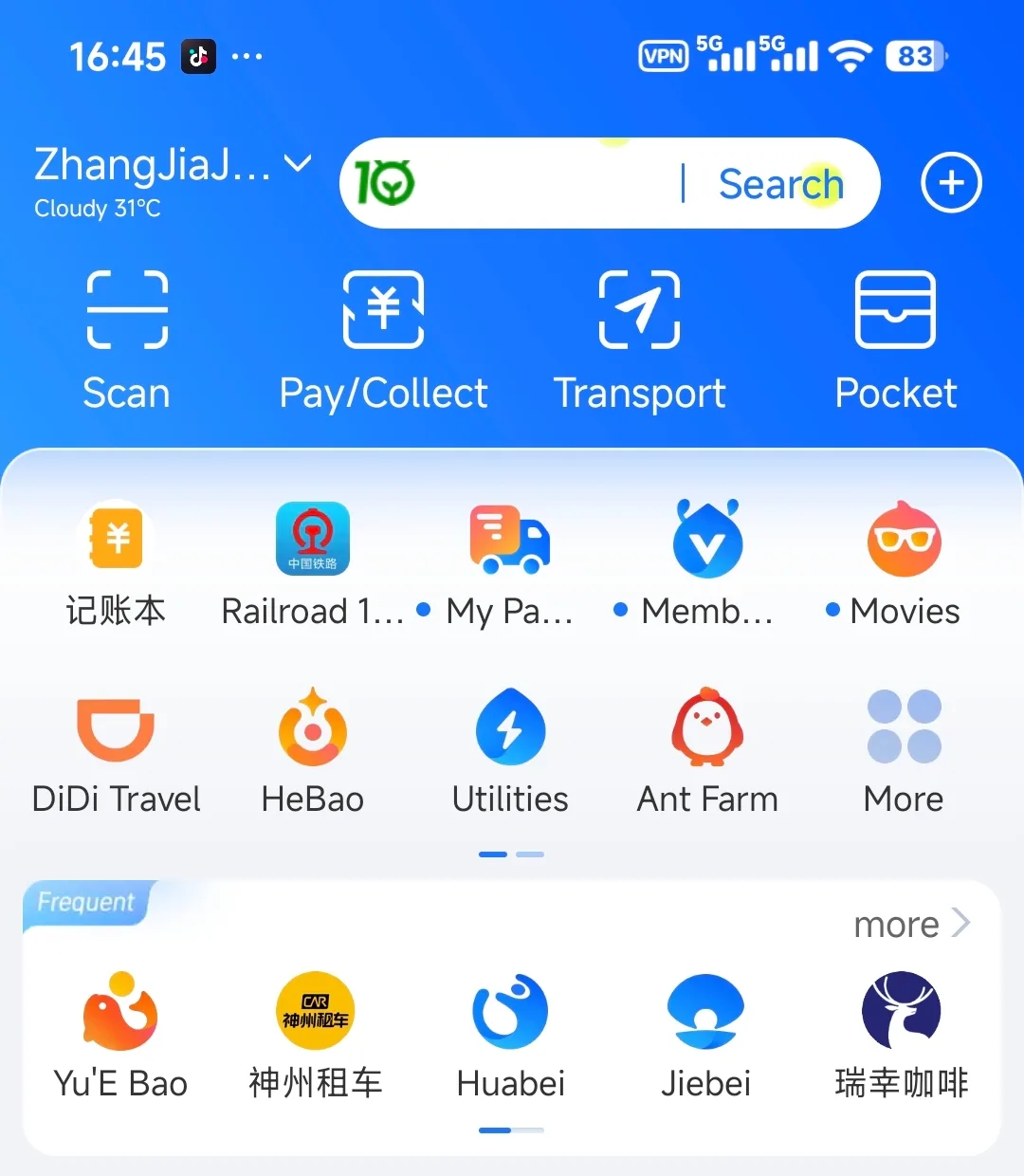
Do this at home, not at the arrivals hall. Registration involves a verification code and an identity check, both easier on your home Wi-Fi with your usual phone number working normally. The whole process takes about ten minutes.
Step 1: Download and Register
Search “Alipay” in your App Store (iPhone) or Google Play (Android) and install it. Open the app, choose your country code, enter your overseas mobile number, and verify with the SMS code it sends. No Chinese number needed — your Malaysian, Indonesian, Saudi, British, or any other number works.
Step 2: Complete Identity Verification
The app will prompt you to verify your identity using your passport. This involves uploading a photo of your passport’s data page and taking a selfie for facial recognition. Follow the on-screen prompts — it is straightforward. In most cases, verification completes within a few minutes. Occasionally it takes longer (up to 1–3 business days), which is the main reason to do this before your flight, not the morning of.
Once verified, your Alipay transaction limits increase to USD 5,000 per single transaction and USD 50,000 per year — more than enough for any tourist trip. (WeChat Pay’s published limits are similar in principle but may be stated in CNY and vary by verification level; in practice, both apps handle normal tourist spending without hitting a ceiling.)
Step 3: Link Your Bank Card
Go to “Me” → “Bank Cards” → “Add Card”. Enter your card number, expiry date, CVV, and billing details. Alipay accepts Visa, Mastercard, American Express, JCB, Discover, Diners Club, and UnionPay International. The app may send a small authorization hold (often $0 or $1) to your card — this confirms the link and drops off your statement within days.
Link two cards from two different banks. If one card gets blocked by the issuing bank’s fraud detection (common on first use in China), the second card keeps you paying. This is the single most useful preparation step and costs you nothing.
Step 4: Test Your Setup
Tap “Pay/Receive” on the home screen. If your payment code (a barcode and QR code) loads successfully, you are ready to pay in China. You cannot complete an actual purchase from outside China, but seeing the code means the wallet is active and the card is linked.
Step 5: Tell Your Bank
Call or message your bank before departure and tell them you will be making payments in China through Alipay. Without this, your bank may block the first transaction as suspicious — the charge appears as a Chinese merchant, which triggers fraud alerts on cards that have never transacted in China. This five-minute call prevents the most common payment failure travelers experience.
Setting Up WeChat Pay: Complete Walkthrough
WeChat Pay lives inside the WeChat messaging app. If you already use WeChat to communicate, you are halfway there; if not, install it for its wallet, not its chat.
Step 1: Download WeChat and Register
Install WeChat from your app store and register with your overseas phone number. The app will ask you to set a display name and profile photo. Registration itself is quick.
Step 2: Open the Wallet
Go to “Me” → “Services” (some versions show “Wallet” or “Pay”). This opens the payment section. If you do not see this option, update the app to the latest version — older versions may not show the wallet for international users.
Step 3: Link Your Card
Inside the wallet, tap “Cards” → “Add Card”. Enter your international card details. WeChat Pay accepts Visa, Mastercard, American Express, JCB, Discover, Diners Club, and UnionPay International. You will be asked to complete real-name verification with your passport — similar process to Alipay, but WeChat’s verification typically completes in seconds.
Step 4: Confirm the Link
WeChat may send a small test charge to your card. Once confirmed, your payment code becomes active under “Pay” → “Payment Code” on the main screen.
The same advice applies: link a second card, and notify both banks about China travel. WeChat Pay has the same fee structure as Alipay (0% under CNY 200, 3% above), so there is no cost difference between the two apps.
How QR Code Payments Actually Work
Every QR payment in China follows one of two patterns, and knowing which one to use at a given counter saves you from the blank stare:
Pattern 1: The Shop Scans You (Most Common at Counters)
Open Alipay or WeChat Pay, tap “Pay”, and your personal payment code appears — a barcode on top, a QR code below. Hold it up to the cashier. They point a handheld scanner at your screen, the amount deducts from your linked card, and you get a confirmation buzz. This takes about three seconds and is the standard method at any shop with a scanner — restaurants, convenience stores, supermarkets, ticket counters.
Pattern 2: You Scan the Shop’s Code (Common at Small Vendors)
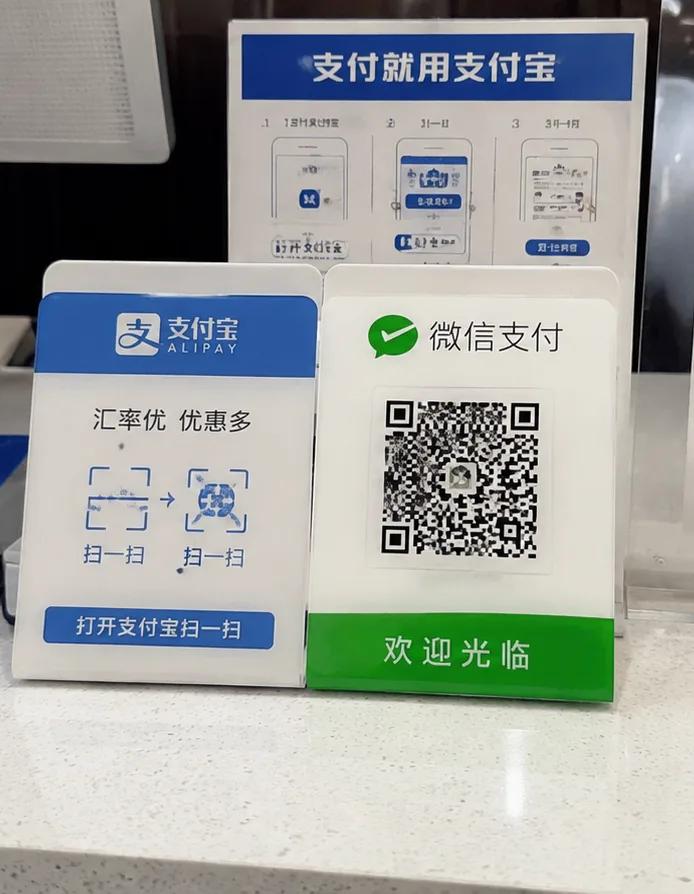
The shop displays a printed QR code on a stand, sticker, or card. You open Alipay or WeChat Pay, tap “Scan”, point your camera at their code, type the amount the vendor tells you, confirm, and show them the green success screen. This method is common at street-food stalls, market vendors, and small shops that do not own a scanner.
The Merchant Code vs. Personal Code Trap
This is the detail that generic payment guides never mention, because their writers never eat where you will eat. Many small halal places — Lanzhou-style noodle shops, family kitchens near mosques, night-market grills — collect money through a personal transfer code rather than a registered merchant code. Foreign cards inside Alipay and WeChat Pay work for merchant payments only; they cannot send personal transfers. So you scan, the app refuses or the shop never receives it, and everyone is confused.
Nothing is broken — the shop’s code and your card simply speak different systems. You can tell the difference by what happens after you scan: a merchant code shows the shop’s registered business name and asks for the amount; a personal code shows an individual’s name and a transfer screen. When you see the transfer screen, stop — it will not work with your foreign card. Pay cash.
This is the single most common payment failure among the travelers we brief, and it is why the cash in your pocket is halal-food insurance first and everything-else insurance second.
Fees, Limits, and How to Keep Costs Down
You will read conflicting fee claims online, including from big-name travel sites. Here are the current rules — the fee exemption under CNY 200 is confirmed by the Beijing municipal government’s payment-services portal — and note the currency carefully: the fee threshold is in yuan, the limits are in US dollars:
| Rule | Number | What It Means Day to Day |
|---|---|---|
| Service fee on foreign cards | 0% if the transaction is CNY 200 or under; 3% on the entire amount if it exceeds CNY 200 | A CNY 45 noodle lunch: no fee. A CNY 300 restaurant bill: CNY 9 fee (3% × 300) |
| Single transaction cap | USD 5,000 equivalent | Covers any normal tourist purchase |
| Annual cap | USD 50,000 equivalent | Not a practical limit for a holiday |
The CNY 200 threshold (roughly USD 28) is the one to remember, because most of a traveler’s daily spending sits under it: a bowl of beef noodles runs CNY 15–40 depending on the city, a taxi across town CNY 20–40, most single attraction tickets CNY 60–250. In practice the 3% touches your hotel bills and big group dinners, not your daily food money.
Four Ways to Minimize Fees
- Let single transactions stay under CNY 200 where natural. Most meals and tickets already are — you do not need to engineer this.
- Pay hotels through your booking platform. Hotels booked on international platforms (Booking.com, Agoda, Trip.com) settle in your own currency, bypassing the 3% entirely.
- Split large group meals. A CNY 800 dinner for eight people can be split into sub-CNY 200 payments at the counter — ask the cashier before doing this rather than surprising them.
- Check your home bank’s foreign-transaction fee. Some banks add their own 1–2% FX fee on top. If yours does, consider linking a card with zero foreign-transaction fees — many travel credit cards offer this.
On an organized trip, the large-ticket items — hotels, entrance tickets, intercity transport, pre-arranged meals — are settled by the operator before you arrive. The 3% fee only touches what you buy independently, which for most travelers is snacks, drinks, souvenirs, and the occasional self-found restaurant.
Cash: How Much to Bring and Why It Still Matters
Bring CNY 300–500 per couple or small family, in notes of 100 or smaller, and treat it as your safety layer, not your spending money. That number comes from watching our own guests: the ones who exchanged large sums at home ended the trip re-exchanging it at a loss, while the ones who landed with nothing hit at least one moment where a phone was dead, a network was slow, or a scan failed at a food stall.
Cash is also protected in a way visitors do not expect from “cashless China”: refusing renminbi cash is against the rules, and a national regulation that took effect on 1 February 2026 tightened this further — businesses must accept cash and may not attach discriminatory conditions to it. A stall holder may look surprised at a 100-yuan note, but they cannot turn it away.
Where to get CNY:
- Before departure: Your home bank or an airport exchange counter. Ask for small denominations (10s, 20s, 50s) — a stack of 100-yuan notes is hard to spend at food stalls where the bill is 20 yuan.
- On arrival: ATMs at major bank branches (ICBC, Bank of China, CCB, ABC) take foreign Visa and Mastercard. Airport exchange counters also work, though rates are slightly worse. Treat ATMs as a top-up option, not a plan — your bank sets the withdrawal fee.
- During the trip: If you run low, any Bank of China branch in a city center can exchange foreign currency over the counter with your passport. This takes about 15 minutes.
The real cash problem is change: a night-market skewer costs CNY 5–15, and a vendor holding a cash box of coins and tens genuinely struggles to break a hundred. Ask for small notes when you exchange, or break big notes at convenience-store chains (Lawson, FamilyMart, 7-Eleven) where tills are full.
Paying at Halal Restaurants and Night Markets
Three habits make these meals easy:
- When the menu is a QR code on the table, the ordering page is almost always Chinese-only. Either point at the pictures with the staff, or use your phone camera’s translate mode on the menu page. The shop can always ring up the order at the counter instead — just walk up and point.
- At busy stalls, have your payment ready before the food is handed over. Small vendors work fast and a fumbled scan holds up a hungry queue. Open your payment code while waiting in line.
- If you plan to leave sadaqah at a mosque you visit, keep a few small notes aside. Do not count on scanning a donation code with a foreign card — most mosque codes are personal codes, not merchant codes, and they will not accept your foreign-linked wallet.
Where the halal food actually is, city by city, is covered in our halal food in China guide.
Beyond Meals: Transport, Tickets, and Daily Life
One of the surprises for first-time visitors is how many separate apps Alipay replaces. Once your wallet is active, you can handle most daily logistics without downloading anything else:
Metro and City Buses
Most cities (Beijing, Shanghai, Guangzhou, Chengdu, Xi’an, Chongqing, and others) support Alipay’s transit QR code. In the app, search for “Transport” or look for the transit card icon on the home screen. Activate the city’s transit code once, and your phone becomes a metro pass — scan at the turnstile, fare deducts from your linked card. Each city requires a separate activation (a one-tap process), so do it for the next city when you arrive.
WeChat Pay also offers transit codes in many cities, though Alipay’s coverage is wider. In cities where neither app works at the gate, single-journey tickets can be bought at station machines — some accept cash, all accept Alipay/WeChat scan.
Taxis and Ride-Hailing (DiDi)
DiDi (China’s ride-hailing app) is built into Alipay — search “DiDi” within Alipay and use it as a mini-program, no separate download needed. Set your pickup and destination (it works in English), confirm the ride, and the fare settles through your linked card automatically. No cash changes hands, no language barrier at the meter.
Regular taxis on the street accept cash, but the driver may not speak English and metered fares require you to read Chinese characters on the meter screen. DiDi through Alipay solves both problems at once.
Train Tickets (High-Speed Rail)
China’s high-speed rail network is the main way to move between cities. Book tickets through the official 12306 railway platform, which has an English interface, registers with your passport, and takes Visa, Mastercard, JCB, and Diners Club directly (American Express is not accepted on 12306). Alternatively, book through Alipay’s built-in 12306 mini-program or through Trip.com.
At the station, board by scanning your passport at the gate — no printed ticket needed if you booked with a passport number.
Attraction Tickets
Many scenic spots and museums in China require advance booking through their official WeChat mini-programs or apps — walk-up ticket windows are disappearing. Your guide or travel planner can handle this, but if you are visiting independently, the booking process is usually Chinese-only. Alipay and WeChat Pay are the payment methods accepted on these platforms; international credit cards on their own usually are not.
Convenience Stores and Supermarkets
Chains like Lawson, FamilyMart, 7-Eleven, and local supermarkets all accept Alipay and WeChat Pay — show your payment code at the register. These are also reliable places to break large cash notes.
Your Phone and Internet: Keeping Payments Working
Mobile payment depends on internet access, so your connectivity setup matters as much as your wallet setup:
- Get a China eSIM or data SIM before departure. An eSIM that works in China is the simplest option — activate it from home, and you land with data. Physical SIM cards bought at the airport also work. Either way, you need consistent mobile data for QR payments to process.
- VPN and payment apps: If you use a VPN to access apps like Google Maps or WhatsApp in China, be aware that Alipay and WeChat Pay sometimes fail to process transactions while a VPN is active. When a payment does not go through, try turning off your VPN, completing the payment, then turning it back on. This takes five seconds and solves most connectivity-related payment failures.
- Keep your phone charged. A dead phone means no payment — cash and a portable battery bank are both essential backup. This sounds obvious until you are at the end of a long day in Zhangjiajie with 3% battery and a dinner to pay for.
- Wi-Fi payments work too. If your mobile data drops, any Wi-Fi connection (hotel, restaurant, café) can complete a payment scan. Most restaurants have Wi-Fi — ask “Wi-Fi mìmǎ?” (Wi-Fi password?) or look for a sign near the counter.
Group Trips: How 10–30 People Actually Pay
Group organizers ask a different question: not “which app” but “how do we keep thirty people’s lunches from becoming thirty separate card problems”. From the group tours we run, three answers hold up.
Have two or three people in the group set up Alipay properly, not everyone. One working wallet can pay for a whole table — the payer covers it, the group settles in cash or at home. Pushing every member through app setup produces frustrated uncles at the airport; redundancy of two or three covers a dead phone without that cost. Note one trap when settling up later: foreign-card wallets cannot transfer money to each other inside China, so square up in cash or back home, not by app.
Second, know what is already paid. On an organized tour the big-ticket items — hotels, entrance tickets, intercity transport, arranged meals — are settled by the operator in advance. On our groups, a normal day needs a phone or wallet only for snacks, drinks, and souvenirs; when we plan the route we also flag which stops are stall-and-cash territory so the group carries small notes that day. That prepaid structure is most of the reason a 20-person group moves through a ticket gate in minutes.
Third, for self-organized groups, appoint one treasurer for shared costs and give them the best-prepared wallet. Splitting a CNY 800 group dinner across eight foreign cards at a small restaurant is technically possible and socially painful.
If a Payment Fails: A 60-Second Checklist
- Switch apps — the same card in WeChat Pay often works when an Alipay scan fails, and the other way round.
- Switch roles — instead of scanning the shop’s code, show your payment code and let the cashier scan you; this routes the payment differently and clears many failures.
- Turn off your VPN — payment apps route through Chinese servers; a VPN can redirect traffic and cause the transaction to fail.
- Check the code type — if it is a personal transfer code (shows an individual’s name), no foreign card will work; use cash.
- Split the bill — a decline on a larger amount sometimes clears when the transaction is smaller (and avoids the 3% fee too).
- Pay cash — this is the moment your CNY 300–500 exists for.
- Let a companion pay — and hand them cash, since app-to-app transfers between foreign cards are not possible.
If a card keeps failing everywhere, the usual cause is the issuing bank blocking unfamiliar Chinese transactions — a quick message to your bank, or switching to a second linked card, fixes it. This is why we suggest linking two different cards from two different banks before departure.
FAQ
Can I use my UK, Canadian, Malaysian, or Indonesian debit card?
If it carries a Visa, Mastercard, American Express, JCB, Discover, or Diners Club logo, it can be linked to Alipay and WeChat Pay like a credit card. Debit cards sometimes trip the issuing bank’s fraud checks more often, so link a credit card as well if you have one.
Should I use Alipay or WeChat Pay?
Use Alipay as your primary app — better English interface, wider transport integration, smoother foreign-card experience. Install WeChat Pay as your backup for the minority of places that only display a WeChat code, and as your fallback when Alipay has a bad moment. Carrying both gives you near-complete coverage.
How do I avoid the 3% foreign-card fee?
Keep single payments at or under CNY 200 where it is natural to do so — most meals and tickets already are. For larger spending, pay hotels through your booking platform and let organized-tour costs be handled in the package. Splitting one large restaurant bill into several sub-CNY 200 payments works, but ask the cashier first rather than surprising them.
Is Apple Pay or Google Pay accepted in China?
Not in any way you should plan around. Checkout hardware is built for QR codes and domestic NFC cards; a foreign card in Apple Pay or Google Pay will not tap successfully at ordinary shops. Treat the QR apps as the standard.
Can I use my physical credit card directly?
Only in a small number of places: international hotel front desks, airport shops, and some large department stores with POS terminals. Ordinary restaurants, shops, and food stalls have no card terminal at all. Your card’s job on this trip is to sit inside Alipay, not in your hand.
Do taxis take cash?
Yes — cash is accepted, and drivers can usually change small notes (not always a 100). The smoother option is DiDi through Alipay, where the fare settles in-app and no roadside scanning is needed.
Can I pay for train tickets with a foreign card?
Yes. The official 12306 railway platform has an English interface, registers with your passport, and takes Visa, Mastercard, JCB, and Diners Club — though not American Express. Alipay linked to a foreign card also works there.
What if I arrive without any setup — can I do it all at the airport?
You can, but it is risky. Airport Wi-Fi may be slow, SMS verification codes sometimes take longer to arrive on foreign numbers, and identity verification can take hours in rare cases. If you set up at home, you land ready. If you arrive unprepared, start with a cash withdrawal at the airport ATM (Bank of China and ICBC ATMs are in every major airport), then set up the apps at your hotel that evening.
Can I get a refund through Alipay or WeChat Pay?
Merchant refunds go back to your linked card through the same app — the shop processes the return, and the refund appears on your card statement within a few business days, depending on your bank. You do not need to do anything special on your end.
Before You Fly: The Complete Checklist
| Task | When | Time Needed |
|---|---|---|
| Download Alipay and register with your phone number | 1–2 weeks before | 5 minutes |
| Complete identity verification in Alipay (passport + selfie) | 1–2 weeks before | 5–10 minutes (result: instant to 3 days) |
| Link Card 1 to Alipay | After verification | 3 minutes |
| Link Card 2 (different bank) to Alipay | After verification | 3 minutes |
| Download WeChat, register, link at least one card | 1 week before | 10 minutes |
| Call both banks: “I’m traveling to China, will use Alipay/WeChat” | 3–5 days before | 5 minutes per bank |
| Get CNY 300–500 in small notes (10s, 20s, 50s) | Before departure or at arrival ATM | 10 minutes |
| Buy a China eSIM or data SIM | Before departure | 5 minutes online |
| Pack a portable battery bank | Packing day | — |
That is the whole preparation. Payment is a solved problem for visitors now, and the leftover risk lives in exactly the small, wonderful, cash-and-QR places this guide has covered — the places where you will eat the best food of your trip.
Once money stops worrying you, the real planning starts: which cities, how many days, where the halal food and prayer stops fit each day. Our China travel tips for Muslim travelers covers the rest of the pre-trip questions, and if you want to see how a full route comes together, this 7-day Chongqing, Zhangjiajie and Fenghuang itinerary is a working example. And if you would rather talk it through with people who arrange these trips every week, send us a message on WhatsApp — payment setup included in the pre-trip briefing we give every group.