Last Updated on October 5, 2026 by Aaron Chen
Until mid-2025, getting from Chongqing to Zhangjiajie meant a 4-to-4.5-hour D-train winding through the mountains. That changed on June 27, 2025, when the new high-speed line opened: direct bullet trains now link Chongqing East and Zhangjiajie West in as little as just over 2 hours, with second-class seats from around ¥199 (about US$28). The connection quietly redrew the route map — two destinations that used to feel like separate trips now sit close enough to combine in one itinerary.
So the transport question is solved. What still needs planning, for a Muslim traveler, is the day itself: which of Chongqing’s three departure stations your train actually leaves from, where your last verified halal meal happens before a ride with no halal food on board, and how prayer times fit around a midday departure. Our team runs Chongqing–Zhangjiajie routes, and this is the leg where a little planning keeps a travel day comfortable instead of improvised.
Is There a Direct Bullet Train from Chongqing to Zhangjiajie?
Yes — and it’s new. The final section of the high-speed line came into full operation on June 27, 2025. Fifteen to seventeen direct trains run daily each way, taking roughly 2 to 4 hours depending on stops; the fastest services do it in just over 2 hours.
| Route | Chongqing East / West / North → Zhangjiajie West |
|---|---|
| Daily trains | 15–17 each way |
| Duration | ~2–4 h (fastest just over 2 h) |
| Second class | from ~¥199 (~US$28) |
| First / last departure from Chongqing | ~07:10 / ~19:35 |

Two practical notes on that timetable. First, evening departures exist, but an evening train means arriving in Zhangjiajie late at night — fine for a seasoned solo traveler, a poor start for a family, for reasons we’ll get to below. Second, prices and schedules shift with seasonal adjustments; treat the numbers above as the current shape of the service, and check the live timetable on China Railway’s official booking site or a booking app once your dates are fixed.
Book a few days ahead in normal months. For July–August, Chinese public holidays, and the October Golden Week, book as soon as sales open — this line now carries much of the traffic between two of China’s most-visited destinations.
Train, Flight, or Bus — Which Should You Take?
Take the train. Before the new line opened, the one-hour flight was the sensible choice; now the math has flipped. By the time you add the ride to Chongqing’s Jiangbei Airport, check-in, boarding, and the transfer from Zhangjiajie’s airport, the flight’s door-to-door time is no better than the train’s — usually worse. Direct flights on this pair have also become few and irregular since the rail link opened, so the schedule may simply not be there in the week you need it. We book the flight for clients only in rare cases, such as a same-day connection from an international arrival at Jiangbei.
The long-distance bus still exists, but at 9+ hours it belongs to a different era of this route. There is no scenario where we would put a family on it.
One honest limit of the train option: bullet-train seats are assigned, carriages are clean and smooth, but there is no halal catering — more on that below, because it decides how you plan the morning.
Which Chongqing Station Does Your Train Leave From?
Every direct train calls at Chongqing East, the city’s newest major station, and a number of them can also be boarded at Chongqing West or North on their way out of the city. The station name is printed on your ticket and shown in your booking app; check it the day before, not in the taxi.
This matters more in Chongqing than in most cities. The three stations sit far apart across a mountainous, river-split city where crossing town can take an hour in traffic. Chongqing East in particular is a new station away from the central districts where visitors stay — if your hotel is around Jiefangbei or Hongyadong, leave generous time rather than treating it like a quick hop.
If you are traveling with parents or grandparents, this is also the leg to slow down: Chinese high-speed stations are large, security and ticket checks involve queues and walking, and the comfortable pattern for an older traveler is to arrive about an hour before departure, sit down near the gate, and let the rush happen around them.
The Halal Travel Day: Meals and Prayer Around a Two-Hour Train
The ride is short, but the travel day is long — hotel checkout, the cross-town transfer, station time, the ride, and the transfer on the far side. Planned as one piece, it’s easy. Left to chance, it becomes the day everyone remembers for eating biscuits.
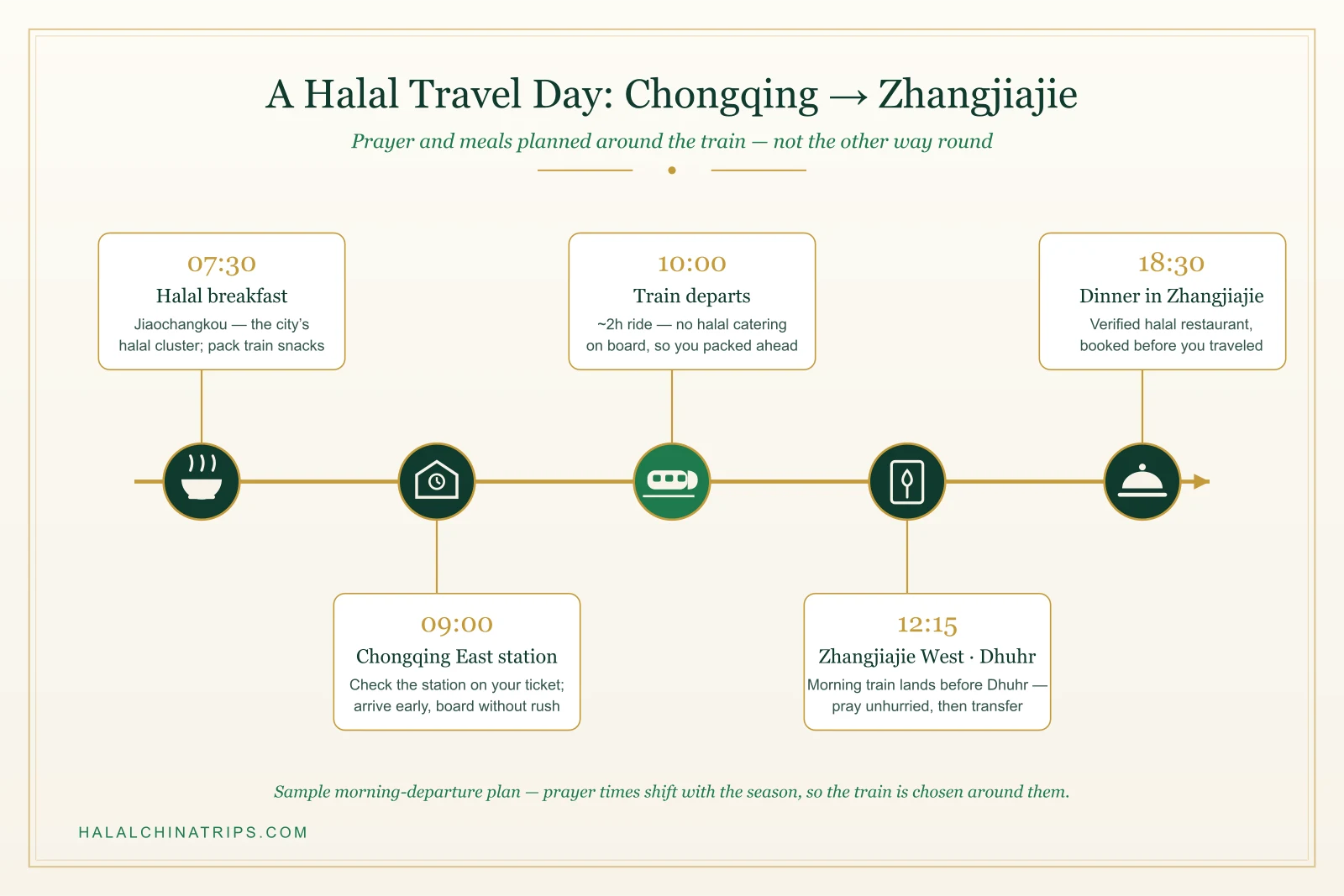
Eat properly before you leave. There is no halal food on board, and nothing we can verify at the stations either. Chongqing’s advantage is that its halal restaurants cluster in one convenient place: the streets around the Muslim Building at Jiaochangkou, in the same central district where most visitors stay — our halal food guide for Chongqing covers the specific restaurants. For a morning train, a solid breakfast there (or a packed meal picked up the night before) is the difference-maker. Fruit, bread, nuts, and sealed snacks from any convenience store fill the gap on board.
Put prayer into the timetable, not against it. A midday departure can put Dhuhr exactly in the awkward window — checked out of the hotel, not yet arrived, standing in a station. The clean solution is to choose the departure time with prayer in mind: a morning train that arrives before Dhuhr, or an early-afternoon train that leaves after it. This is exactly how we build the day for our travelers — the train is booked around the prayer window, not the other way round, and it costs nothing extra to do. Travelers who keep to the traveler’s concessions for prayer on the move will know their own practice; our job is to plan a day where you’re not forced to decide anything standing in a moving carriage.
For women and families, the practical notes are small but worth knowing: stations and trains have clean, private washrooms (Chinese high-speed rail is genuinely comfortable by any standard), luggage racks take large suitcases at the carriage ends, and seats can be booked together — tell whoever books to select seats in one block, which matters more for a group of eight than a couple.
Arriving at Zhangjiajie West
Zhangjiajie West is modern and easy to navigate. The onward step — into Zhangjiajie city or straight to Wulingyuan, where the national park is — is a separate short transfer with its own timing; our Zhangjiajie arrival and transfer guide covers the options from both the airport and the West station.
The planning point we insist on: arrive with daylight. An afternoon train that lands around 5–6 pm still leaves time to reach your hotel and sit down to a proper dinner — Zhangjiajie has a small but reliable set of verified halal restaurants, mapped in our Zhangjiajie halal food guide. A late arrival means hunting for dinner in a city you don’t know yet, in the dark, with tired children. On this route the difference between a good first evening and a bad one is usually just the train you picked.
One expectation to set now, honestly: Zhangjiajie has no public mosque for visitors. Prayer there happens in your hotel room or at quiet spots arranged along the day’s route — it works smoothly, but it’s a different rhythm from Chongqing, where mosques are available. Our Zhangjiajie Muslim travel guide explains how we handle it.
Can You Visit Zhangjiajie as a Day Trip from Chongqing?
The timetable technically allows it — early train out, late train back — but don’t. Even on the fastest trains, you’d spend four-plus hours on the rails plus the transfers at both ends: the national park entrance is not at the station but an onward ride away. What’s left is a few rushed hours in a park whose core areas genuinely need two to three days. We tell clients who ask: if Zhangjiajie is worth the train ticket, it’s worth at least two nights.
The combination that works — and the reason this train line matters — is a two-city route: two to three days in Chongqing, then three to four in Zhangjiajie, with an optional extension to Fenghuang Ancient Town. We ran exactly this route for a group this year, and the two-hour train is what makes it flow: no flight day, no repacking stress, halal meals verified at both ends. If Zhangjiajie plus Fenghuang is the part you want handled, our Zhangjiajie and Fenghuang 5-day package covers that half ready-made, and the Chongqing days can be built on top — tell us your dates and group size on WhatsApp and we’ll put the whole route, halal meals and prayer windows included, into one plan with one transparent price. No forced shopping, no hidden fees.
Still deciding what to do on each end? Our Chongqing itinerary for Muslim travelers and Chongqing destination page cover the city side.
Quick Questions
How far is Zhangjiajie from Chongqing?
Roughly 480 km by the high-speed rail line. The train covers it in roughly 2–4 hours; driving takes most of a day and is not worth it.
How early should I book the train?
A few days ahead in normal months; immediately when sales open for July–August, Golden Week (early October), and Chinese public holidays.
Which direction should the route run — Chongqing first or Zhangjiajie first?
Either works. We usually start in Chongqing: it’s the bigger international gateway, and ending in Zhangjiajie lets the nature days close the trip — with the option to exit via Changsha if your flights route that way.
Is there luggage space on the train?
Yes — overhead racks for cabin-size bags and racks at the carriage ends for large suitcases. No extra fee and no weighing, unlike a flight.