Last Updated on October 25, 2026 by Aaron Chen
Every week someone posts a version of the same question in a China travel group: “I’m flying to China on Friday. Can I still use WhatsApp? My family will worry if I go quiet.”
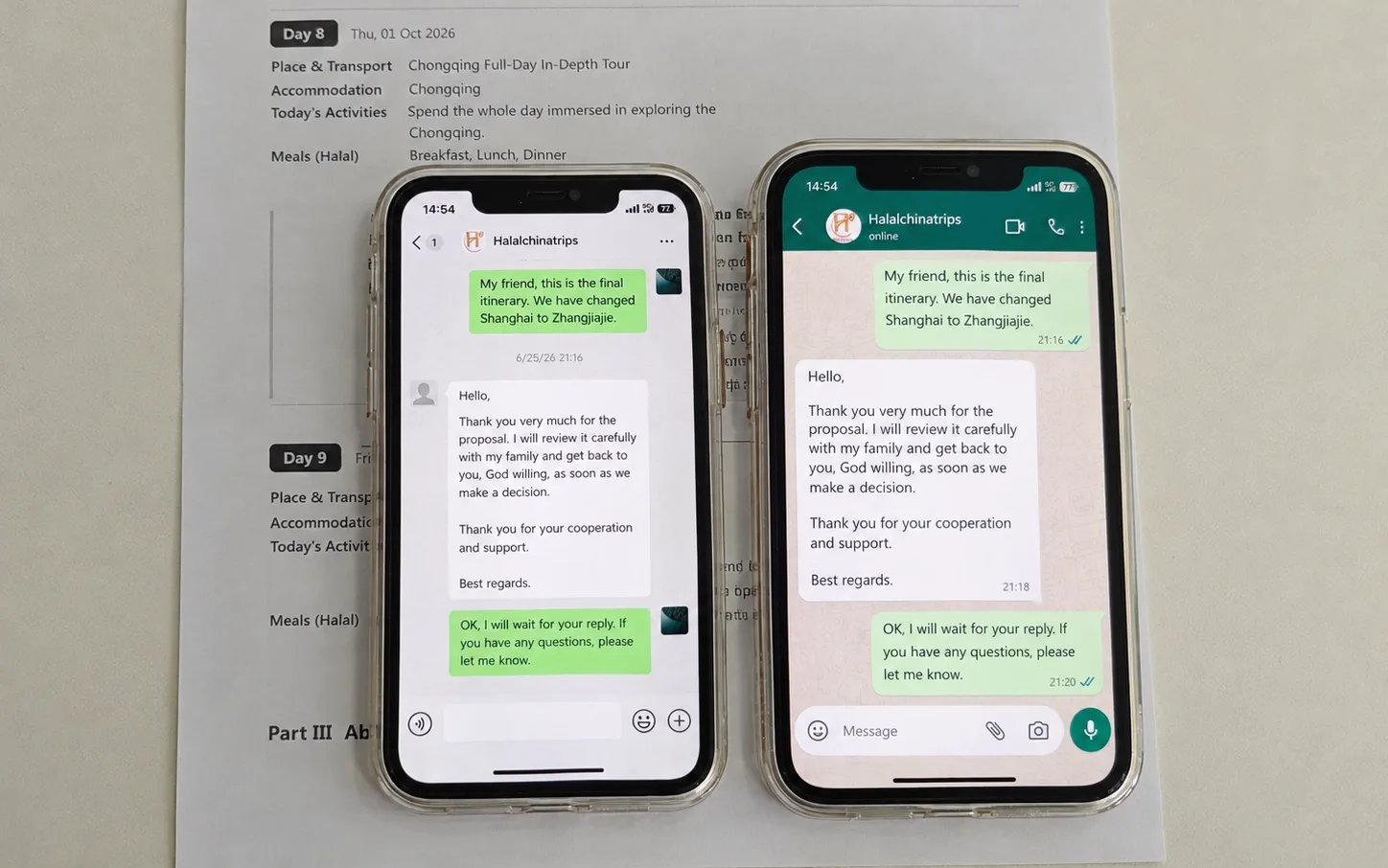
Here is the answer we can give with more confidence than most websites: yes, you can use WhatsApp for your entire trip to China — if you set up your data connection before you fly. WhatsApp is blocked on China’s local networks, but on international roaming or a travel eSIM it works normally. We know because we run Muslim group tours inside China, and our guests message our team on WhatsApp every day of their trip — photos, voice notes, “can we push dinner back after Maghrib,” all of it.
We sell neither eSIMs nor VPNs, so whichever option you choose, our only interest is that it works when your family calls. What follows is simply what we see working, trip after trip.
The Four Ways Tourists Get Online in China — and What WhatsApp Does on Each
This table is the whole article in miniature. Find your row before you fly.
| Your connection | Does WhatsApp work? | Why |
|---|---|---|
| International roaming (your home SIM, data roaming on) | Yes — fully. Messages, calls, photos, voice notes. | Your data routes through your home carrier, outside the firewall. |
| Travel eSIM bought outside China | Yes — fully, for the major travel eSIMs. | Same principle: traffic exits through a non-mainland gateway. |
| Hotel Wi-Fi | No — don’t rely on it. | It’s a mainland connection. Without extra tools, WhatsApp won’t work properly. |
| Local Chinese SIM card (including ones sold at airport arrival counters) | No — don’t rely on it. | Same mainland routing. There are reports of text-only messages getting through; treat that as a curiosity, not a plan. |
A few practical notes on the two rows that work:
- Roaming is the simplest option. Check the price before you leave — Malaysian, Indonesian and UK carriers all sell China roaming passes (check yours for the current price), and for a 5–10 day trip this is usually the least fiddly choice. Many of our guests arrive on exactly this setup and are messaging us from the arrivals hall.
- A travel eSIM is the budget option for newer phones. Buy and install it before departure — you cannot easily download it once you land and have no working connection. We deliberately don’t recommend brands; the practical test is simple — if the seller plainly states that WhatsApp and Google work in China without a VPN, the product routes traffic outside the mainland, and that is the whole game.
- The trade-off to be honest about: both options give you data that works with all your apps, but roaming with your home number also keeps you reachable by ordinary phone call — worth something if elderly parents are the ones checking on you. An eSIM is data-only; your WhatsApp still works, but ordinary calls to your home number only reach you if you also keep roaming switched on.
- Traveling as a family? You don’t need five separate plans. One parent’s roaming or eSIM data can be shared by personal hotspot with the kids’ tablets and with an older phone that doesn’t support eSIM — every device on the hotspot inherits the working route. Confirm your plan allows hotspot use before relying on it, and remember the host phone’s battery is doing all the work.
One more preparation step costs nothing: make sure WhatsApp is installed, updated, and logged in before you fly. Inside China, app stores behave unpredictably for foreign services, and re-verifying an account by SMS can turn into a headache. Arrive with it working.
Why the Internet Gives You Three Different Answers
Research this question and you will meet three contradictory claims: “completely blocked” (eSIM and VPN company blogs), “works, but only text messages” (an expat blogger testing a local connection), and “worked fine my whole trip, no VPN” (travelers on Reddit — typically posting from roaming or eSIM setups). All three honestly describe different rows of the table above. China’s internet filtering — the system usually called the Great Firewall — operates at the network level, not the app level. WhatsApp has been blocked on mainland routes since September 2017, but nothing is wrong with the app on your phone; which answer you get depends entirely on which route your data takes.
What Our Guests Actually Do
Communication is not a side topic for us — WhatsApp is how our trips run. A typical booking goes like this: a family messages us months out with questions, we send the itinerary and quote in the same chat, and once they land, the thread just keeps going. During the trip it carries the real work of Muslim travel in China: confirming tomorrow’s pickup time around Fajr, adjusting a dinner reservation when the drive runs long, sending the name card of a halal restaurant in Chinese so the guest can show a taxi driver.
Two examples of what that looks like in practice:
- Guests’ families use the same channel indirectly: when a group is out of touch on a mountain section with weak signal, a quick message from our team to the group chat — “all fine, back in coverage by 6” — spares a lot of worry back home.
- It works for harder questions too. During a recent Canton Fair, a buyer we were assisting messaged to ask whether the exhibition complex had a prayer room; our team phoned the venue, confirmed the exact hall and floor, and sent the answer back in the same thread. Nearly impossible to settle from abroad — one phone call for a team on the ground.
None of this would function if WhatsApp genuinely didn’t work in China. It works — for everyone who arrives with the right connection. If you want to test it yourself, you can message our team on WhatsApp while planning; we reply within 24 hours, usually faster. During a trip itself it isn’t a ticket system at all — the thread with our planners simply stays open, they stay in touch with your guide on WeChat, and things get sorted as they come up.
Is a VPN Legal for Tourists? A Calm Answer
The honest picture: China regulates VPNs, and the rules are aimed at unauthorized providers and operators — the businesses running the services — rather than at individual visitors. We are not aware of any publicized case of a tourist being penalized for personal VPN use for email, maps or messaging. At the same time, no official document spells out a guarantee for foreign visitors, so we won’t pretend one exists.
Our practical advice is more useful than a legal debate:
- Don’t build your trip’s communication plan on a VPN alone. VPN reliability inside China fluctuates; roaming or an eSIM is the sturdy first line, and a VPN at most a backup.
- If you do want one as a backup, install it before you fly — provider websites are themselves blocked once you’re inside.
- Use it for the ordinary things tourists use the internet for. That is what ordinary travelers around you are doing.
Your Other Apps Have the Same Problem
WhatsApp gets the headlines, but the block list covers most of what’s on your home screen: Facebook and Messenger, Instagram, all Google services — including Gmail and Google Maps — YouTube, X, Telegram and Signal are all unreachable on mainland networks. The same fix covers all of them: on roaming or a foreign eSIM, everything works exactly as at home.
For Muslim travelers, two of these matter more than people expect:
- Google Maps is the one that catches people off guard — it is blocked and its China map data is poor even when you can load it. Your guide or driver navigates locally anyway; for independent walks, screenshot your route while on your working connection.
- Prayer and Quran apps vary in how they behave, so we won’t make promises app by app. The safe pattern is the same one this whole article rests on: with a working data route, the apps you use at home keep working; and it never hurts to note down prayer times for your travel dates offline. If your itinerary is with us, the daily plan is already built around prayer windows — that’s covered in how we plan halal travel in China.
Do you need WeChat as well? Yes, install it too, for a different job. Your local guide and driver will almost certainly not be on WhatsApp: most of our guides only use WeChat, so before departure the guide adds you there. WhatsApp stays your line to home and to our planners. If WeChat won’t cooperate, you won’t be cut off, because our team stays on WhatsApp throughout the trip and passes messages to the guide. Registration, the friend-scan check and adding your guide are covered in our guide to using WeChat in China.
Quick Answers
Can Malaysians use WhatsApp in China?
Yes — same rule as everyone else. Malaysian carriers’ roaming passes route your data outside the mainland, so WhatsApp works fully. Many of our Malaysian guests run their whole trip on a home-carrier pass.
Can a tourist use WhatsApp in China without a VPN?
Yes, on international roaming or a foreign travel eSIM. No, on hotel Wi-Fi or a local SIM. The VPN question only arises if you insist on using mainland connections.
Can China see my WhatsApp messages?
WhatsApp’s end-to-end encryption stays intact wherever you connect — that encryption is, in fact, one reason the service is blocked. On a mainland network the messages mostly won’t go through at all; on roaming they travel encrypted as normal.
Does WhatsApp work in Hong Kong and Macau?
Yes, fully and openly — the mainland’s internet rules don’t apply there. If your itinerary enters the mainland afterwards, sort your roaming or eSIM before you cross.
Will I be able to reach my tour operator during the trip?
If they’re on WhatsApp, yes — that’s exactly how our guests reach us daily. It’s worth confirming before booking that your operator actually answers on a channel that works for you in China; it tells you something about how they run trips on the ground.
Before You Fly: The 5-Minute Version
The block is real; the fix is boring and reliable.
- Decide your route: a roaming pass from your home carrier (simplest) or a travel eSIM (cheaper) — not hotel Wi-Fi, not a local SIM.
- Buy and activate it the week before, not at the airport.
- Update WhatsApp and make sure you’re logged in.
- Sharing one plan as a family? Test the hotspot at home first.
- Save the numbers that matter — family, hotel, and whoever is running your trip on the ground.
Do that, and your family group chat carries on as if you never left home — apart from the odd mountain valley, and that’s coverage, not censorship.
And if any part of the China plan still feels uncertain — connectivity, halal food, prayer arrangements, whether the whole thing is doable with your parents along — the broader picture is in our guide to whether China is Muslim-friendly, and the specific questions are what our team answers on WhatsApp all day. Ask before you book anything; the reply will come from inside China — over WhatsApp, working exactly as promised.
Facts current as of September 2026. Network policies can change; we revisit this page regularly because our own operations depend on it.