Last Updated on October 12, 2026 by Aaron Chen
Most tourists applying for a China L-visa do not need an invitation letter at all — a round-trip flight booking and hotel reservations covering your stay are accepted instead. But if your passport isn’t on China’s visa-free lists — Pakistan, Bangladesh, and Egypt among them — and especially if you or someone in your family has faced a refusal before, the question changes from “do I need one” to “who can honestly give me one.” Our team gets this question on WhatsApp almost every week, usually from Muslim travelers planning a family trip, and often after a refusal. So here is the full answer — including the parts the visa agencies selling letters won’t tell you.
Do You Actually Need an Invitation Letter for a China Tourist Visa?
Check two things before you spend any time on invitation letters.
First, check whether you need a visa at all. Passport holders from Malaysia, Saudi Arabia, the UAE, Qatar, and a growing list of other countries currently enter China visa-free for up to 30 days. For the current official lists, check China’s National Immigration Administration page on unilateral visa exemptions and the foreign ministry’s mutual visa-exemption table. If your passport is on either list, stop reading — you don’t need a letter, because you don’t need a visa.
Second, check what your local Chinese visa center actually asks for. The official L-visa document list gives applicants a choice, not a stack of requirements. You submit either itinerary documents — round-trip air ticket booking plus proof of hotel reservations — or an invitation letter issued by an organization or individual in China. One or the other. This is stated on China’s official government services site and in the checklists published by Chinese Visa Application Service Centers (CVASC) worldwide.
Some applicants have it even easier: Chinese missions in the United States stopped requiring flight bookings, hotel proof, itineraries, and invitation letters for L-visa applicants inside the US back in January 2024, and that simplification was still in place as of the embassy’s September 2025 update.
So why does anyone bother with an invitation letter? Two honest reasons:
- Your consulate asks harder questions of your passport. Applicants from countries with high refusal rates sometimes find that flight-and-hotel bookings alone draw requests for more evidence. A letter from a named host in China gives the visa officer a responsible party to point to.
- You’re applying after a refusal, and you want the strongest file you can build the second time. More on that below.
If neither applies to you, the flight-plus-hotel route is simpler, cheaper, and just as valid.
Who Can Issue One — and What It Must Say
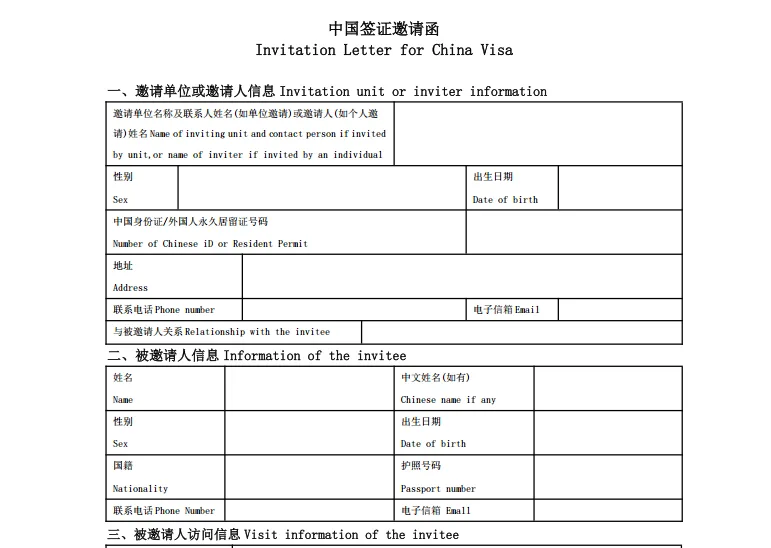
A standard tourist invitation letter is not a government form. It’s a signed statement from whoever is hosting you in China, and only three kinds of hosts make sense for a tourist:
- A relative or friend living in China — they write the letter personally and attach a photocopy of their Chinese ID card (a foreign resident attaches their passport page and residence permit instead — check the exact copy requirements on your center’s checklist);
- A company or organization in China — the letter goes on letterhead with the official red company stamp;
- A travel agency in China that is actually handling your trip — more on how that works in the next section, because this is the one most travelers misunderstand.
Whoever writes it, consulates expect the same three blocks of information:
- About you: full name exactly as in your passport, gender, date of birth, passport number;
- About the visit: arrival and departure dates, the cities you’ll visit, where you’ll be staying;
- About the inviter: name (person or organization), address, phone number, and either the organization’s stamp or the individual’s handwritten signature.
A printout, photocopy, or fax is normally accepted, but the consular officer has the right to ask for the original — so your inviter should keep it. Every name, date, and passport number must match your application form; mismatches are a common reason letters get bounced.
One detail that matters to many of our readers and never appears in generic visa guides: for the photo in your application, head coverings worn for religious reasons are permitted — your facial features must be clearly visible, with no shadow across the face. The exact photo rules, and what they mean in practice, are in our guide to wearing hijab in China.
How a Travel Agency Invitation Letter Actually Works
This is where we can speak first-hand, because issuing these letters is part of our work.
When travelers ask us “do you sponsor a visa invitation issued by the Chinese government?”, the honest answer is: no travel agency can issue that. A letter issued or verified by a government body or a local foreign affairs office is a different document, and only those authorities produce it. What we can do for our own clients is assist with that application — prepare the itinerary and booking documents it requires and walk you through the process. But we don’t represent the Chinese government or any foreign affairs office, we cannot promise such an application will be approved, and we will never use that letter as a reason to pressure you into booking with us.
What a travel agency issues in its own name is the standard travel agency invitation letter: the agency acts as your host, and it takes responsibility for your visit by putting its name on the letter. That responsibility is exactly why the letter carries weight, and it is also why no legitimate agency hands letters to strangers.
Here is the actual arrangement, which is standard practice among licensed Chinese operators, not just our policy:
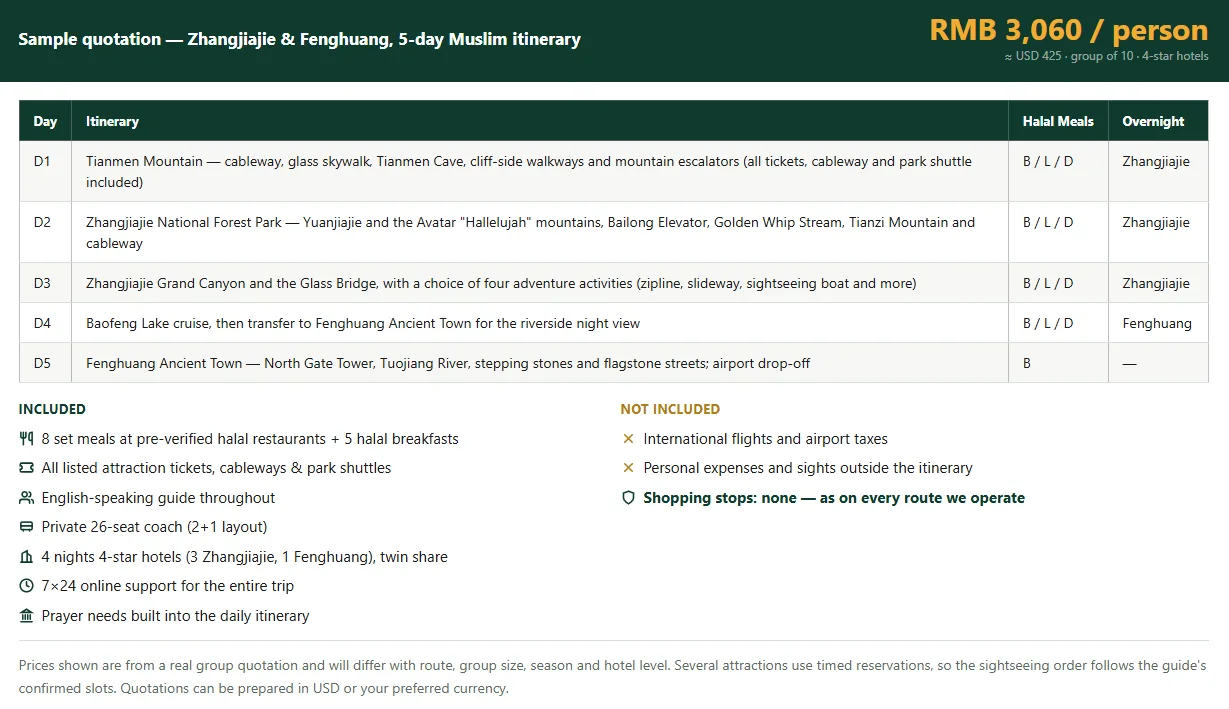
- The letter follows a confirmed booking. We issue an invitation letter after your itinerary is confirmed and the deposit is paid, using your passport details. It is part of the service, not a product — there is no separate charge for it.
- It is never sold on its own. If you are not traveling with us, we cannot invite you, because we would be vouching for a trip we’re not running. Any “agency” that sells standalone letters is asking you to start your visa file with a false statement.
- Some nationalities we cannot issue for. Policy on this sits above individual agencies and changes without much notice. We learned this the hard way: earlier this year an organizer asked us about letters for his travelers; we said yes at first, then checked properly with the relevant department — and went back to withdraw the offer. Since then our rule is simple: we verify what’s currently possible for your nationality before you pay anything, and tell you plainly if the answer is no.
- Ask about your deposit before you pay it. Our quotations spell out payment and cancellation terms in writing. If a visa refusal would be a real risk in your case, raise it at the quotation stage and get the answer for your booking in writing — from us or from any agency you talk to.
- Build in lead time. Certain letter types need to be applied for well in advance — in a recent case, about one month before the application. If your travel date is six weeks out and your visa still isn’t filed, tell your agency now, not after the deposit.
- A letter is not a visa. The decision always belongs to the consulate. We put this in writing to our own clients, and you should distrust anyone who won’t.
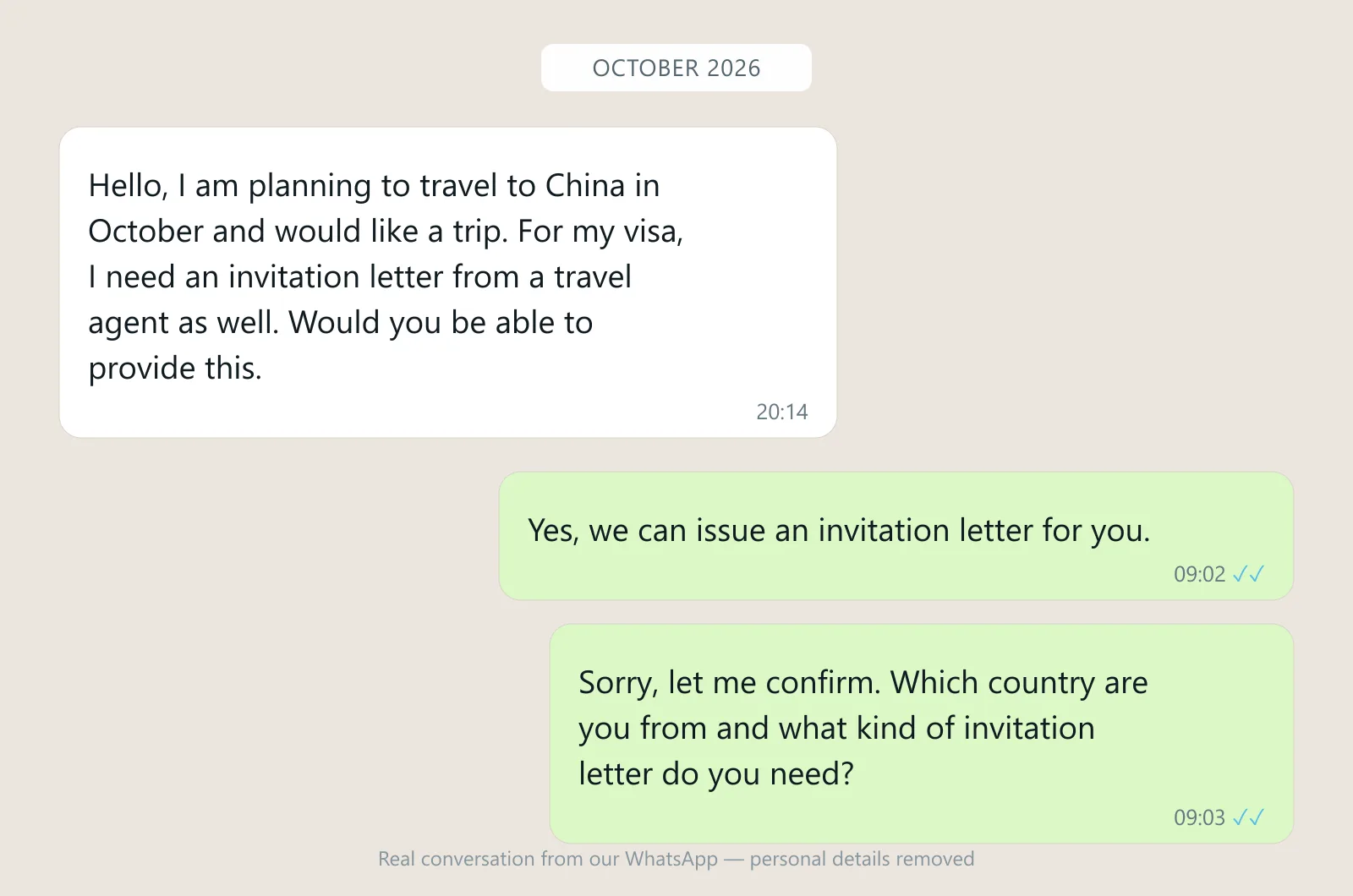
If you’re weighing whether to book with a Chinese operator at all — for the letter, the halal meal planning, or both — our comparison of booking yourself vs. using a halal tour operator covers how to judge whether an agency is real before you send anyone money.
Red Flags: How Invitation-Letter Scams Work
Because so many applicants are anxious, a small industry sells them exactly what they want to hear. The pattern is consistent, and each red flag follows from how legitimate letters work:
- A letter for sale, no trip attached. Legitimate letters document a real hosting relationship. A letter from a company that will never see you contradicts itself — and consulates are familiar with the pattern.
- “Guaranteed approval.” Nobody outside the consulate can guarantee anything. An inviter who promises approval is lying about the one thing they cannot control.
- Passport scans demanded before any agreement. The order matters: with a legitimate agency — ours included — you discuss the itinerary and see the quotation first, and passport details come only after you’ve decided to book. A stranger collecting passport scans up front is harvesting documents.
- The letter sold as the product. The letter itself costs a legitimate agency nothing but responsibility — which is why it comes free with a booking. Anyone charging you for the letter alone is selling paper, not hosting.
A refused application sits in your record. Starting your file with a purchased letter risks more than the fee.
If Your Visa Was Refused Before
We’ve had this conversation more than once — a traveler whose family member was refused twice asked whether booking a guide with us would get her an invitation. The honest answer we gave: a letter can strengthen the next application, but it is not an appeals mechanism, and anyone who treats it as one is overpromising.
What actually helps on a second attempt, in order of impact:
- A complete, consistent paper trail — flights, hotels for every night, and an itinerary that matches them, with no gaps a visa officer has to guess about;
- A credible host — if you book a full itinerary with an agency, the invitation letter puts a licensed Chinese company’s name behind your trip, which answers the “will this person actually tour and leave” question better than bookings alone;
- Honest answers about the previous refusal — the application asks, and inconsistency is treated as worse than the refusal itself.
One more thing families ask us: if one member has a refusal history, keep the whole family’s file consistent — same itinerary, same bookings, same dates — and let that member’s form address the refusal honestly. Don’t leave the visa officer to find the mismatch.
What doesn’t help: a letter bought from a stranger, a new application identical to the refused one, or dates so close to your travel that the consulate has no time to look favorably on anything.
Business Trips and Trade Fairs Are Different
Everything above covers the tourist L-visa. If you’re coming to buy, exhibit, or meet suppliers, you’ll apply for an M (business) visa, and there the invitation letter is, for most applicants, not optional — it comes from your Chinese business partner or the event organizer, stamped with their company seal.
The practical shortcut for traders: the Canton Fair issues invitation letters through its official buyer badge registration — no agency needed for most buyers. Our Canton Fair guide for Muslim buyers walks through that registration, plus the halal food and prayer logistics around the fairground.
Quick Answers
Is the invitation letter issued by the Chinese government?
The standard tourist letter, no — it’s written by your host in China: a relative, a company, or the travel agency running your trip. Government- or foreign-affairs-office-issued letters are a separate category that only those authorities produce; an agency can assist its own clients with that application, but cannot issue one and cannot guarantee the outcome.
Can I go to China without an invitation letter?
If your country is on the visa-free list, yes — no visa at all. If you need a visa, the standard L-visa checklist accepts round-trip flight plus hotel bookings instead of a letter.
Does the letter need notarization or verification by a foreign affairs office?
For most applicants, no — a signed letter with the required details is the standard. A few consulates add their own requirements for certain nationalities, so treat the checklist of the specific CVASC or embassy handling your application as final.
How long does it take to get one from a travel agency?
Once a booking is confirmed, a standard letter is fast — we issue ours from your passport details shortly after deposit. Some letter types must be applied for around a month in advance, so raise the visa question in your first conversation with any agency, not your last.
My whole family is applying — does everyone need their own letter?
Practice varies by visa center, so confirm with the one handling your application whether a single letter listing every traveler is accepted or each applicant needs their own copy. Either way, the details across the whole family’s applications must match perfectly.
What happens to my deposit if the visa is refused?
Don’t let any agency leave this vague. Our quotations include written payment and cancellation terms — ask us to confirm in writing how a refusal would be handled for your booking before you pay, and expect the same in writing from anyone else you book with.
If your trip needs a visa and you’d rather have one team handle the itinerary, the halal meal planning, and the invitation letter together, tell us your nationality and travel dates on WhatsApp — we’ll tell you honestly, before you commit to anything, whether we can invite you and what your stronger options are.