Zhangjiajie Mountains: Why They Are Not Just Another Mountain Trip
Page Contents
- What Makes the Zhangjiajie Mountains Different?
- Zhangjiajie National Forest Park
- Tianmen Mountain
- Tianmen Mountain vs National Forest Park
- Why Travelers Who “Have Seen Many Mountains” Still Enjoy Zhangjiajie
- Muslim-Friendly Travel Notes
- Muslim-Friendly Zhangjiajie Mountain Itinerary
- Common Mistakes to Avoid
- How HalalChinaTrips Can Help
- Travel FAQ
feel free to know about halalchinatrips
OR INQUIRY NOW

Page Contents
- What Makes the Zhangjiajie Mountains Different?
- Zhangjiajie National Forest Park
- Tianmen Mountain
- Tianmen Mountain vs National Forest Park
- Why Travelers Who “Have Seen Many Mountains” Still Enjoy Zhangjiajie
- Muslim-Friendly Travel Notes
- Muslim-Friendly Zhangjiajie Mountain Itinerary
- Common Mistakes to Avoid
- How HalalChinaTrips Can Help
- Travel FAQ
Many travelers have already seen mountains before. They may have visited famous alpine ranges, volcanoes, forest hills, limestone peaks, or highland viewpoints. So when they first hear about the zhangjiajie mountains, they may think: “Are they really that different?”
The answer is yes. Zhangjiajie is not simply a place where you stand far away and look at mountains. It is a destination where the mountain experience becomes vertical, layered, misty, and almost architectural.
The two most important mountain experiences are Zhangjiajie National Forest Park and Tianmen Mountain. They are both in Zhangjiajie, but they feel completely different. One is a vast sandstone peak forest filled with thousands of natural stone pillars, deep valleys, streams, forest paths, elevators, cable cars, and cloud scenery. The other is a dramatic city-side mountain known for Tianmen Cave, cliff paths, glass walkways, a long cableway, and the famous winding mountain road.
For Muslim travelers, the value of visiting the zhangjiajie mountains is not only the scenery. These mountains also require smart route planning, food timing, prayer breaks, hotel location choices, ticket coordination, and transport arrangements. A well-planned Zhangjiajie trip can feel inspiring, comfortable, and very different from a normal mountain tour.
What Makes the Zhangjiajie Mountains Different?
The biggest difference is the shape.
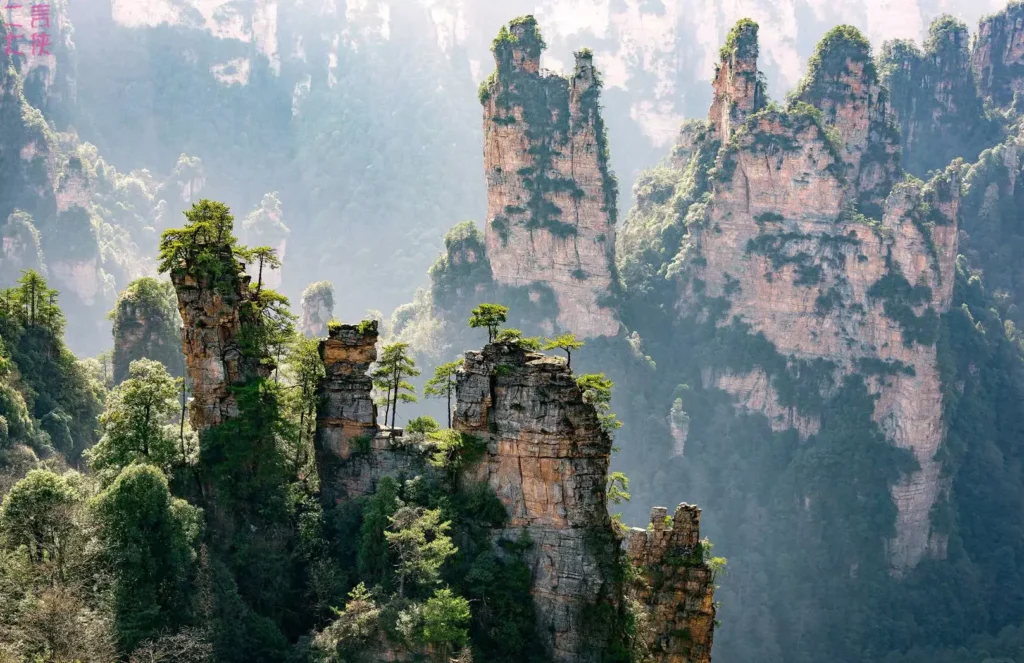
Many mountains are experienced as ridges, slopes, summits, or distant panoramas. The zhangjiajie mountains, especially inside Wulingyuan and Zhangjiajie National Forest Park, are famous for their narrow sandstone pillars and peak forests. UNESCO describes Wulingyuan as an area of more than 26,000 hectares dominated by more than 3,000 narrow sandstone pillars and peaks, many over 200 meters high, with ravines, gorges, streams, pools, waterfalls, caves, and natural bridges between them.
That means Zhangjiajie does not feel like one mountain. It feels like a forest of stone towers.
When you move through Zhangjiajie National Forest Park, the view changes constantly. One moment you may be walking beside a stream. Then you may be looking up at vertical stone pillars. Later, you may take an elevator or cable car to a high platform and look across peaks rising from the valley below.
This is why many travelers feel Zhangjiajie is more like entering a natural sculpture world than visiting a normal mountain area.
Zhangjiajie National Forest Park: The Peak Forest Experience
If Tianmen Mountain is dramatic and symbolic, Zhangjiajie National Forest Park is immersive and otherworldly.
According to the Hunan Provincial Department of Culture and Tourism, Zhangjiajie National Forest Park is located in Wulingyuan District and was included in the World Natural Heritage Site List in 1992 because of its “peculiar quartz sandstone peak forest.” The same official source also notes that the park became one of China’s first national 5A scenic areas in 2007 and covers 4,810 hectares.
What makes this place different from ordinary mountains is that you are not just looking at a single peak. You are moving through a three-dimensional landscape with different scenic layers.

1. It is a forest of stone pillars, not a single mountain
Many mountain destinations are built around one summit. Zhangjiajie National Forest Park is different. The scenery is made of countless sandstone pillars, cliffs, platforms, valleys, and forested peaks.
Official Hunan tourism information says Wulingyuan is known for unique mountains, deep valleys, luxuriant forests, and more than 3,000 jagged peaks and pillars. Main attractions include Huangshi Village, Golden Whip Stream, Yuanjiajie, and Yangjiajie.
This creates a sense of discovery. The scenery is not finished after one viewpoint. It changes as you move.
2. You can experience the mountains from below and above
In many mountain destinations, travelers either hike upward or take a cable car to a viewpoint. In Zhangjiajie National Forest Park, the experience is more layered.
You can walk through lower valleys such as Golden Whip Stream, where the mountains rise above you like stone walls. You can also visit higher areas such as Yuanjiajie and Tianzi Mountain, where you look across the peak forest from above.
This below-and-above experience makes the zhangjiajie mountains feel more dynamic. You are not only seeing height. You are feeling depth.
3. Mist changes the entire landscape
Zhangjiajie is especially powerful after rain or in misty weather. Clouds and fog move between the stone pillars, sometimes hiding the valleys and sometimes revealing the peaks. UNESCO also notes that the landscape is enhanced by mists and clouds that frequently shroud the site.
For travelers who have seen many mountains before, this is one of Zhangjiajie’s strongest visual differences. The mountains do not always appear as fixed objects. They appear and disappear like a moving ink painting.
4. It is not only a hiking destination
Zhangjiajie National Forest Park can involve walking, but it is not only for strong hikers. Depending on the route, travelers may use scenic buses, cable cars, elevators, and shorter walking sections.
This is important for Muslim families and elderly travelers. A good route can reduce unnecessary walking while still showing the most impressive scenery. The key is to avoid planning too many scenic zones in one day.
Tianmen Mountain: The “Sky Gate” Mountain Experience
Tianmen Mountain feels completely different from Zhangjiajie National Forest Park.
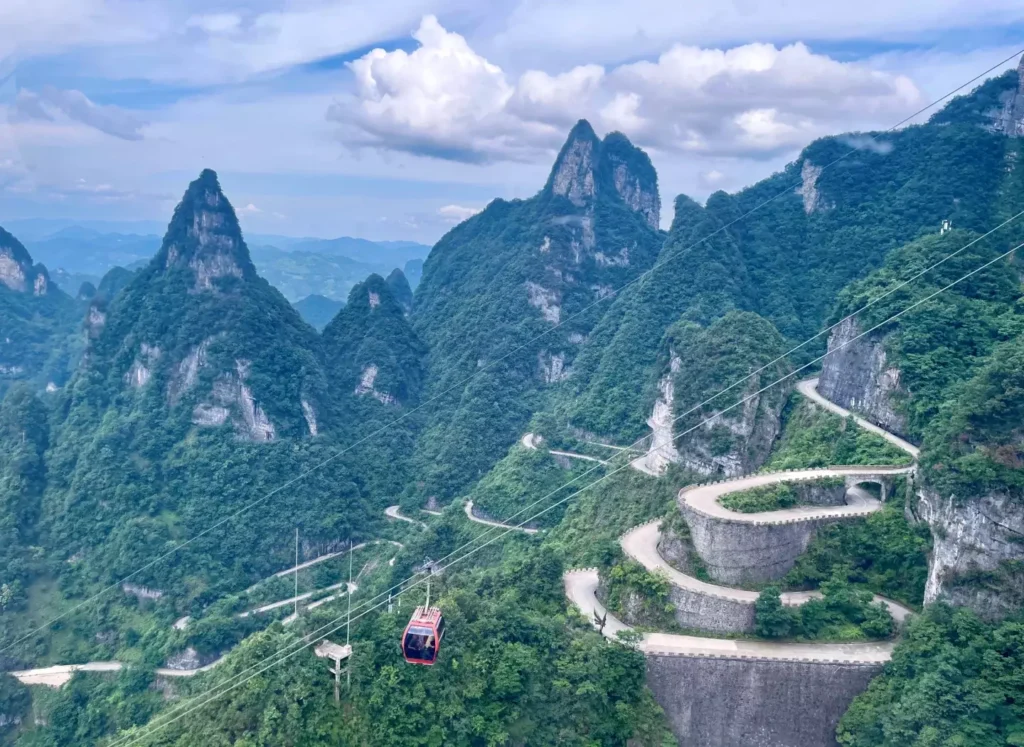
If the National Forest Park is a vast peak forest, Tianmen Mountain is a single dramatic mountain experience close to Zhangjiajie city. It is famous for cliff scenery, extreme viewpoints, Tianmen Cave, glass walkways, the cableway, and the winding road climbing toward the cave area.
The Hunan Government’s international website describes Tianmen Mountain as one of the preferred scenic spots for foreign tourists in Zhangjiajie and notes that the area has hosted international extreme challenge events, including wingsuit flying and parkour competitions.
That already tells you something important: Tianmen Mountain is not just about looking at a mountain. It is about height, movement, roads, edges, and dramatic human-made access routes built into the natural mountain.

1. Tianmen Mountain is more vertical and dramatic
Tianmen Mountain has a stronger “sky mountain” feeling. You go up from the city toward the mountaintop, then walk along high cliff paths and viewing areas. The feeling is more direct and dramatic than the wider forest experience of Wulingyuan.
For travelers who think all mountains are similar, Tianmen Mountain can change that idea quickly. The attraction is not simply a green mountain. It combines natural cliffs, mountain roads, cableway views, and the famous cave opening.
2. Tianmen Cave makes the mountain symbolic
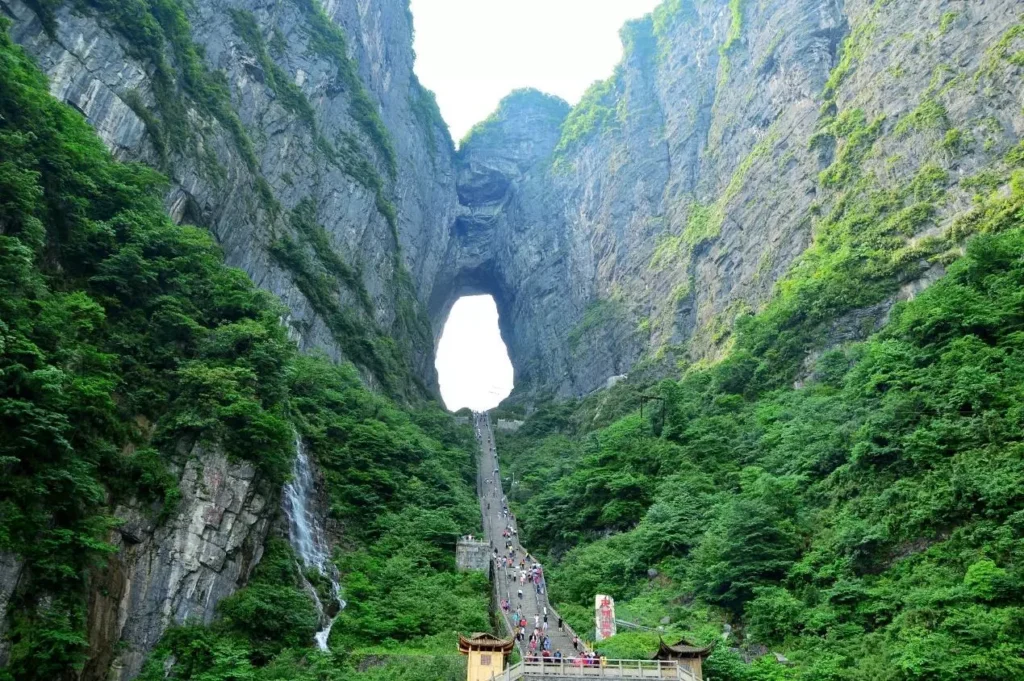
One of Tianmen Mountain’s most famous features is Tianmen Cave, often described as a natural “Heaven’s Gate” opening in the mountain. Zhangjiajie Tourism Information Web describes Tianmen Mountain as famous for Tianmen Cave, a door-like cave formed after ancient cliff collapse, and says visitors may walk 999 steps to reach it.
This makes Tianmen Mountain different from normal mountain sightseeing. You are not only visiting a viewpoint. You are moving toward a natural opening that has become a symbol of Zhangjiajie.

3. The journey up is part of the attraction
In many destinations, transport is just a way to reach the mountain. At Tianmen Mountain, the transport itself is part of the experience.
Zhangjiajie Tourism Information Web describes the Tianmen Mountain Cableway as starting from Zhangjiajie city center and going to the peak area, creating changing views of the mountain landscape. The same source also describes the mountain road to Tianmen Cave as less than 11 kilometers long, rising rapidly from about 200 meters to 1,300 meters, with 99 turns.
This is why Tianmen Mountain feels cinematic. The route is not just “go to the top.” It is a carefully staged mountain journey.
4. Tianmen Mountain is better for a city-based one-day route
Compared with Zhangjiajie National Forest Park, Tianmen Mountain is easier to arrange from Zhangjiajie city. For travelers staying in the city area, it can fit well into a one-day plan.
For Muslim travelers, this can be useful because food and hotel access may be easier to manage before or after the visit. However, prayer timing, ticket routes, cableway arrangements, and return transport still need to be planned carefully.
Tianmen Mountain vs Zhangjiajie National Forest Park
Many visitors ask whether they should visit Tianmen Mountain or Zhangjiajie National Forest Park. The better answer is: visit both if you have enough time, because they offer different mountain experiences.
| Comparison | Zhangjiajie National Forest Park | Tianmen Mountain |
|---|---|---|
| Main feeling | Vast sandstone peak forest | Dramatic sky gate mountain |
| Best for | Classic Zhangjiajie scenery, peak forests, valleys | Cableway, Tianmen Cave, cliff paths, city-based route |
| Landscape style | Thousands of stone pillars and deep valleys | One symbolic mountain with cave, road and cliff views |
| Route style | Bigger area, often needs 1–2 days | Usually suitable for one day |
| Muslim-friendly planning need | Food timing, shuttle routes, prayer breaks, hotel location | Ticket route, cableway timing, prayer before/after, return transport |
| Best traveler type | First-time visitors, photographers, nature lovers | Short-stay travelers, dramatic-view lovers, city-stay visitors |
If you only visit Tianmen Mountain, you may miss the peak forest that makes the zhangjiajie mountains famous worldwide. If you only visit Zhangjiajie National Forest Park, you may miss the powerful “Heaven’s Gate” experience of Tianmen Mountain.
For a stronger first-time Zhangjiajie trip, both are recommended.
Why Travelers Who “Have Seen Many Mountains” Still Enjoy Zhangjiajie
The reason is simple: Zhangjiajie is not selling only height.
Many mountains impress travelers because they are high, snowy, remote, or famous. The zhangjiajie mountains are different because they feel almost impossible in shape. The sandstone pillars rise like towers. The valleys cut deeply between them. The clouds move through the gaps. The forest grows on cliffs and narrow peaks. The walking routes, cableways, elevators, cliff paths, and viewing platforms create a sense of moving inside a vertical world.
For travelers who already know Switzerland, Japan, Korea, Turkey, Indonesia, Malaysia, the Middle East, or other mountain destinations, Zhangjiajie still offers something distinct.
It is not “just another mountain.” It is:
- A natural stone forest
- A cloud-and-mist landscape
- A vertical canyon world
- A photography destination
- A family-friendly scenic route when planned well
- A dramatic contrast between forest park and sky mountain
- A place where route design strongly affects the experience
That final point is important. Zhangjiajie can feel amazing or exhausting depending on how you plan it. A rushed route may turn the mountains into long queues and tired walking. A smart route can make the scenery feel unforgettable.
Muslim-Friendly Travel Notes for the Zhangjiajie Mountains
For Muslim travelers, the zhangjiajie mountains are very worth visiting, but planning should be practical.
Halal food should be checked before mountain routes
Do not assume halal-certified food is available inside every scenic area. It is better to eat before entering, bring snacks, and plan dinner after returning to a checked restaurant area.
Prayer timing should be part of the route
The mountain scenic areas are not prayer-focused locations. Dedicated prayer rooms should not be assumed. Plan prayer around your hotel, transfer timing, quiet rest points where suitable, or after returning from the scenic area.
Families and elderly travelers should avoid overpacked days
Zhangjiajie routes often involve walking, waiting, shuttle buses, cable cars, elevators, stairs, and weather changes. Families and elderly travelers usually enjoy the trip more with slower pacing and private transfer support.
Weather matters
Mist can make Zhangjiajie beautiful, but rain and fog can also affect visibility. Keep some flexibility in your itinerary, especially if Tianmen Mountain is included.
Suggested Muslim-Friendly Zhangjiajie Mountain Itinerary
For first-time visitors, a balanced route may look like this:
Day 1: Arrival and city rest
Arrive in Zhangjiajie, check hotel location, confirm food options, and rest after travel. If time allows, consider an easy evening activity.
Day 2: Zhangjiajie National Forest Park
Focus on one main scenic route instead of trying to see everything. Choose a route that balances Yuanjiajie, Tianzi Mountain, Golden Whip Stream, or other areas based on your group’s comfort.
Day 3: Tianmen Mountain
Visit Tianmen Mountain as a separate day. Plan ticket route, cableway timing, prayer breaks, and return transport in advance.
Day 4: Flexible route or departure
Use this day for Baofeng Lake, Zhangjiajie Grand Canyon, 72 Wonder Tower, a Xiangxi extension, or departure depending on your travel style.
Common Mistakes to Avoid
Mistake 1: Thinking Zhangjiajie is only one mountain
Zhangjiajie is a mountain destination, but not one single mountain. Tianmen Mountain and Zhangjiajie National Forest Park are very different experiences.
Mistake 2: Visiting only one attraction and thinking you have seen all Zhangjiajie mountains
If your schedule allows, visit both Tianmen Mountain and Zhangjiajie National Forest Park. They show two different sides of Zhangjiajie.
Mistake 3: Planning too much walking for families or elderly travelers
Some routes look easy on a map but feel tiring because of transfers, queues, stairs, and weather.
Mistake 4: Ignoring halal food planning
Mountain scenic areas are not the best places to start searching for food. Plan meals before the route.
Mistake 5: Leaving prayer planning until the last minute
Prayer time should be considered when choosing route order, rest points, and return timing.
Mistake 6: Treating weather as unimportant
Clouds and mist can be beautiful, but heavy fog may block views. Keep your schedule flexible.
How HalalChinaTrips Can Help
HalalChinaTrips helps Muslim travelers understand why the zhangjiajie mountains are different and how to visit them comfortably.
We can help with:
- Choosing between Tianmen Mountain and Zhangjiajie National Forest Park
- Designing a route that includes both major mountain experiences
- Checking halal restaurant options near your hotel and route
- Planning prayer and rest timing
- Reviewing ticket and scenic transport options
- Advising hotel location
- Coordinating private transfer where available
- Adjusting routes for families, elderly travelers, or weather
- Combining Zhangjiajie mountains with Xiangxi or other destinations
We do not claim every scenic area has halal food or prayer facilities. Instead, we help travelers plan realistically before arrival.
Plan your trip to Zhangjiajie
FAQ
Yes. The zhangjiajie mountains are famous for quartz sandstone peak forests, narrow stone pillars, deep valleys, streams, caves, natural bridges, mist, and cliff scenery. This makes them feel very different from ordinary mountain ranges.
They are different. Zhangjiajie National Forest Park is better for classic sandstone peak forest scenery, while Tianmen Mountain is better for Tianmen Cave, cliff paths, cableway views, and a dramatic city-based mountain route.
For most first-time travelers, 3 to 4 days is more comfortable. This allows one day for Zhangjiajie National Forest Park, one day for Tianmen Mountain, and extra time for weather, food planning, rest, or other attractions.
Yes, but the route should be planned carefully. Cable cars, elevators, private transfer, shorter walking sections, and slower pacing can make the trip more comfortable.
You can, but visibility may be affected by rain or fog. Check the weather before departure and keep a backup plan.
No. They are separate attractions with different scenery and route styles. Zhangjiajie National Forest Park is known for sandstone peak forests, while Tianmen Mountain is known for Tianmen Cave, cliff roads, glass walkways, and cableway views.