
Last Updated on October 7, 2026 by Aaron Chen
Yes — if you hold an ordinary Saudi passport, you can enter mainland China without a visa for up to 30 days per entry, with a cap of 90 days total within any 180-day period. This comes from China’s unilateral visa-free policy, currently set to run until 24:00 on December 31, 2026. Unlike some countries’ bilateral agreements, this one has a firm deadline — so if you’re planning, the window is open now, and planning what you’ll actually eat and where you’ll pray once you land matters more than the border itself. (Policy verified October 2026 against the Chinese Embassy in Saudi Arabia and official extension notice for 45 countries.)
That’s the short answer. Below: how the 30 days are counted, whether iqama holders qualify, what to prepare before your flight, direct routes from Saudi Arabia, and the part most visa articles skip — eating halal and praying on schedule once you’re actually in China.
How Long Saudi Citizens Can Stay — and Why the Deadline Matters
Two numbers govern your stay.
The 30-day rule. Each entry allows up to 30 days. The count starts at 0:00 on the day after you enter and runs to 24:00 on the 30th day. Land in Shanghai on March 1, and you can stay through March 31.
The 90-in-180 rule. Your visa-free days cannot exceed 90 within any rolling 180-day period. A normal holiday pattern — one or two China trips a year of 5–14 days — never comes close to this cap. It only matters if you’re visiting almost monthly for business or family reasons.
Why the Deadline Matters
China’s visa-free arrangement for Saudi Arabia is a unilateral policy — a decision by the Chinese government, not a bilateral treaty between the two countries. The current period runs until December 31, 2026, and China has not announced whether it will be extended beyond that date. The policy has been progressively expanded (from 38 countries in late 2024 to the current list), so an extension is plausible, but there is no guarantee.
The practical takeaway: if you’re thinking about a trip in late 2026 and want certainty, book and travel while the policy is confirmed. If you need to stay longer than 30 days — say, for an extended family visit or a work assignment — you’ll need a visa regardless.
For context: the UAE and Qatar have separate bilateral visa-free agreements with China (in place since 2018), which don’t carry this deadline. Saudi Arabia’s arrangement, along with Oman, Kuwait, and Bahrain, is the newer unilateral type. Together, all six GCC states now have visa-free access to China — a useful fact if you’re organizing a multi-country group.
Iqama Holders: Who Is Actually Covered
The policy applies to nationals of Saudi Arabia holding ordinary passports. That wording is specific, and it means:
- Saudi citizens with an ordinary passport: covered. Diplomatic and service passport holders have separate arrangements.
- Non-Saudi nationals living in Saudi Arabia on an iqama (residence permit): not covered by this policy. If you’re an Indian, Pakistani, Bangladeshi, Egyptian, or other nationality working in Saudi Arabia, your iqama does not change your visa requirements for China — you’ll need to check based on your passport’s nationality.
Some nationalities do have their own visa-free access to China (the current list covers roughly 80 countries under various unilateral and bilateral arrangements), but many common iqama-holder nationalities — India, Pakistan, Bangladesh — are not on it. If that’s your situation, apply through the Chinese Visa Application Service Center or the Chinese Consulate in Jeddah before you travel.
Not sure where you stand? Send us a message on WhatsApp with your passport nationality and we’ll point you in the right direction.
What You Can Do Visa-Free — and When You Still Need a Visa
The policy covers tourism, business, visiting family and friends, exchanges, and transit — which fits nearly every Saudi traveler’s plans. You still need a visa if you’re staying longer than 30 days, working, studying, or on a journalism assignment.
If something unexpected — a medical situation, cascading cancellations — keeps you past your 30 days, go to the local Public Security Bureau’s exit-entry office before your period expires and apply for a temporary stay permit. Overstaying carries fines and potential entry bans.
Before You Fly: Passport, Arrival Card, and What to Prepare
Three practical items cover nearly everything Saudi travelers ask us before the flight.
Passport. At least six months of validity remaining, undamaged. Check this the day you book flights, not the week you fly.
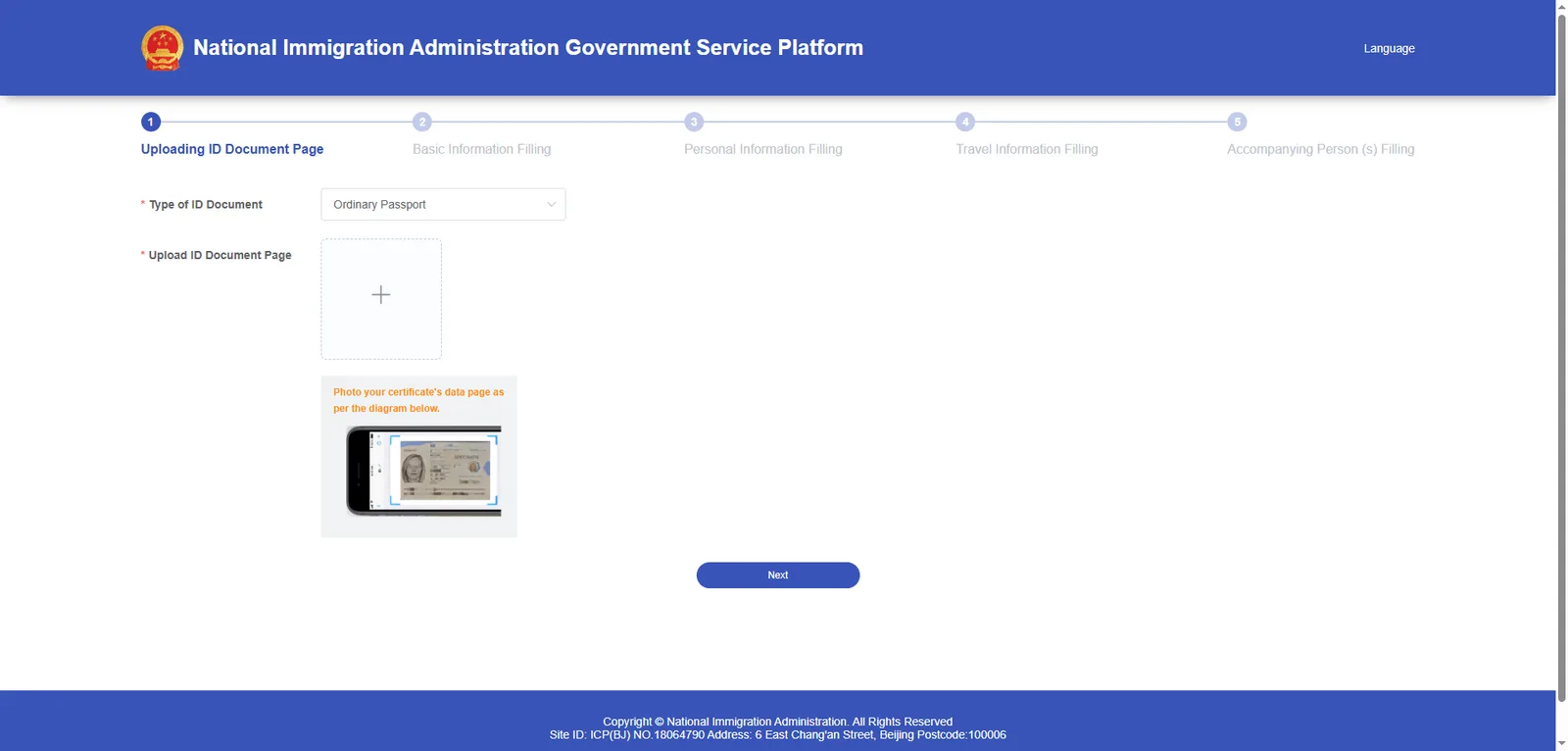
The arrival card — now online. Since November 2025, foreign visitors can fill in the China arrival card online before departure through the National Immigration Administration’s official arrival card portal, the NIA 12367 app, or WeChat/Alipay mini-programs. Filing online before your flight is the single easiest way to cut your queue time at immigration. Three things worth knowing:
- It’s free. If a website asks you to pay a “service fee” for the arrival card, you’re on a copycat site — close it and use the official NIA portal.
- If you don’t manage to file in advance, you can still do it on arrival — by QR code at the immigration hall, or on a paper card.
- The form is available in English. Arabic is not yet an option, but the fields are straightforward: passport details, flight number, address in China.
At the border. Immigration officers may ask about your itinerary, where you’re staying, and your return flight. Have your hotel confirmations and return booking reachable on your phone. One more rule to know: China requires foreigners’ accommodation to be registered with police. If you stay in hotels, the front desk handles this automatically at check-in — you’ll notice them scanning your passport. Only if you stay in a private home — a relative’s or friend’s — do you need to register yourself at the local police station within 24 hours in cities (72 hours in rural areas).
When our clients travel, we send a one-page pre-departure checklist covering exactly these items — it’s a small thing, but it’s the difference between a 40-minute arrival and a stressful one.
Getting to China: Direct Flights from Saudi Arabia
Direct flights between Saudi Arabia and China have expanded considerably since the visa-free policy began. (Routes and frequencies below are as of October 2026 — check with your airline for current schedules.)
Saudia operates routes between Saudi Arabia and China, including Jeddah to Guangzhou (four flights per week) and Riyadh to Beijing. Routes and frequencies have shifted since the visa-free policy launched — the Jeddah–Beijing service, for example, has been rerouted through Dammam — so check Saudia’s current schedule when you book.
Hainan Airlines flies Jeddah to Haikou three times per week — relevant if your trip includes Hainan Island.
Riyadh Air, Saudi Arabia’s new carrier, has received regulatory approval from China’s Civil Aviation Administration for routes from Riyadh to Beijing (three weekly) and Riyadh to Shanghai (four weekly), though launch dates have not been announced as of this writing.
For most Saudi travelers, the practical route is through Beijing or Guangzhou as the entry point, then connecting domestically by high-speed rail or a short flight. Typical flight time from Riyadh or Jeddah to Beijing runs around 9–11 hours depending on the route.
What Visa-Free Doesn’t Solve: Halal Food and Prayer in China
Here’s the part most visa articles skip entirely: the border is no longer the hard part of a China trip for Saudi travelers. The ground logistics are.
China is not Saudi Arabia. Outside a handful of established Muslim districts, halal food is something you plan toward, not something you walk into. Major cities have genuine halal restaurants — Beijing, Shanghai, Xi’an, and Guangzhou all have long-established Muslim communities and halal kitchens — but they’re unevenly spread, and the gap widens fast near major scenic areas, where a certified halal meal can be an hour’s drive from the gate.
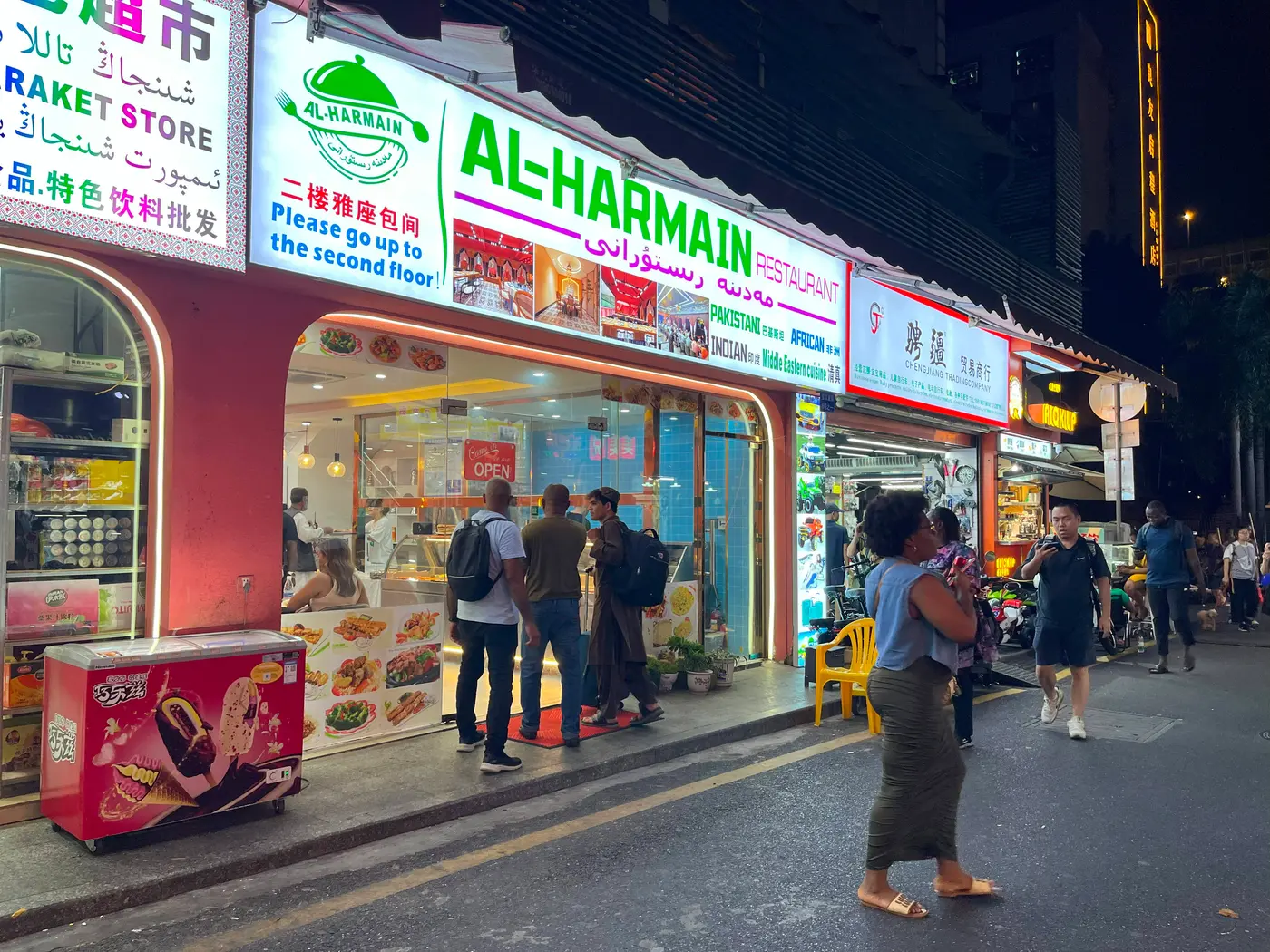
Prayer facilities follow the same pattern: mosques exist in most large cities, but some destinations popular with Gulf travelers — Zhangjiajie’s national park among them — have no public mosque at all, so prayer happens at your hotel or along the route, and the day’s schedule has to account for that.
How We Handle It
Three principles our team plans around, every trip:
- Verify restaurants before departure, not after landing. “Halal” tags on Chinese map apps are unreliable; a restaurant’s status can change between your planning and your arrival. Our process: check the halal certification, call the restaurant to confirm it’s still operating and halal, then reconfirm closer to travel dates — because arriving hungry at a closed door at 9pm is a problem we’ve learned to prevent, not react to.
- Build prayer into the route, not around it. With scenic areas and travel days, the workable pattern is prayer at the hotel morning and night, and a known clean stop midday — decided before departure. For clients who care about Jumu’ah, we adjust the itinerary’s city sequence so that Friday falls in a city with a major mosque, like Xi’an’s Great Mosque or Guangzhou’s Huaisheng Mosque.
- Choose hotels by dinner distance. The most common self-planned mistake we see: a well-reviewed hotel that’s 40 minutes from the nearest halal restaurant, three nights running.
Dress code. There are no restrictions on wearing hijab or modest dress in China — no national law against it, and in practice it draws no more attention than any other foreign clothing style. We’ve covered this in detail: can you wear hijab in China.
A note on language. Our guides speak English in every city we operate in — that’s a guarantee. Arabic-speaking guides are not something we can promise: they’re occasionally available but not reliably so across all destinations. In practice, most of our Saudi and Gulf clients communicate comfortably in English, and our team handles all restaurant ordering, directions, and local coordination in Chinese, so the language gap rarely becomes a problem on the ground.
Once the visa is sorted, the practical questions pile up fast. We’ve covered the ones Saudi travelers ask most: is China actually Muslim-friendly, which cities have mosques you can visit, how to pay when everything runs on QR codes, and how to keep WhatsApp working in China.
How to Use Your 30 Days: Itinerary Starting Points
Thirty days is far more than most Saudi travelers use — the typical trip we plan runs 5 to 10 days. The real question isn’t “is the limit enough?” but “which China do you want first?”

Two starting points that work well:
- Nature first: Zhangjiajie + Fenghuang, 5–8 days. The sandstone peaks from Avatar, the glass bridge, and an ancient riverside town in one loop. Our Zhangjiajie + Fenghuang 5-day route starts from $348 per person (2–14 travelers; covers guides, transport within the route, and accommodation — flights to Zhangjiajie are separate) — halal meals pre-verified, prayer times built in, no shopping stops.
- Cities and heritage: Beijing or Shanghai + Xi’an, 7–10 days. The Great Wall or the Bund, then the Terracotta Army and Xi’an’s Muslim Quarter with its halal food street — the culture-and-food version of a first China trip.
If you organize group trips — a family reunion, a company retreat, or a community travel group of 10 to 30 people — every traveler enters visa-free individually, with no group visa paperwork at all. Getting the group across the border is now the simple part; keeping everyone fed halal, prayed on time, and moving on one schedule is where advance planning earns its keep.
Not sure how your dates, group size, and must-sees fit together? Send them to us on WhatsApp and we’ll sketch how we’d arrange it — no obligation, and you’ll know within 24 hours whether your plan fits comfortably inside the 30-day window.
FAQ
Is China still visa-free for Saudi citizens in 2026?
Yes. China’s unilateral visa-free policy for Saudi Arabia is in effect until 24:00 on December 31, 2026. It covers stays of up to 30 days per entry for tourism, business, family visits, exchanges, and transit. China has not confirmed whether it will be extended beyond that date, but the program has been progressively expanded since its launch.
How many days can Saudi citizens stay in China without a visa?
Up to 30 days per entry, counted from midnight after your arrival day. There is also a cumulative cap of 90 visa-free days within any rolling 180-day period. There is no limit on the number of entries.
Can iqama holders enter China visa-free?
No. The policy covers nationals of Saudi Arabia holding ordinary passports only. Non-Saudi residents with an iqama must check visa requirements based on their own passport nationality. Some nationalities have their own visa-free access; many do not.
Do Saudi travelers need to fill in an arrival card?
You can — and should — file it online for free before departure via the National Immigration Administration portal or its WeChat/Alipay mini-programs. It speeds up immigration considerably. If you don’t, you can complete it on arrival by QR code or on paper. Beware of third-party sites that charge a fee — the official card is always free.
Is China visa-free entry free of charge?
Yes. There is no fee for visa-free entry. You simply present your Saudi passport and arrival card at immigration. This is different from a visa application, which involves fees and processing time.
Can I extend my stay beyond 30 days?
Not under the visa-free policy. If you need more than 30 days, apply for a visa through the Chinese embassy or consulate before you travel. In exceptional circumstances (medical emergency, cancelled flights), you can apply for a temporary stay extension at the nearest Public Security Bureau exit-entry office — but do this before your 30 days expire, not after.