Last Updated on September 14, 2026 by Halalchinatrips
Ask whether a Chinese city is Muslim-friendly and the honest answer usually needs conditions: which district, which restaurants, how far to the nearest mosque. Xi’an is the one major tourist city where the answer is simply yes. A Hui Muslim community has lived in the center of the walled city for more than 1,300 years, which means halal food and working mosques are not services arranged for visitors here — they are the neighborhood. There is one catch, and it is the reason even Xi’an needs a plan: that friendliness covers the city center, while Xi’an’s biggest sight, the Terracotta Army, sits an hour outside it. Here is the full judgment.
Is Xi’an a Muslim City? No — and Why That’s the Wrong Question
Let’s answer the question people actually type. No, Xi’an is not a Muslim city — it is a majority Han Chinese city of over ten million people. But it holds one of the oldest urban Muslim communities in China: the Hui neighborhood behind the Drum Tower, usually called the Muslim Quarter or Huifang, traces back to Silk Road merchants who settled in the Tang dynasty capital. The community never left. Its lanes, butchers, bakeries and mosques have operated continuously in the exact geographic center of the city.
For a traveler, that history cashes out in a way no statistic can: in most Chinese cities, halal is something you search for; in central Xi’an, it is the default. The food the city is famous for — yangrou paomo, beef roujiamo, cumin lamb skewers — came out of Hui kitchens in the first place. You are not hunting for a halal version of the local cuisine. The local cuisine is halal at its origin. Our Muslim Quarter guide walks the neighborhood lane by lane.
Eating Halal: The One City Where It Takes No Effort — Inside the Walls
Within the walled city, eating is the easiest it gets anywhere in China. The Quarter’s core streets carry no pork and no alcohol — the vendors are Hui Muslims serving their own community, with 清真 (qingzhen) signs on nearly every shopfront. And unlike cities where halal means noodle counters only, Xi’an has century-old sit-down institutions: Lao Sun Jia has served paomo since 1898, Tongshengxiang since 1920 — real restaurants where a family or a full tour group can have a proper dinner, not just a quick bowl.
Two things still deserve honesty. First, halal in China is community-based, not certificate-based — there is no national certification system, in Xi’an or anywhere else. Here that standard is at its most reassuring, because you can watch the community pray at its own mosques, but travelers who follow a strict certificate-only rule should know how it works before arriving. Second, the moment you step outside the Quarter, the rules of the rest of China apply: the same roujiamo that is braised beef inside the Quarter is pork by default everywhere else in the city, under the same name. The habit that keeps you halal is checking the shopfront for the 清真 sign before reading any menu — our halal food in Xi’an guide covers that rule, the dishes and the restaurant list in full.
Prayer: The Great Mosque Anchors the Whole Trip
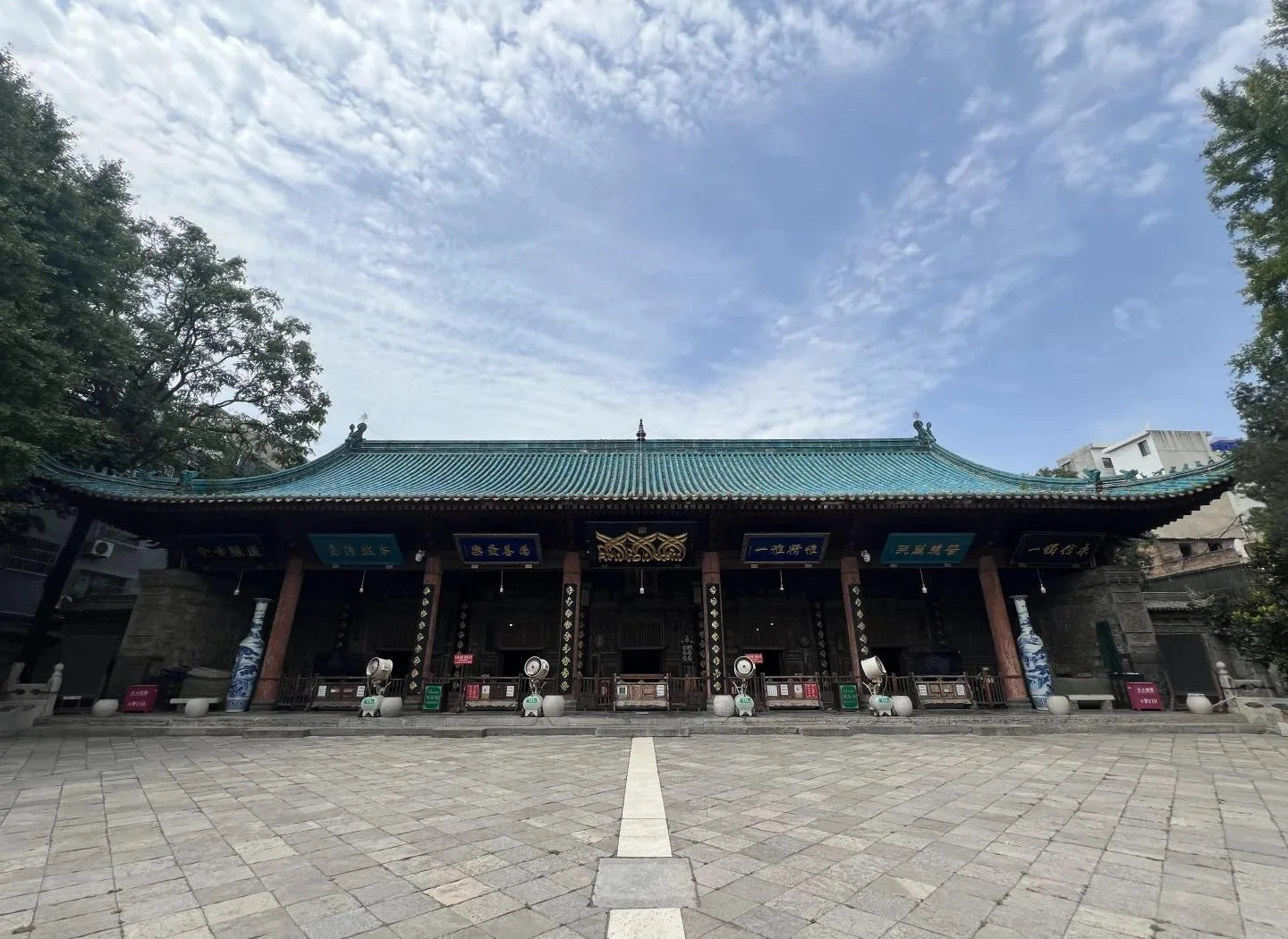
Most Chinese cities ask Muslim travelers to fit prayer around the trip. Xi’an lets you build a day of the trip around prayer. The Great Mosque on Huajue Lane — traditionally dated to 742 and among the largest premodern mosques still standing in China — is an active mosque holding all five daily prayers, and Muslim visitors pray there free; tell the gate staff you have come for prayer. It sits inside the Muslim Quarter, a few minutes’ walk from the food streets, so Dhuhr at the mosque flows straight into lunch with no detour at all.
If your dates include a Friday, treat it as the anchor of the whole day: Jumu’ah at the Great Mosque, then the Quarter at Friday-afternoon pace, is for many of our clients the most memorable stop of their China trip. Several smaller neighborhood mosques operate in the surrounding lanes as well, so within the center you are never far from a prayer space. On the days your route leaves the center — and there will be such days — prayer works the way it does across China: at the hotel, or at a quiet clean spot beside the vehicle. Where Xi’an stands among Chinese cities on this, and what praying elsewhere actually looks like, is in our guide to mosques in China.
The Catch: Xi’an’s Friendliness Ends at the City Wall
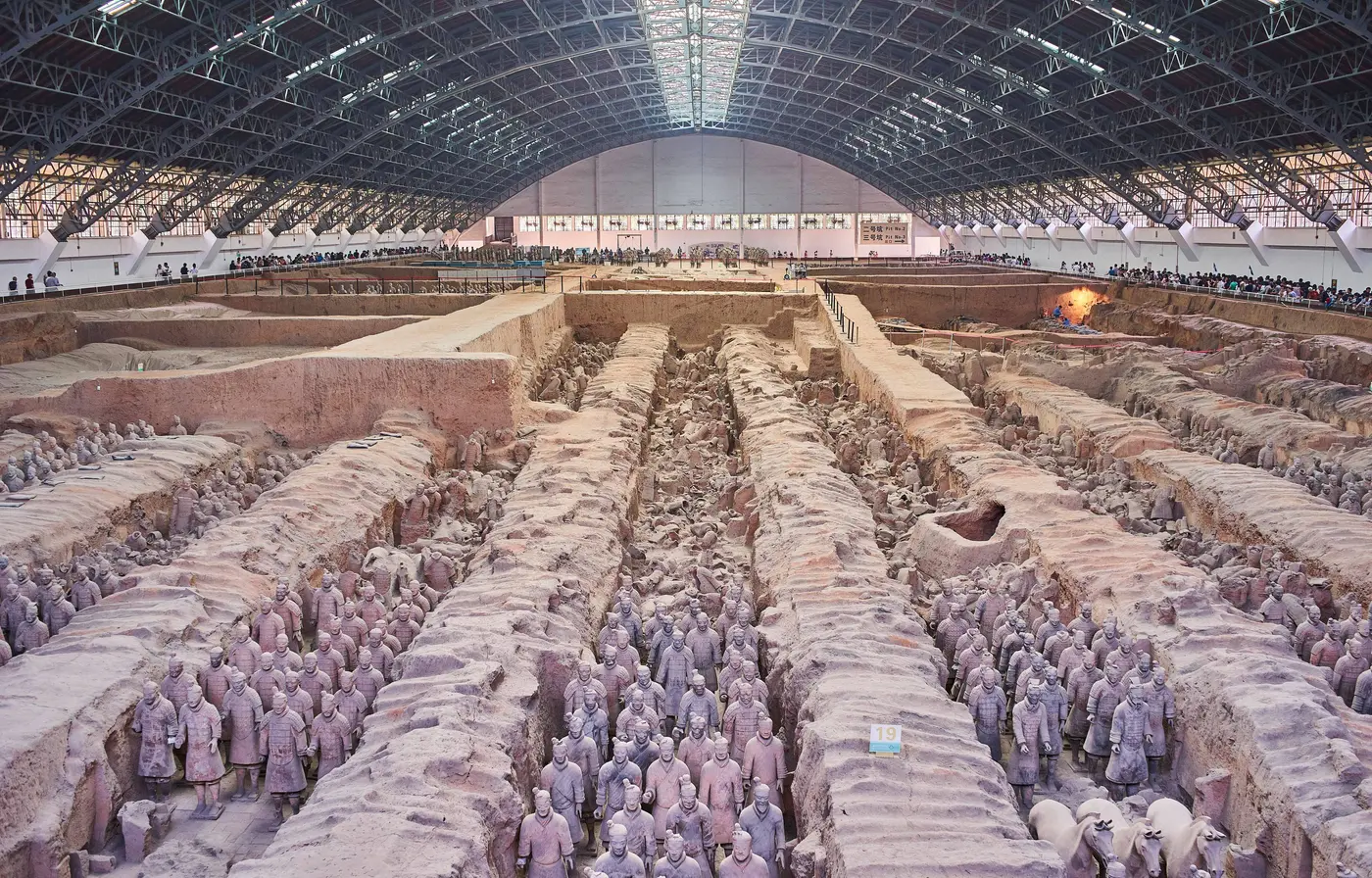
Now the part that catches people precisely because the center is so easy. Xi’an’s headline attractions are not in the center. The Terracotta Army is in Lintong District, roughly an hour’s drive northeast, and the site area — built for tour-bus volume — has no halal restaurant we have verified and would send clients to. Mount Hua, the other big day trip, is further still. Travelers assume that a city this halal-easy will stay easy wherever the itinerary goes, and that assumption is exactly how the best food city in China produces a hungry afternoon.
The fix is sequencing, not sacrifice. On our Terracotta days the pattern is fixed: a real breakfast before leaving, sealed snacks and water in the daypack, three to four hours at the pits, then back to the city for a late lunch or early dinner at a verified halal restaurant — the driver’s route ends at the table, not a hotel lobby. Start early and you are eating a proper meal by mid-afternoon; start late and the same route delivers you to the Quarter just as it lights up. With elders in the group we slow this day further — the pits involve real walking, so we build in seated breaks and never stack Mount Hua onto the same trip day. Get the sequencing right and the most tiring day of a Xi’an trip ends well; miss it, and you will be choosing between hunger and guesswork at a tourist restaurant row.
Where to Stay: The Simplest Hotel Decision in China
In most Chinese cities we spend real effort on hotel placement, because staying in the wrong district quietly taxes every halal dinner. Xi’an compresses that decision to one sentence: stay inside the walls, near the Bell and Drum Towers. From there the Muslim Quarter, the Great Mosque, the City Wall and the metro are all on foot, breakfast is solved by the Quarter’s morning stalls instead of a hotel buffet that was never halal anyway, and Xi’an North high-speed rail station is a direct ride away on Metro Line 2 (the airport takes a car or one metro change). The center is also flat and compact — a genuine advantage when the group includes grandparents. Book that location and the city-center portion of your trip runs itself.
Who Xi’an Suits — and How It Fits a China Route
If what you want from China is immersion in its Muslim heritage — streets where the halal signs outnumber everything else, a mosque older than most countries, food culture that is yours by default — Xi’an is not just friendly, it is the point of the trip. This is the city we mean when we tell clients that China’s Muslim-friendliness depends on where you stand; the full country-level picture is in Is China Muslim-friendly?
Two to three days covers it well: one day for the Terracotta Army, one for the walled city — wall, towers, Quarter, Great Mosque — and a third for Mount Hua or a slower second evening of eating. On a longer route, Xi’an pairs naturally with Beijing or Chengdu by high-speed rail, and for travelers drawn to the Silk Road story it is the classic eastern end of the road that leads to Kashgar. If your group is all women — a sisters’ trip, a mother-and-daughters route — tell us when you ask: we arrange a female guide for all-women groups, and have delivered exactly that before. Getting into China is often simpler than travelers expect; Malaysians, for one, enter visa-free for up to 30 days. Start from the Xi’an destination overview, or tell us your dates on WhatsApp and we will sketch how Xi’an fits your route, meals and prayer stops included.
Bringing a Group of 10 or More?
Xi’an seats Muslim groups better than almost any city in China — but not spontaneously. The Quarter’s famous small shops are exactly that, small; a fifteen-person group walking in at 7 pm is the plan that fails first. The two grand paomo institutions are the venues that can genuinely seat a group together, and the working method is to agree the menu and tables with the restaurant before the day, then let the street-food evening run as free time with a meeting point. That advance coordination — restaurant, menu, timing against the day’s route — is what we handle for group organizers, and per-person costs fall as the group grows. Send us your group size and dates and we will return a Xi’an plan with the group meals and prayer windows already fixed.
FAQ
Is Xi’an safe for Muslim travelers?
Yes — for Muslim travelers Xi’an is one of the most comfortable cities in China, because a working Muslim neighborhood sits at its center and being visibly Muslim is ordinary here. The two things to expect anywhere in China still apply: cigarette smoke in public places, and alcohol served at ordinary restaurants outside the Quarter. Neither is aimed at you, and we plan routes and hotels around both.
Can you wear a hijab in Xi’an?
Yes, everywhere and without restriction — in the Quarter you will simply blend in. Our full answer for the whole country, including ID checks and visa photos, is in Can you wear a hijab in China?
Is there a women’s prayer area at the Great Mosque?
Provision for women varies mosque by mosque in China, and we have not found a published arrangement for the Great Mosque we would rely on — so for families and sisters’ groups this is one of the items we confirm by phone before the day, along with prayer times. Traveling independently, ask at the mosque office when you arrive; the question is a routine one there.
Is the street food in the Muslim Quarter actually halal?
On the core streets, yes — vendors are Hui Muslims and the neighborhood standard excludes pork and alcohol, though the standard is community trust rather than paper certification. The Muslim Quarter guide covers which lanes locals actually eat on.
How many Muslims live in Xi’an?
Estimates vary and we will not pretend to a precise count. The useful fact for a visitor: the Hui community numbers in the tens of thousands and is one of the oldest urban Muslim communities in China, concentrated in and around the Muslim Quarter, with its own mosques, schools and butchers in daily use.
Does Xi’an work during Ramadan?
Better than almost anywhere in China — you will be fasting in a neighborhood that fasts with you, and iftar there is a highlight rather than a compromise. The month shifts the Quarter’s rhythm toward the evening, so confirm daytime restaurant hours for non-fasting family members before you build a lunch plan around them.